
Every institution that stores documents eventually runs into the same question: where do you put everything that no longer fits on the shelves, and how do you do it in a way that keeps documents accessible, secure, and compliant with regulatory requirements? The answer rarely lies in expanding the premises – more often, it lies in choosing the right shelving system.
Archive shelving isn’t just a metal structure for stacking boxes and folders. It’s a tool that directly affects three practical measures: how many square metres you actually need, how long it takes a member of staff to find a given document, and how securely those documents are protected from damage, unauthorised access, or simple wear over time. Static shelving requires an aisle between each row, and these aisles combined can take up as much as half the floor area of an archive room. A mobile shelving system solves this problem – several rows move along rails, and only one aisle stays open at any given time, so significantly more storage units can be fitted into the same space.
For state and municipal institutions, this question is especially pressing. Document retention periods and procedures are governed by regulations, and non-compliant storage – whether it’s an overcrowded room, obstructed access to fire-safety equipment, or simply documents being damaged by damp – can create both administrative and legal problems. At the same time, library and archive managers, office administrators, and warehouse specialists face a more practical everyday challenge: how to achieve maximum storage efficiency within the available budget and space without losing convenient access.
In this article, we’ll look at four document storage solutions offered by VVN – hand-operated mobile shelving systems, electric SOFT TOUCH shelving systems, and single-sided and double-sided metal shelving systems – and help you work out which one best suits your space, budget, and volume of documents.
VVN (“Everything for Shops and Warehouses”) has been supplying shop, warehouse, and office equipment solutions to businesses and institutions across the Baltics and Scandinavia for more than 10 years. The company’s client base includes both private businesses and state and municipal institutions.
When choosing an archive shelving system, a client can rarely predict exactly how many shelving units, in what configuration, and with what access frequency the room will actually be used in the long term. That’s why VVN takes an individual approach to every order – before preparing a quote, the company’s specialists draw up a free shelving layout plan for the archive, warehouse, or office space, taking into account the room’s geometry, floor load capacity, access requirements, and projected growth in document volume. This approach helps avoid, right from the start, a situation where the system purchased turns out to be too small or unsuited to the space a few years down the line.
VVN offers a quality and price guarantee – if a client has received a better offer elsewhere, the company undertakes to beat it. Along with the products, the client also receives a full delivery and installation cycle – from measuring the space and developing the technical solution through to installing the finished system and putting it into operation.
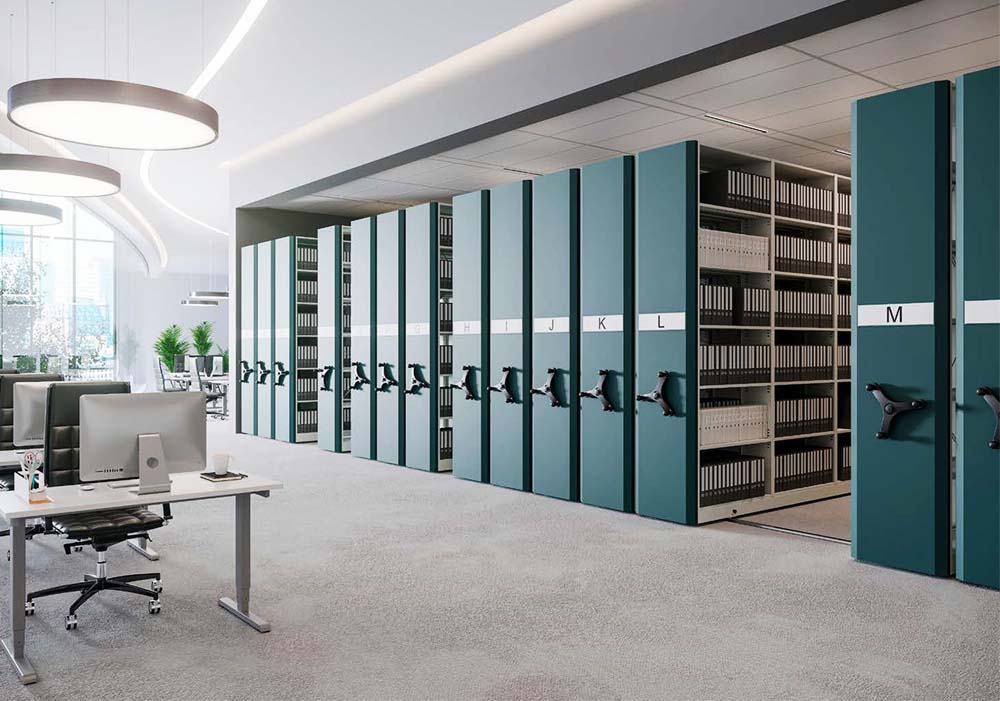
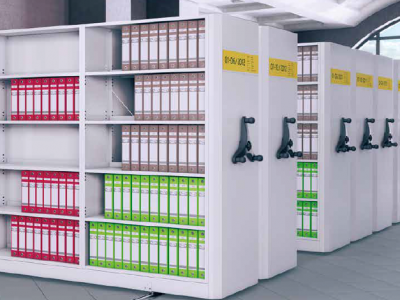
A hand-operated mobile shelving system is a solution in which rows of shelving sit not on a fixed base but on metal trolleys (a chassis) that move along rails built into the floor. A crank mechanism sits at the end of each row – turning the handle drives a chain that shifts the entire row sideways, closing or opening an aisle at the desired shelving block. Thanks to a gear ratio of 1 to 6.8, a row of shelving under a full document load can be moved with relatively little physical effort, and the crank shaft includes a locking function that prevents the system from shifting accidentally.
The rails are made from galvanised steel sections (2 x 70 mm and 10 x 20 mm) welded together and bolted to the floor with 8 x 60 mm expansion bolts with a conical flange; the rail height is 12 mm. The number of rails depends on the length of the shelving row: rows up to 3,000 mm long require 2 rails, up to 5,000 mm require 3 rails, and up to 7,000 mm require 4 rails, with both outer rails fitted with an anti-tip system. A mechanical stop at the ends of the rails prevents the shelving from shifting off the edge of the rail.
The chassis frame is 100 mm high, made from closed steel sections, with cast-iron wheels on axles – all wheels are fitted with ball bearings for smooth, quiet movement. The frame has spacer buffers that protect staff hands from getting caught while the system is moving. The front and side panels of the shelving unit are made from powder-coated steel sheet perforated every 25 mm, allowing shelf height to be freely adjusted, while additional cross-braces provide structural rigidity. The front decorative panels consist of a 70 mm-thick curved cover in a standard light grey finish (RAL 7035), though any colour from the RAL palette is available on request; the panels include space for labelling shelf contents.
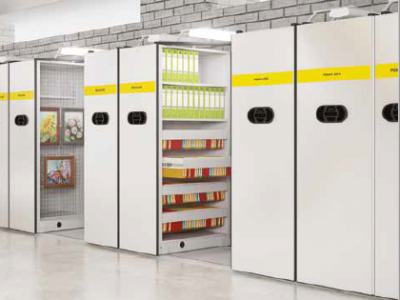
Optional accessories include shelf dividers, a lock, crank locking, pull-out boxes and frame-type drawers for document storage (available for 370 mm-deep shelves), pull-out shelves, a mesh panel system (for example, for storing paintings or posters), and cloakroom shelving.
A hand-operated mobile system is the ideal solution where document volume is high but access frequency is relatively moderate – for example, in municipal archives where a given file is accessed once a month or less, in accounting firms’ document archives, and in library storage. This system requires a smaller initial investment than the electric version while delivering the same space savings – up to 70% compared with static shelving with fixed aisles.
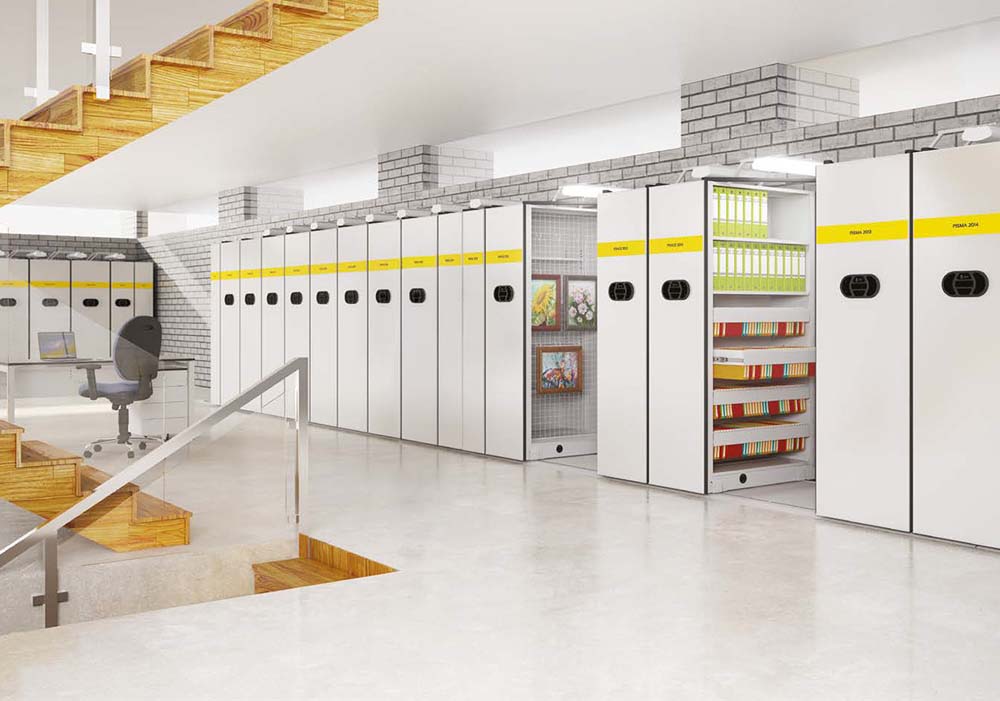
The electric mobile shelving system works on the same basic principle as the hand-operated version – rows of shelving move along floor rails to create a single shared aisle instead of several fixed ones – but movement is powered by an electric motor and drive shaft rather than physical effort. A touch-sensitive control panel is built into the front of each section, letting staff open the desired aisle within seconds at the press of a button. A single control unit can operate the entire system, including several rows of shelving at once, which greatly simplifies work in large spaces.
The control system offers several functions – opening, locking, closing, an alarm, a ventilation mode, and user protection/safety. At night, the system can automatically switch to a positioning and ventilation mode, in which all sections are spaced evenly apart, maintaining an optimal microclimate for the stored materials.
Since the electric system moves heavy rows of shelving without direct human control over the physical force involved, safety features play a particularly important role. The system is fitted with electronic overload protection that responds immediately to obstacles in the aisle – the stop function triggers at just 30 kg of resistance, reacting to a rise in current in the electrical circuit when an obstacle is encountered during movement. In addition, a passive safety system checks that the aisle is clear before it closes. LED indicators signal any system faults, and optional software is available to identify and report the location and type of fault. Access to individual sections can be locked with special keys, restricting access to specific staff members.
The electric SOFT TOUCH system delivers up to 90% more storage capacity than static shelving and can save up to 45% of floor space, since only one access aisle is needed instead of several fixed ones. The technical specifications largely match the hand-operated version – system height of 2,019 mm or 2,394 mm, shelf width of 1,000 mm or 750 mm, depth of 300 mm, 5–7 shelves per section plus a top dust cover, shelf spacing of 350 mm adjustable in 25 mm increments, and a load capacity of 40 kg or 80 kg on request.
This solution is particularly well suited to state and municipal institutions that need to store administrative documents, archival materials, and legal records while meeting storage requirements in administrative buildings with limited floor space; to archives and libraries that need to store large volumes of books, periodicals, and historical documents while keeping every shelf conveniently accessible and protecting materials from unnecessary exposure to light and dust; to offices, where the electric system frees up valuable floor space for staff workstations; and to museums and storage facilities, where additional accessories – such as mesh panels for hanging paintings or posters – let the system be adapted to specific storage needs.
Interestingly, VVN’s range also includes an office shelving version with a SOFT TOUCH drive, designed not for documents but for adapting office furniture and the functionality of a space – the last, fixed section can be fitted with a padded seat where staff can rest during a break or take a phone call, while the remaining sections serve as wardrobes with clothes hangers and shoe racks. This solution is an alternative to building fixed partitions and lets an office adapt flexibly as the organisation’s needs change.
The electric solution pays off where documents need to be accessed frequently and quickly – in archives, libraries, and government institutions with high visitor or staff traffic – whereas in spaces with less frequent access and a tighter budget, the hand-operated system is often the more practical choice.
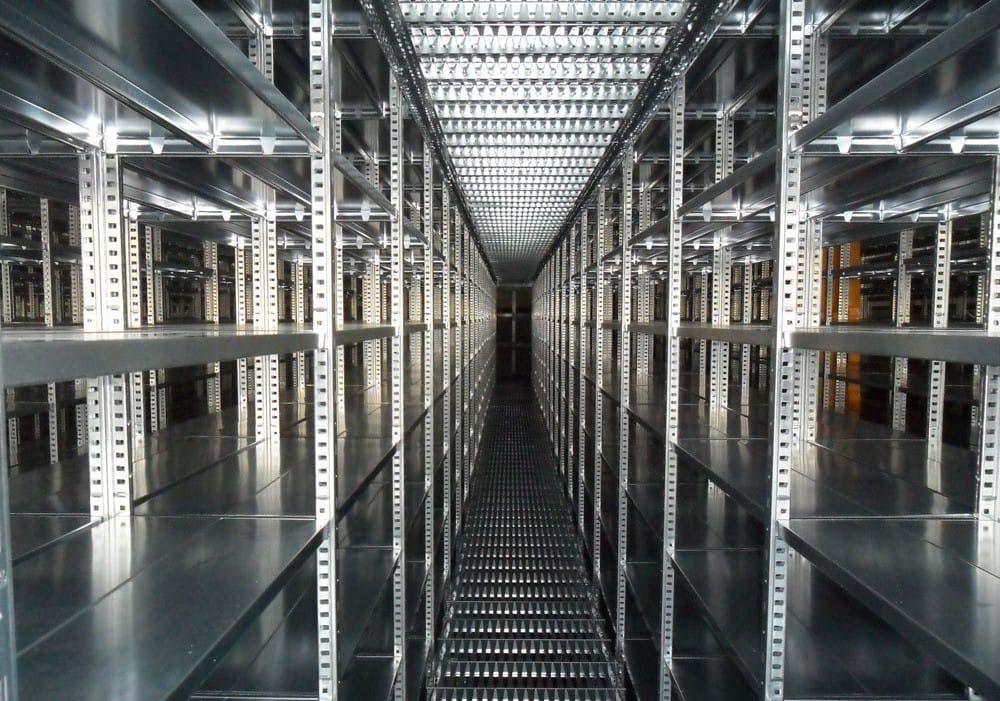
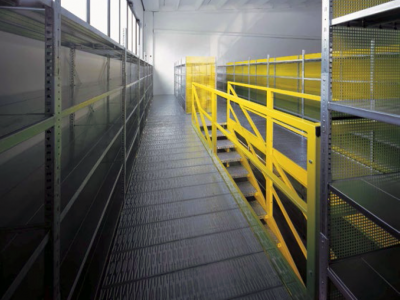
A single-sided metal shelving system is a static solution designed to be positioned along a wall or around the perimeter of a room – documents are accessed from one side only. This is the simplest and most affordable archive shelving configuration, and it’s particularly well suited to rooms with limited width where access from both sides isn’t possible, or to situations where rows of shelving need to sit directly against a wall without leaving unused space behind them.
Each section is built on a rigid frame with adjustable feet, allowing the system to be levelled even on a slightly uneven floor. Shelves adjust in 25 mm increments, and the spacing between shelves must not be less than 330 mm – enough to accommodate standard archive boxes and lever-arch files. The back edge of each shelf has a lip that supports files and prevents documents from falling off the back of the shelf, while the lip on the sides of each section acts as a book support. Additional sections sharing a side panel with the adjacent section can be added to a base section, allowing long rows of shelving to be built without duplicating structural elements and reducing overall system cost per metre of storage.
VVN offers a wide range of sizes and load capacities for single-sided metal shelving, which can be adapted to the specifics of a given space and the weight of the materials being stored. Standard shelf load capacity typically ranges from 90 kg up to 340 kg depending on the model and structural strength chosen, while section height varies from 2,000 mm to 2,500 mm. Lighter-duty models (around 90–150 kg per shelf) are ideal for storing standard documents, binders, and folders, while heavier-duty versions (up to 340 kg per shelf) are suited to storing heavier items, equipment parts, or large-format materials in warehouse spaces.
Because a single-sided system doesn’t require access from both sides, its depth is typically half that of its double-sided equivalent – around 300 mm for document storage – allowing it to be installed even in fairly narrow rooms or corridors without obstructing the flow of movement. This solution is a cost-effective choice for institutions on a limited budget that don’t need maximum storage density per square metre but do need a reliable, durable, and easily expandable system.
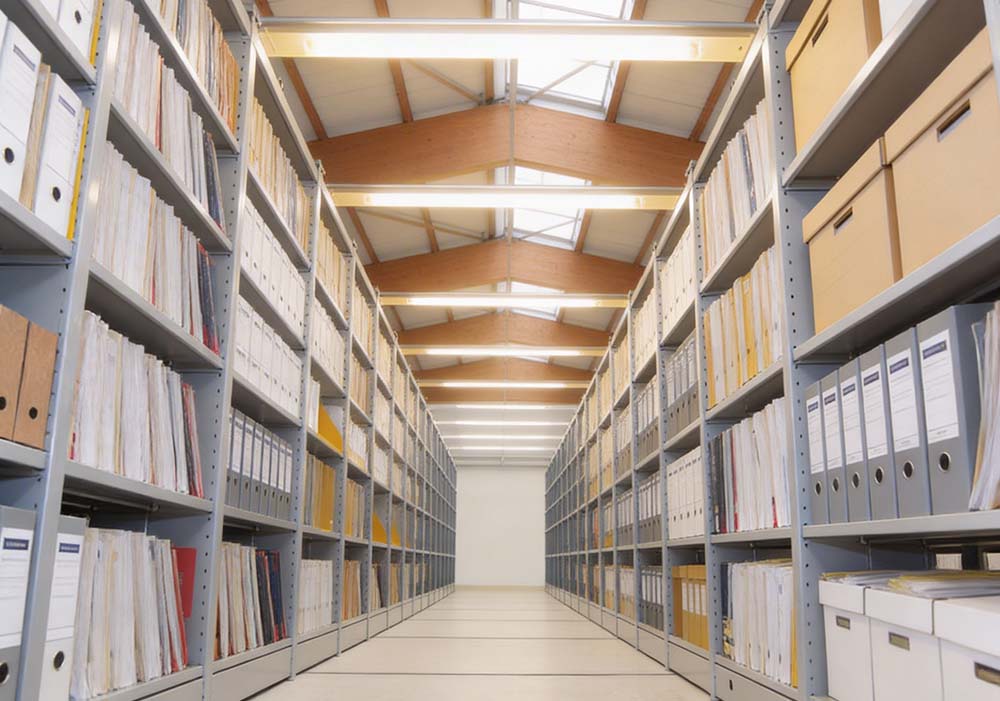
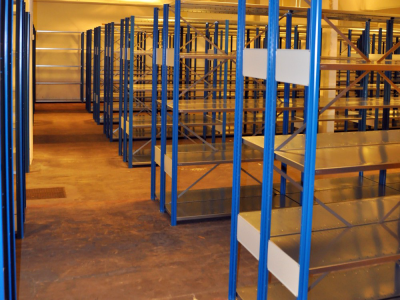
Unlike a single-sided system, double-sided metal shelving is designed to be positioned in the centre of a room, with access possible from both sides at once. This means that a single structure combines two single-sided shelving “walls” with a shared back support – fitting almost twice the storage capacity into the same floor area compared with filling the same room with single-sided shelving along the walls alone.
This layout is especially advantageous in medium and large archives and warehouses, where the central part of the room would otherwise remain unused or serve only as a walkway. By placing double-sided shelving in the middle of the room with single-sided shelving positioned along the walls, it’s possible to create a thoughtful, efficient layout in which every square metre is used for storage, while convenient access is maintained through regular aisles between the rows.
VVN’s range of double-sided metal archive and warehouse shelving (WMS series) includes models with varying numbers of shelves, heights, and load capacities:
All models adjust in 25 mm increments, with a minimum shelf spacing of 330 mm, providing flexibility for arranging documents and materials of various sizes. As with the single-sided system, additional sections sharing a side panel can be added to a base section here too, reducing the cost of building long rows of shelving.
Choosing the right solution depends on four key factors: the available floor space, the budget, the volume of documents to be stored, and how often access is needed.
If floor space is limited but document volume is high, a mobile shelving system (whether hand-operated or electric) is usually the only solution that achieves the desired storage capacity without expanding the room – savings can reach 70–90% compared with a static shelving system. If the room is spacious and saving floor space isn’t the main priority, static single-sided or double-sided metal shelving is often the more cost-effective solution, since it doesn’t require rails, drive mechanisms, or a power connection.
In terms of budget, the order typically runs as follows: single-sided metal shelving is the most affordable option, followed by double-sided shelving (thanks to its greater capacity), then the hand-operated mobile system, with the electric SOFT TOUCH system being the most expensive but also the most functionally advanced solution. However, when calculating cost per stored document box or per square metre saved, mobile systems often turn out to be more cost-effective in the long run – particularly in cases where the alternative would be renting additional space or building an extension.
Access frequency is the deciding factor between the hand-operated and electric mobile systems. If a given row of shelving is accessed rarely – say, a few times a month – a hand-operated system is entirely sufficient and considerably cheaper. If access is needed several times a day, as is often the case in busy archives, registries, or libraries with high visitor traffic, the electric system pays for itself through time savings and reduced physical strain on staff.
Criterion | Single-sided shelving | Double-sided shelving | Mobile (hand-operated) | Mobile (electric) |
Space savings | Low | Medium | Up to 70% | Up to 90% |
Initial cost | Lowest | Medium | Medium-high | Highest |
Access speed | Instant | Instant | Seconds to half a minute | A few seconds |
Suited to high-volume archives | Limited | Yes | Yes | Yes |
Suited to frequent access | Yes | Yes | Moderate | Yes |
Power connection required | No | No | No | Yes |
Before choosing a shelving system, it’s worth assessing several practical aspects that affect both the choice of system and its successful long-term operation.
Floor load capacity. For mobile shelving systems, especially in heavily loaded archives, floor load capacity should be at least 1,000 kg per square metre – this figure should be checked before placing an order, since insufficient load capacity may require additional floor reinforcement. It’s also advisable to seek advice on the floor parameters of the specific room for static shelving holding heavy materials.
Floor levelness. For mobile systems, floor height variation must not exceed 5 mm over a 4-metre length – otherwise the floor needs to be levelled before the rails are installed to ensure smooth shelving movement.
Power connection. If you’re planning to install the electric SOFT TOUCH system, a suitable power connection nearby needs to be planned for at the design stage to avoid additional costs later on.
Aisle width and ergonomics. Even in mobile systems, a sufficiently wide working aisle needs to be provided – not just for access to the shelving, but also so staff can work comfortably with documents and use a trolley or a stepladder for higher shelves.
Room for growth. When planning a system, it’s worth building in a margin for future growth in document volume – either by leaving space for additional sections or by choosing a system that can be expanded without a complete rebuild.
Fire safety and microclimate. Archive rooms must comply with fire-safety regulations, and where document volumes are large, it’s also worth considering humidity and temperature control to protect documents from long-term deterioration.
Labelling system. Whichever shelving system you choose, investing in a well-thought-out labelling and record-keeping system (for example, shelving panels with space for content labels) significantly reduces the time needed to locate a specific document.
This is exactly where the value of VVN’s free space-planning service comes in – the company’s specialists can assess all these factors on site and propose a solution that meets both current and future needs from the very outset.
The right archive shelving system isn’t a one-off expense – it’s an investment that shapes an organisation’s day-to-day efficiency for years to come. Whether your institution needs a compact solution for limited office space, a high-capacity electric system for a busy state archive, or simply reliable, cost-effective metal shelving for a warehouse, the right choice starts with an accurate assessment of your space and needs.
The VVN team is ready to help you find the document storage solution best suited to your specific situation – from a free site survey and shelving layout plan through to a tailored quote and a complete installation cycle.
Get in touch with VVN today for a free consultation and a personalised offer for your archive, warehouse, or office space – we’ll help you build a system that performs safely, efficiently, and reliably for years to come.
| Cookie name | Active |
|---|
Uzraksti mums.