
A daily challenge facing every warehouse manager and logistics business owner often comes down to the same question: how do you store more goods without expanding your warehouse footprint? Sales volumes keep growing, product ranges keep expanding, yet available space keeps shrinking – and building a new warehouse or renting additional space is one of the most expensive solutions a company can choose.
This is exactly where mobile pallet racking systems come in – a solution that lets you significantly increase storage capacity within the same space you already use. This technology, which has been used worldwide for several decades, is increasingly becoming the standard wherever space is expensive but the volume of goods to be stored is large.
VVN (Viss Veikaliem un Noliktavām) has been supplying retail and warehouse equipment solutions to businesses across the Baltics and Scandinavia for more than 10 years, and mobile pallet racking systems are one of the solutions that help our clients get the greatest possible return from every square metre of warehouse space. In this article, we’ll explain how these systems work, what advantages they offer compared with traditional racking, what their technical specifications are, and how to choose the right solution for your business.
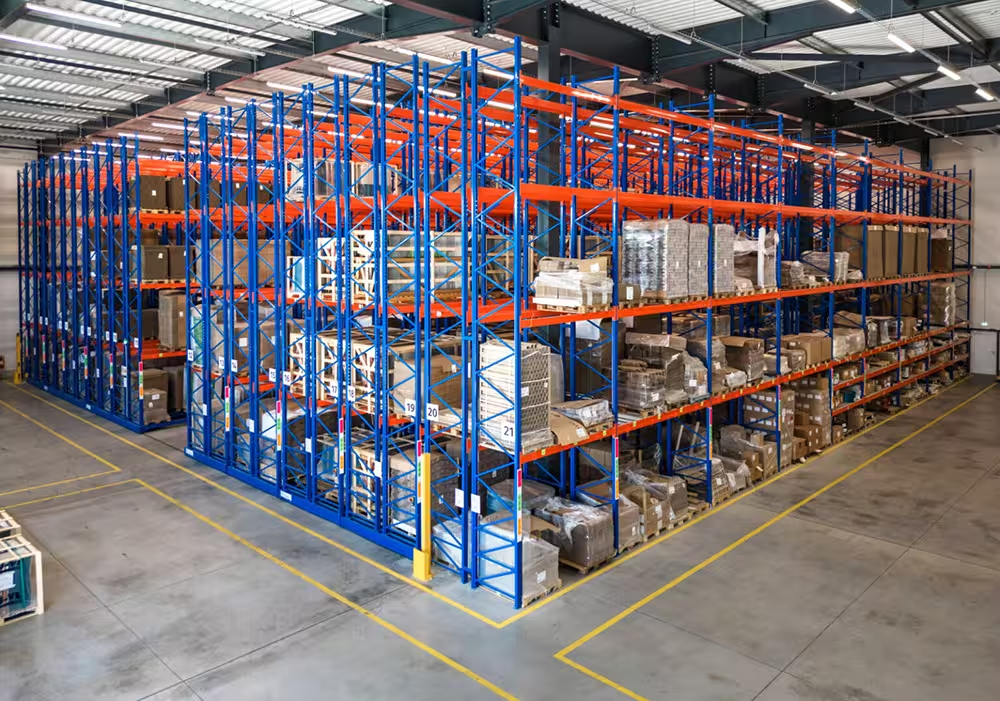
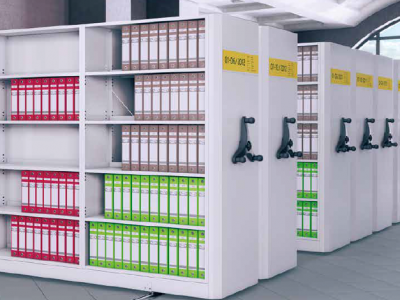
Mobile pallet racking systems – sometimes also called compact pallet racking – are essentially traditional pallet racks that, instead of being fixed permanently to the warehouse floor, are mounted on mobile metal bases that move along rails embedded in the floor.
In a traditional pallet racking system, every row of racking needs its own permanent aisle so that equipment – a forklift, reach truck, or an operator with a pallet truck – can access the goods. Because aisles are required between every row, a significant proportion of the warehouse floor area – often 40–50% or even more – is used not for storing goods, but simply for providing access.
A mobile system solves this problem radically: because the rows of racking can be moved sideways, permanent aisles next to every row are no longer needed – an aisle is created only where and when it’s actually required. At the push of a button or using a control panel, the operator opens an aisle exactly where access to a particular product is needed, while all the other rows remain closely packed together. As a result, significantly more rows of racking – and therefore more goods – can be fitted into the same space.
This principle is especially valuable for businesses where expanding the warehouse isn’t possible or isn’t desirable – whether because the space is leased and its boundaries can’t be changed, or because new construction would require significant capital investment and time that simply isn’t available to the business.
The system is based on three main components: the racking structure itself, which is identical or very similar to traditional pallet racking; the mobile base – a wheeled carriage that moves along built-in rails; and the drive, or control, system that moves the rows.
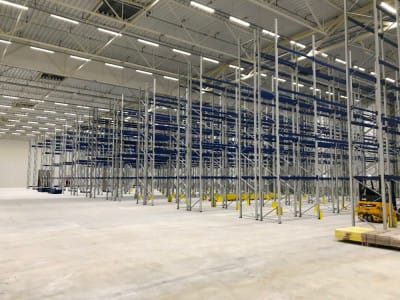
Metal rails are embedded in the floor, on which the mobile bases are positioned. Each base serves as a platform for one or more racking sections, and racking can be installed on it up to 12,000 mm high – meaning mobile systems can also be used in high-bay warehouses, where the height of the space is used just as efficiently as its floor area.
Movement is provided by a drive that moves each row along the rails at a speed of 0.08 m/s. This speed may seem slow, but it’s a deliberate choice: slow, controlled movement ensures safety for both staff and goods, preventing the risk of sudden stops or collisions. The operator controls movement via a control panel or remote control, and in more modern systems this can also be integrated with a warehouse management system (WMS).
When access to a particular product is needed, the operator specifies which aisle to open. The system automatically moves the relevant rows, creating a free aisle exactly where it’s needed, while the other rows remain closed up. The process usually takes only a few minutes, and in modern systems it can be carried out by a single operator rather than several members of staff, as is sometimes needed in more complex warehouse processes.
It’s worth noting that mobile systems can be designed with either a simpler drive for smaller solutions or a fully motorised, automated drive for large-volume warehouses, where row length can reach up to 70,000 mm and a single row can bear a load of up to 600 tonnes.
In modern solutions, the control system is increasingly complemented by digital features – from simple button-panel control to fully programmable sequences, in which the system remembers which aisle was last used and lets the operator plan the next movements in advance. This is particularly useful in warehouses with high product turnover, where the time saved on each operation adds up over time to a significant increase in work efficiency.
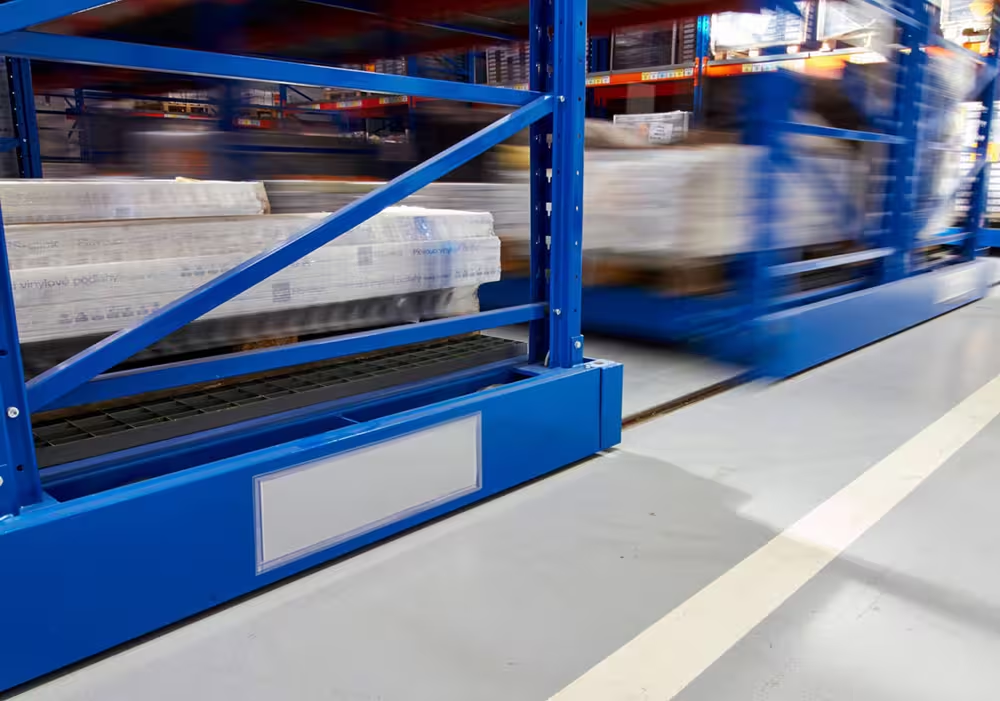
To understand the real value of mobile pallet racking systems, it’s useful to compare them with traditional, static pallet racking systems.
In a traditional system, every row needs its own aisle, typically 2.8–3.5 metres wide depending on the equipment used. If a warehouse has, say, 10 rows of racking, that means at least 9–10 permanent aisles.
A mobile system needs only one working aisle – it’s simply moved to wherever work is currently taking place. In practice, this means the same floor area can accommodate 60–100% more pallet positions than would be possible with traditional racking.
Let’s look at a simple example: in a 2,000 m² warehouse space, using a traditional pallet racking system with standard aisles, you could fit approximately 800–900 pallet positions. Switching to a mobile pallet racking system, which needs only one working aisle, the same 2,000 m² area can accommodate approximately 1,400–1,600 pallet positions – that’s 60–80% more, without reducing accessibility to any of the goods.
This increase in capacity translates directly into financial benefit. If a business is short of warehouse space, its usual options are two: rent additional space or invest in building a new warehouse. Both solutions are expensive: renting warehouse space can cost anywhere from several to several dozen euros per square metre per month, depending on location and the quality of the space, while building a new warehouse can cost hundreds of euros per square metre.
If a mobile system lets you fit 70% more goods into the same floor area, that effectively means the business doesn’t need to rent or build an additional 70% of space to achieve the same capacity. In the example above, this would mean that to achieve the same capacity as the mobile system using a traditional system, you would need roughly another 800–1,000 m² of additional space – which, depending on the region and rental prices, could mean additional costs ranging from several thousand to several tens of thousands of euros a month, or hundreds of thousands of euros if it’s a matter of building a new warehouse. Even if a business isn’t planning to expand in the near future, a mobile system provides headroom for future growth without the need to look for new premises.
A smaller warehouse footprint also means lower costs for heating, ventilation, lighting, and cleaning – this is especially significant in freezer- and chiller-type warehouses, where maintaining temperature across a large area is expensive. Mobile systems are designed to operate across a wide temperature range, from -25°C to +30°C, making them ideally suited to low-temperature storage spaces too, where every square metre saved reduces cooling costs.
Unlike traditional racking, whose layout is practically never changed after installation, mobile systems offer greater flexibility in day-to-day operation – the operator can quickly adjust access exactly where it’s needed at any given moment, without leaving unused space where aisles aren’t required.
Because a mobile system reduces the total aisle space and the rows are kept closed up, the risk of unauthorised staff or visitors gaining access to goods is also reduced, and overall warehouse control and oversight improve.
When choosing a mobile pallet racking system, it’s important to know the technical parameters that determine which type of warehouse environment and load volume the system is suited to. VVN’s mobile pallet racking systems meet the following technical specifications:
Parameter | Value |
Maximum racking height | up to 12,000 mm |
Maximum permissible weight per row | up to 600 tonnes |
Maximum racking length | up to 70,000 mm |
Operating temperature | -25°C to +30°C |
Standard compliance | PN-EN 15095 |
Movement speed | 0.08 m/s |
Additional equipment | emergency stop system, distance sensors, manual activation system |
These parameters allow mobile systems to be adapted for relatively small storage solutions as well as for large, high-throughput distribution centres that need to store heavy, bulky loads.
Compliance with the PN-EN 15095 standard ensures that the system is designed and manufactured in line with European safety requirements specifically for mechanised and motorised storage systems – this is particularly important because, unlike static racking, mobile systems include moving parts that require additional safety mechanisms.
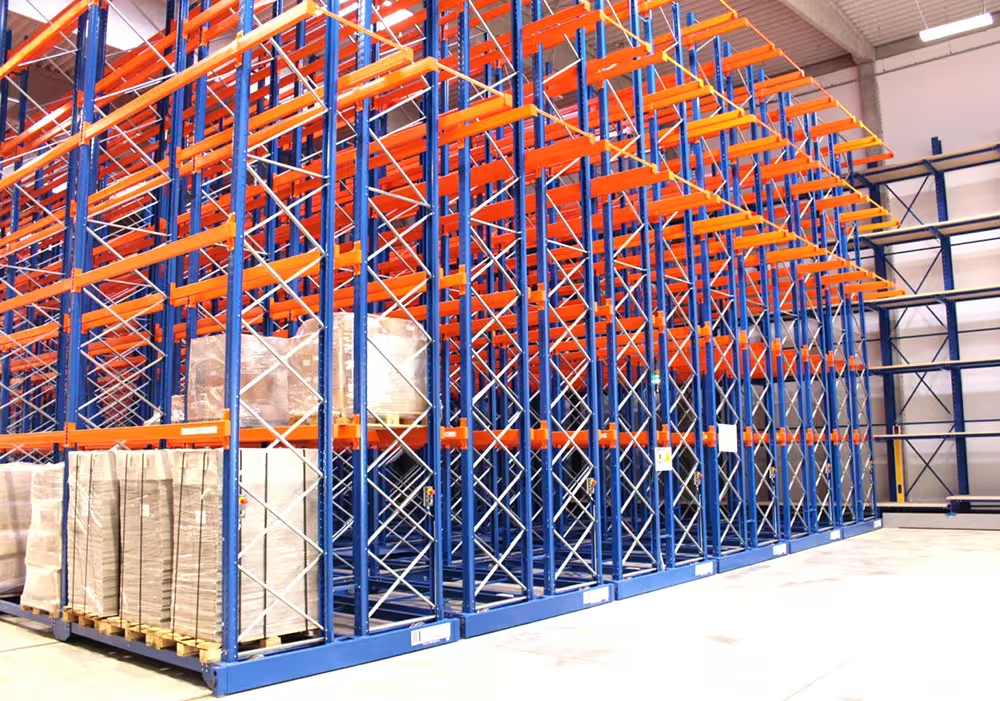
In each of these industries, the main value of mobile systems is the same – turning space that would otherwise be used for aisles into productive, revenue-generating storage area.
It’s also worth mentioning that mobile systems can be combined with other warehouse and retail equipment solutions offered by VVN – from traditional racking systems for less active goods to fully automated assortment solutions – creating a unified warehouse ecosystem tailored to your business’s needs, rather than a separate, isolated piece of equipment.
Because mobile pallet racking systems involve moving, motorised structures of considerable weight, safety is one of the most important factors when choosing and operating such a system. VVN’s systems are designed in accordance with the PN-EN 15095 standard, which sets out safety requirements for mechanised and motorised storage systems, and they incorporate several safety mechanisms:
Together, these mechanisms form a multi-layered safety system that allows mobile systems to be operated safely even in intensive warehouse conditions, where people and equipment are often working in close proximity to the rows of racking.
It’s also worth remembering that safety isn’t just a matter of equipment – it’s also a matter of staff training. Every employee who works with or near a mobile racking system needs to learn how to use it correctly, and the business must ensure regular technical maintenance of the system so that all safety mechanisms function flawlessly.
Mobile pallet racking systems aren’t a one-size-fits-all solution equally suited to every warehouse – every space is different, and the right system should be chosen taking several factors into account:
That’s exactly why VVN specialists always assess the specific warehouse site, the nature of the loads, and the company’s work processes before preparing a proposal, in order to offer a solution that genuinely meets your real needs, rather than just a generic, standardized system.
VVN (Viss Veikaliem un Noliktavām) has been a trusted partner for more than 10 years to businesses across the Baltics and Scandinavia that need quality retail and warehouse equipment solutions. Over the years, we’ve helped many clients – from manufacturing companies to distribution centres and retail chains – optimise their use of storage space and reduce the associated costs.
By choosing VVN as your partner in implementing a mobile pallet racking system, you get:
If your warehouse is already overcrowded, or if you feel that product volumes will keep growing in the coming years, mobile pallet racking systems could be the solution that lets you avoid costly expansion or moving to larger premises. By investing in the right storage system, you not only increase the capacity of your existing space by 60–100%, but also improve the efficiency of your work processes, reduce energy costs, and create a safer working environment for your staff.
Every warehouse is unique, and the best way to find out how much space and money you could save is through an individual consultation with specialists who understand both the technology and the specifics of your industry. Often, it’s precisely that initial consultation – whether online or in person – that reveals opportunities the business itself wouldn’t have noticed, whether that’s the chance to use warehouse height that has so far gone unused, or the chance to replan the existing layout so that the most frequently requested goods are easier to access.
Get in touch with VVN specialists today at www.vvn.lv, and receive an individually tailored proposal for a mobile pallet racking system that matches your warehouse’s exact needs. Our team is ready to assess your space, listen to your requirements, and offer a solution that works for you for years to come.
| Cookie name | Active |
|---|
Uzraksti mums.