
Pallet trucks are the essential equipment of every warehouse – without them, efficient goods handling is simply unimaginable. In today’s logistics environment, where speed and safety go hand in hand, the right mechanical pallet truck saves both time and labour. The MPT2 model is designed specifically for those who move heavy loads daily – from 2,000 to 3,500 kg – and require reliable, easy-to-maintain equipment. Thanks to a wide range of configurations and a choice of three wheel materials, MPT2 pallet trucks are equally suited to cold-storage warehouses and production facilities.

You get a better offer?
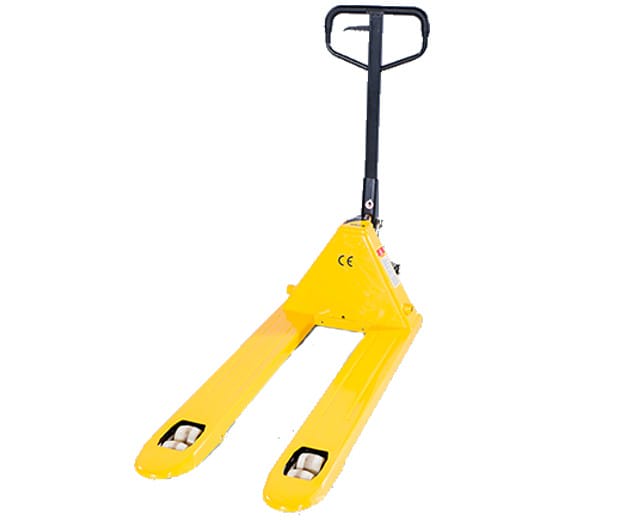
*Available a wide range of sizes and parameters of pallet truck models to suit specific needs, functions and tasks.
When selecting a manual pallet truck, specifications are more than numbers – they determine whether the equipment can operate safely and efficiently in your specific conditions. Load capacity, fork dimensions, and wheel material together form a system that either matches your goods-handling requirements or introduces unnecessary risk. We therefore recommend reviewing each parameter group carefully before placing an order.
Parameter | Value |
Load capacity | 2,000 / 2,500 / 3,000 / 3,500 kg |
Fork length | 1,150 / 1,220 mm |
Fork width | 160 mm |
Overall width | 520 / 550 / 685 mm |
Lift height (min.) | 75–85 mm |
Lift height (max.) | 190–200 mm |
Wheel material | Nylon, polyurethane, rubber |
Weight | 59.5–79.5 kg |
The MPT2 is available in four load-capacity versions: 2,000, 2,500, 3,000, and 3,500 kg. This means you can select the model that precisely matches your actual load weights without paying for unnecessary reserve capacity. The most popular choice among B2B clients is the 2,500 kg model, which covers the vast majority of standard logistics requirements.
Fork lengths of 1,150 mm and 1,220 mm ensure compatibility with the most common EUR and industrial pallets. Three overall-width options (520, 550, and 685 mm) allow the truck to be adapted to narrow warehouse aisles as well as wider pallet structures.
A minimum lift height of 75–85 mm ensures free pallet entry even on uneven floors, while the maximum of 190–200 mm is sufficient for standard pallet transport and stacking operations. This range complies with international warehouse operating standards.
Three wheel options – nylon, polyurethane, and rubber – allow you to match the truck precisely to the floor surface and load type. See the section ‘Which Wheel Material Should You Choose?’ below for a detailed comparison.
Depending on the configuration, the MPT2 mechanical pallet truck weighs between 59.5 and 79.5 kg. This weight ensures stability at maximum load whilst still allowing the operator to manoeuvre the truck freely even when unloaded.
Wheel material is one of the most important decisions when selecting a pallet truck. The wrong choice leads to accelerated wear, floor damage, or reduced operational efficiency.
Nylon wheels are the most durable and best suited to dry, clean, and smooth floor surfaces – concrete or tiled floors in production and logistics facilities. They withstand high loads well and are resistant to oil and chemical substances. However, on softer or dirty surfaces nylon may cause scratching, and it absorbs noise less effectively than other materials.
Pallet trucks with polyurethane wheels are the optimum choice for warehouses where floor quality is a priority – for example, epoxy-coated or polished concrete floors. Polyurethane does not mark the floor, absorbs vibration, and provides a smoother ride even under heavy loads. This is the most frequently requested option in retail centres and the food industry.
Rubber wheels are most suitable for outdoor use or on uneven, rough surfaces – concrete yards, loading areas, or wooden decking. They provide the best shock absorption and reduce noise. It should be noted that rubber is not suitable for high-temperature environments or exposure to aggressive chemical substances.
If you are unsure which option is right for you, please contact our specialists – they will help you select the correct configuration based on your warehouse conditions.
In food logistics, hygiene and moisture resistance are the primary requirements. The MPT2 with polyurethane wheels performs excellently in cool and damp environments without marking the floor. The corrosion-protection coating on the steel frame ensures compliance with food industry standards.
In a production environment, pallet trucks must lift heavy loads – raw materials and semi-finished goods – multiple times per day. The MPT2’s load capacity of up to 3,500 kg and robust hydraulic system handle this with ease. Nylon wheels on industrial concrete floors deliver a long service life with minimal maintenance.
Retail and warehouse operators appreciate the MPT2’s compact dimensions and quiet operation with polyurethane wheels. These manual pallet trucks maneuvers easily between shelves and through narrow aisles, speeding up stock replenishment and reducing handling time.
In cargo transshipment terminals, MPT2 mechanical pallet trucks handle high daily goods throughput with ease. The broad choice of load capacity allows the equipment to be matched to specific load types, whilst the straightforward construction ensures that even multi-shift operation does not lead to unexpected costs.
The maximum load capacity of the MPT2 is 3,500 kg.
The model is available in four versions - 2,000, 2,500, 3,000, and 3,500 kg - so you can choose exactly the capacity that matches your load weights. The most popular option is the 2,500 kg model, which meets the requirements of most standard warehouse operations.
Yes, provided you select the appropriate wheel material. For outdoor use on concrete or cobbled surfaces, rubber wheels are recommended: they absorb vibration and ensure stable movement. Nylon and polyurethane wheels are better suited to clean indoor surfaces.
Nylon wheels are preferable for dry industrial environments where floor protection is not a priority but the load is high. Polyurethane wheels do not damage the floor covering and operate more quietly, making them a better choice for retail or food warehouses with quality flooring. If you are uncertain, pallet trucks with polyurethane wheels are generally the more versatile option.
The MPT2 requires minimal maintenance - regular lubrication of the hydraulic system and cleaning the wheels of debris are the primary procedures. It is advisable to inspect the hydraulic system seals and the degree of wheel wear once a year. These tasks can be carried out by any member of staff without specialist training.
Yes, the MPT2 is available in several standard configurations - with different fork lengths, overall widths, and wheel materials. If the standard options do not meet your requirements, please contact the VVN.lv team to discuss the possibilities. Our specialists will help you find or configure a solution that precisely matches the needs of your warehouse.
| Cookie name | Active |
|---|
Uzraksti mums.