
Electric pallet trucks have become indispensable warehouse equipment in modern Latvian logistics companies, where pace of work, ergonomics and cost efficiency determine competitiveness. An electric pallet truck reduces the operator’s physical effort, increases working speed and lowers the risk of injury – particularly during intensive shift work. VVN offers the EPT3 model, a proven solution for warehouses with a load capacity of up to 1800 kg, a built-in charger and a durable construction. Whether your company operates in food logistics, FMCG distribution or the building materials trade, the EPT3 is built to work in the conditions of Latvian warehouses and retail premises. As an experienced supplier of warehouse equipment in Latvia, Lithuania and Estonia, VVN provides both equipment delivery and service support.

You get a better offer?
An electric pallet truck – also known as a power pallet jack – is a warehouse vehicle with an electric drive, designed for the horizontal movement and lifting of pallets. Unlike manual pallet trucks, which require the operator to physically walk alongside and pump a handle, an electric pallet truck uses a built-in electric motor for travel and a hydraulic system to raise the forks. The operator steers the unit using a handle with an integrated control panel.
The EPT3’s forks enter standard Euro pallet fork openings (80 mm in height), and the operator raises the pallet at the push of a button. The electric motor provides a travel speed of up to 6 km/h, while the hydraulics lift the pallet to a height of up to 200 mm – enough to keep it clear of the floor during transport.
| Rated capacity | Sizes of forks (length x width) | Battery (V/Ah) | Charger | Drive motor | Max./ min. lifting height |
Price (excluding VAT) |
|---|---|---|---|---|---|---|
|
1500 kg |
1150 mm x 540/560/685 mm; |
24 V/65 Ah |
Built-in |
0,75 kW |
200/85 mm |
on request |
|
1800 kg |
1150 mm x 540/560/685 mm; |
24 V/65 Ah |
Built-in |
0,75 kW |
200/85 mm |
on request |
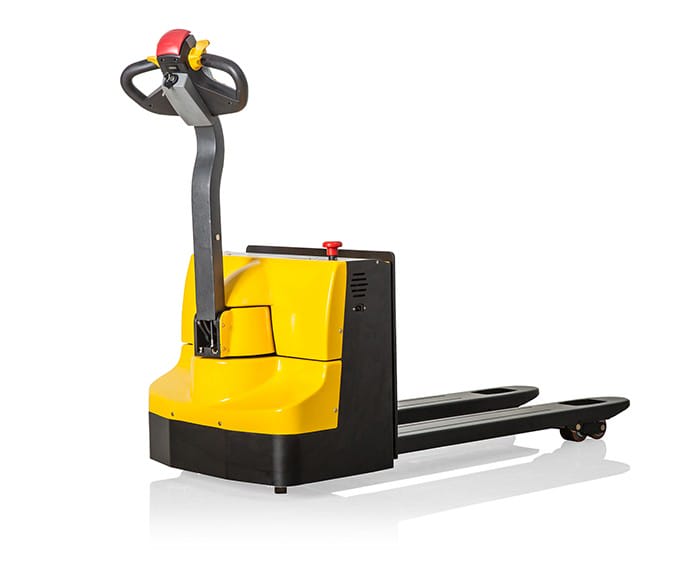
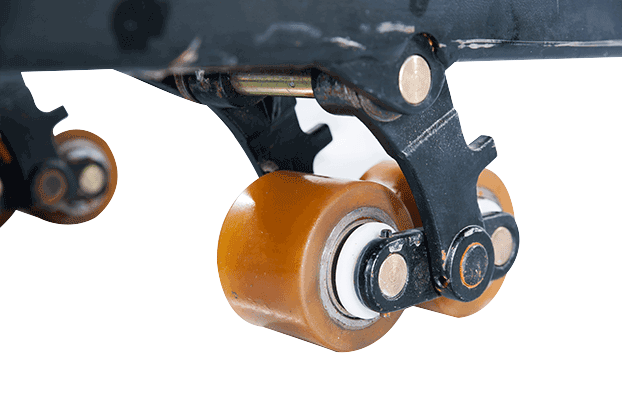
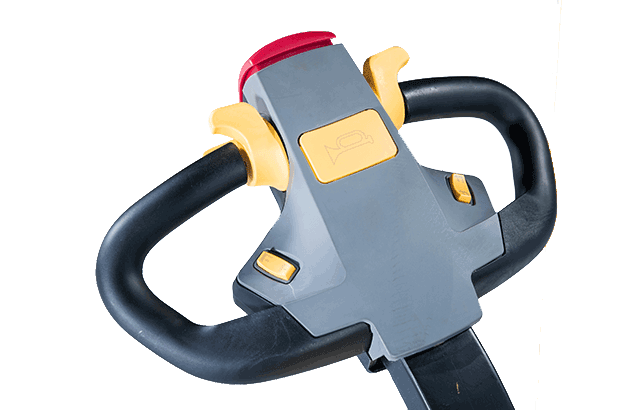
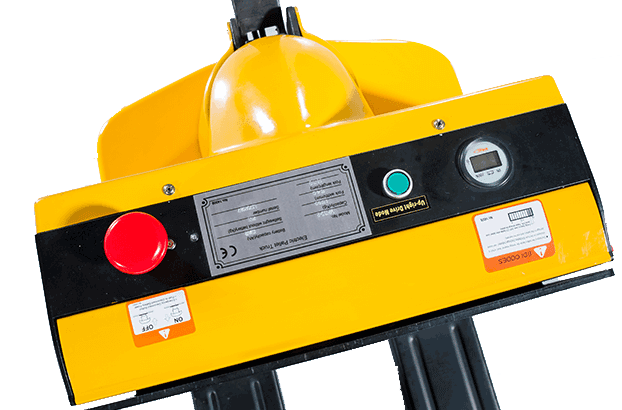
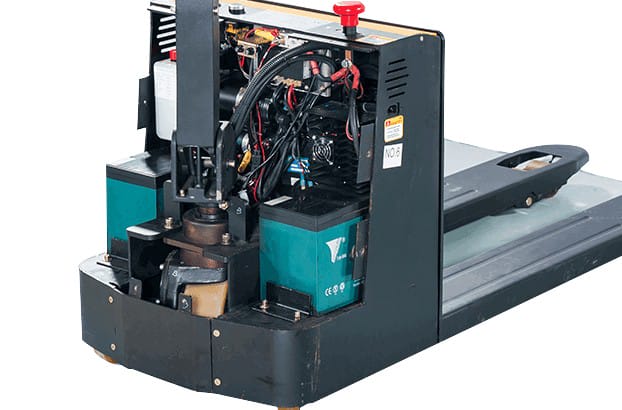
24V / 65Ah battery – this is the unit’s ‘heart’ and one of the most important parameters when choosing an electric pallet truck. A capacity of 65 amp-hours means the EPT3 can run without a break through a typical 8-hour shift at average load (roughly 40–60 pallet movements). By comparison, units with a 20–30Ah battery last only half a shift under intensive use. The built-in charger allows the unit to be charged directly at the workplace – via a standard 220V socket – without needing to take it to a centralised charging station.
1500 kg or 1800 kg load capacity – a fully loaded standard Euro pallet weighs an average of 600–1200 kg, depending on the type of cargo. Both EPT3 versions allow even the heaviest standard pallets to be moved safely. The 1800 kg version is recommended for manufacturing plants and building materials warehouses, where loads frequently reach the upper limit.
0.75 kW drive motor – a compact but efficient motor that provides a steady travel speed and energy efficiency. This output is optimal for pallet trucks used in flat-floor warehouses without ramps.
Choice of fork width (540 / 560 / 685 mm) – allows the unit to be adapted to different pallet standards. The 540 mm version suits European EUR-1 pallets, while 685 mm suits wider industrial pallets. This makes the EPT3 a versatile solution for warehouses across different sectors.
The EPT3 is not simply a ‘power pallet jack’ – it is an investment in warehouse productivity that pays for itself within the first year. Here is what this means for specific Latvian businesses:
Criterion | Electric pallet truck (EPT3) | Manual pallet truck |
Purchase price | Higher (on request from VVN) | Lower (from ~€150) |
Long-term costs | Lower (fewer injuries, higher productivity) | Higher (labour costs, injury risk) |
Working speed | High – electric-motor travel | Low – operator pulls/pushes manually |
Ergonomics | Excellent – minimal physical strain | Poor – high physical effort |
Max. load capacity | Up to 1800 kg (EPT3) | Typically 2000–2500 kg (static) |
Suitable environments | Warehouses, logistics centres, retail | Short distances, low intensity |
Maintenance | Regular: battery, oil, wheels | Minimal: hydraulics and wheels only |
Operator requirements | Training in warehouse equipment use | No licence required |
When to choose the electric version? If your warehouse handles more than 20–30 pallets a day, if work is carried out in shifts, or if the operator moves loads over distances greater than 20–30 metres, an electric pallet truck is an economically justified choice. Manual pallet trucks remain the optimal solution only where loads are moved infrequently, over short distances and in small quantities – for example, in a retail shop’s back-of-store warehouse with low stock turnover.
The EPT3 electric pallet truck is designed for versatile use – its compact dimensions, Euro-pallet-compatible forks and 65Ah battery make it suitable for a wide range of applications.
The EPT3’s fork width options (540 mm, 560 mm, 685 mm) provide compatibility with both standard EUR-1 pallets (800×1200 mm) and wider industrial pallets, making it a versatile piece of warehouse equipment.
Choosing the right electric pallet truck saves money and prevents investment mistakes. Follow these steps before making a decision:
The price of electric pallet trucks in Latvia varies depending on the manufacturer, load capacity, battery capacity and the supplier's service package. Models on the market with a standard 1500 kg load capacity start at around €1500–2000 (excluding VAT), while high-capacity or lithium-ion battery models can reach €3000–5000 or more. The price of VVN's EPT3 model is available on individual request, as it includes a delivery and service package tailored to Latvia. It is worth noting that a lower purchase price does not always mean lower total costs - also factor in maintenance, spare parts and labour costs over a 3–5 year period. Contact VVN to receive a specific price quote within 24 hours.
The main difference lies in the type of drive and ergonomics. Manual pallet trucks rely on the operator's physical strength - a person raises the pallet using a pump handle and pushes or pulls the loaded unit themselves. Electric pallet trucks use an electric motor for travel and hydraulics to raise the forks - the operator simply steers the unit using a control handle. In practice, this means an operator using an electric pallet truck can handle 2–3 times more pallets per shift with significantly less physical effort. Manual trucks are cheaper to buy and suitable for light loads, but for companies with intensive warehouse operations, electric pallet trucks are a more cost-effective solution in the long run.
The EPT3's battery (24V/65Ah) fully charges in approximately 6–8 hours under standard charging - ideal for overnight charging between shifts. Charging takes place via the built-in charger when the unit is plugged into a standard 220V mains supply. Important: a battery that has already noticeably lost capacity should not be allowed to discharge fully before recharging - it is recommended to charge after every shift regardless of remaining capacity. Regular charging extends battery life. If your warehouse operates two shifts, discuss fast-charging or spare-battery solutions with VVN.
Yes, the EPT3 is suitable for use in narrower warehouse aisles. The unit's overall width with 540 mm forks is approximately 560–580 mm, allowing it to manoeuvre in aisles from 1.8 to 2.0 metres wide. The larger stabiliser wheels and compact body make precise manoeuvring in tight spaces easier. However, in very narrow aisles (under 1.6 m), a special narrow-aisle warehouse equipment solution may be required. Before purchasing the EPT3, it is advisable to measure the width of all warehouse aisles and consult a VVN specialist on the optimal configuration. Note that the choice of fork width (540/560/685 mm) also affects the minimum aisle width required.
The EPT3 electric pallet truck is available in two load-capacity versions: 1500 kg and 1800 kg. Both versions use the same battery (24V/65Ah) and drive motor (0.75 kW), differing mainly in the hydraulic system and body construction. The 1500 kg version is suitable for most standard logistics and retail warehouses, where Euro pallets typically do not exceed 1200 kg. The 1800 kg version is recommended for manufacturing plants and warehouses that regularly handle heavier loads - for example, building materials, metal products, or large quantities of bakery goods. When choosing a load capacity, always allow a 10–15% safety margin.
Yes, like any warehouse equipment, an electric pallet truck requires regular maintenance. Preventive servicing of the EPT3 includes: checking the battery and diagnosing the charging system, monitoring hydraulic oil levels, inspecting the wheels and stabiliser system, checking electrical connections, and calibrating the self-diagnostic handle. The manufacturer recommends servicing once a year or after a set number of operating hours (typically 500–1000). VVN provides service support in Latvia, covering both scheduled maintenance and emergency repairs. Regular servicing extends the unit's working life to 8–12 years and reduces the risk of unexpected downtime. Contact VVN to arrange a service agreement.
The EPT3 electric pallet truck can be ordered from VVN in several ways: email: info@vvn.lv | phone: +371 27727449 or +371 20379394 | website: vvn.lv. Ordering process: 1) contact VVN, specifying the required load capacity, fork width and intended use; 2) receive an individual price quote within 24 hours; 3) once the order is confirmed, VVN agrees the delivery timeframe and terms with you; 4) delivery and commissioning of the unit in Latvia. VVN delivers throughout Latvia, as well as to Lithuania and Estonia. Before ordering, it is advisable to consult a VVN specialist on the optimal configuration for your specific working conditions.
Yes, the EPT3 is also built for work on loading ramps. Its enlarged stabiliser wheels with a floating design effectively absorb small height differences between the warehouse floor and the vehicle platform (typically 20–60 mm). The unit's compact dimensions also allow it to be used for loading and unloading standard trailers. Important: if a ramp has a significant gradient (above 5–8°), consult VVN about safety beforehand - electric pallet trucks are not designed for steep ramps. The EPT3's 0.75 kW motor and stable stabiliser system make it a reliable loading-ramp solution for wholesale and logistics businesses.
With proper care, the EPT3's lead-acid battery (24V/65Ah) lasts an average of 3–5 years, or approximately 600–1000 charge cycles. Battery life is affected by several factors: charging discipline (the battery should not be fully discharged), charging temperature (optimally +10°C to +30°C), storage conditions and maintenance regularity. Once the battery has reached the end of its service life, it must be replaced - VVN supplies replacement batteries. To extend battery life: charge after every shift, avoid deep discharging, and store the battery charged if the unit is not in use for an extended period. Modern lithium-ion battery versions last 2–3 times longer, though at a significantly higher price.
Yes, electric pallet trucks are significantly safer than manual ones in several respects. First, the electric drive removes the need for large physical effort, meaning a lower risk of strain and spinal injuries. Industry studies show that switching from manual to electric pallet trucks reduces workplace injuries by 40–60%. Second, electronic handle controls provide more precise handling and reduce the chance of an unplanned load slipping. Third, the EPT3's self-diagnostic handle warns of a technical fault before it becomes a safety issue. It should be stressed that both electric and manual trucks require appropriate training - operating warehouse equipment without instruction is dangerous regardless of the type of equipment.
| Cookie name | Active |
|---|
Uzraksti mums.