
School desks are a fundamental element of any classroom – how comfortably, healthily and productively pupils spend their lessons depends significantly on the choice made. VVN offers a wide range of single-seat school desks for Latvian schools, municipal educational institutions and other types of teaching establishments, covering both height-adjustable and fixed-height models built to meet the requirements of the LVS EN 1729 standard. A correctly chosen school desk gives the pupil an anatomically correct sitting posture, reduces strain on the back and neck during prolonged sitting, and helps maintain attention throughout the lesson – whereas a desk of the wrong size can have exactly the opposite effect. For school management and procurement specialists at educational institutions looking for a reliable supplier, VVN offers more than 10 years’ experience in supplying furniture and equipment to state and municipal institutions across the Baltics and Scandinavia, competitive prices and delivery throughout Latvia. This page brings together the key information needed when choosing school desks for an educational institution – from ergonomic requirements and material choice to specific practical criteria that will help you make an informed decision.
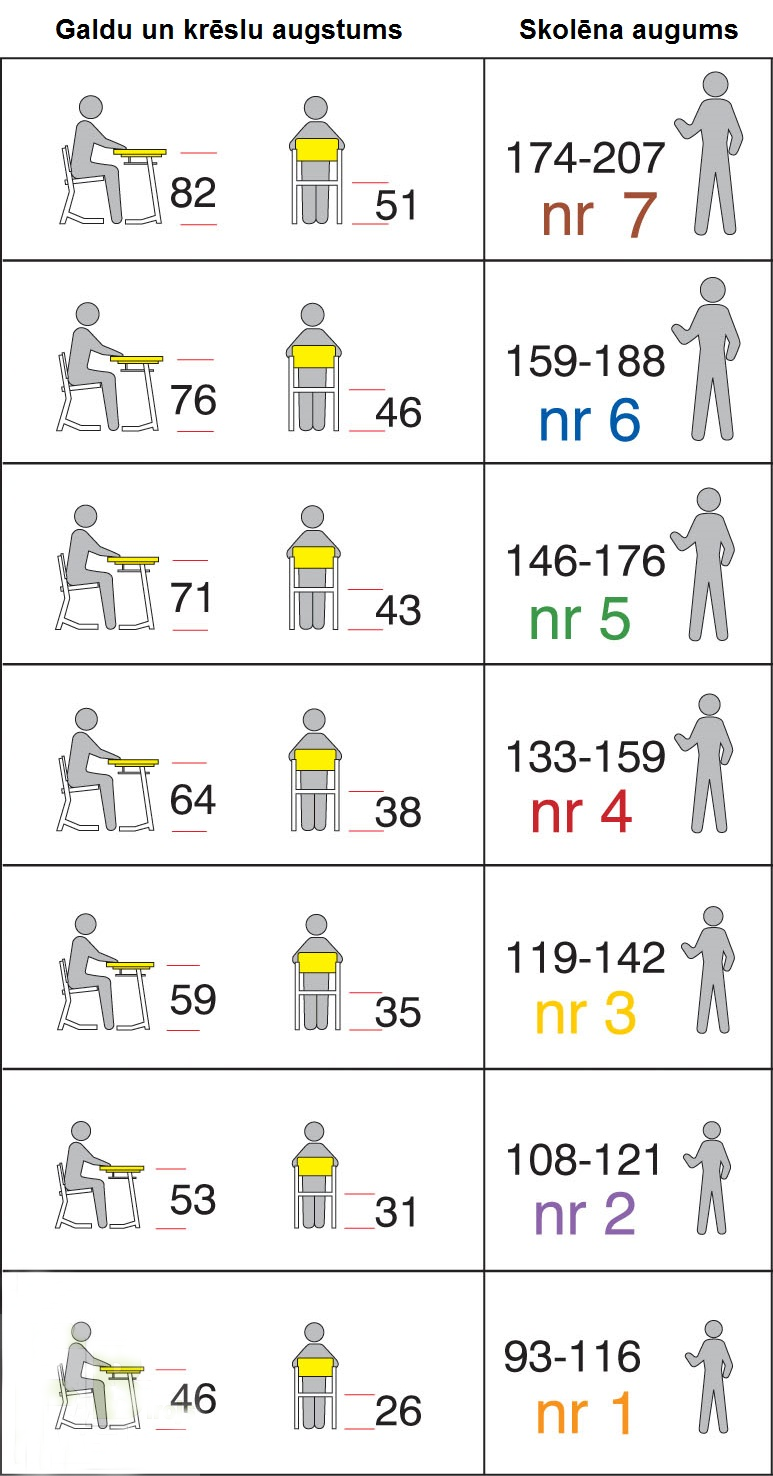
Desk height dimensions table:
Quality school desks affect three areas – pupils’ physical health, their ability to concentrate during lessons, and how long the furniture lasts. A desk that doesn’t match a pupil’s height encourages poor sitting posture, which can lead to back and neck strain over time. A durable, properly constructed desk, on the other hand, serves many school years without additional investment.
Pupils in a classroom typically spend several lessons there each day, so the workplace needs to be suitable for prolonged use. Ergonomics specialists point out that an incorrect desk or chair height is one of the most common causes of posture problems that begin to develop in children and teenagers already during their school years. An uncomfortable desk also distracts from the lesson content – pupils are constantly shifting position in search of a more comfortable posture instead of concentrating on the lesson. VVN school desks are made from durable materials – laminated chipboard 16-25 mm thick and a powder-coated metal frame – which provide resistance to the intensive daily load created by active pupils. Investment in quality school desks therefore pays off twice over: it improves the learning environment while also reducing the need for frequent furniture replacement, which saves the educational institution’s budget in the long run.

You get a better offer?
Single-seat school desks give each pupil their own personal workspace, reduce distractions from neighbouring classmates and allow the classroom layout to be changed flexibly. Compared with two-seat desks, they generally take up less space per pupil and allow the classroom to be rearranged quickly to suit the format of the lesson.
An individual workspace is especially important during tests and independent work, when concentration matters and less dependence on the actions of a neighbouring pupil is needed. The layout of single-seat desks can be changed much faster than that of two-seat desks – a teacher can transform the classroom from rows into a U-shape for discussion or small groups within a few minutes, without having to move two pupils at once. This is especially useful in modern teaching approaches, where a single lesson may combine a lecture segment, group work and individual task completion. VVN’s range of single-seat school desks includes more than ten different models – from compact 650 mm wide desks fitted with a front panel, a book shelf and bag hooks, to large 800 mm wide desks with a reinforced steel frame. This variety lets a school choose exactly the solution that matches the size of a particular classroom and the pupils’ needs, without sacrificing the convenience of the work surface for laying out books, notebooks and digital devices.
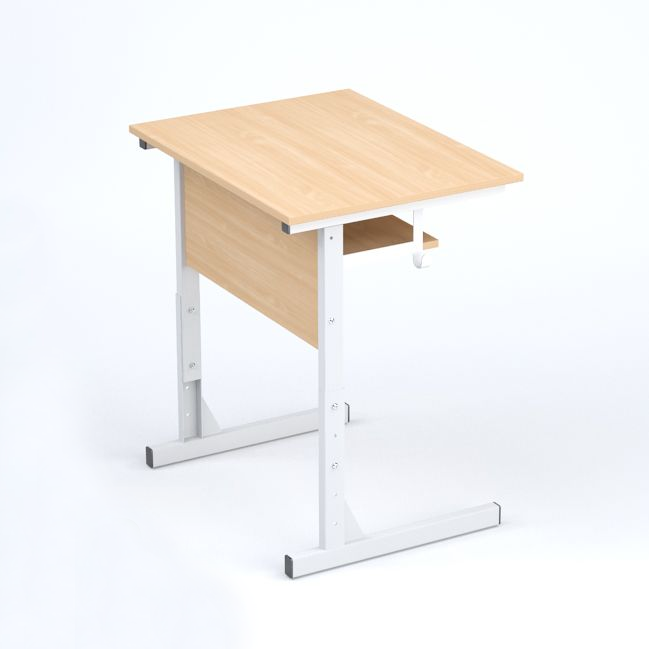
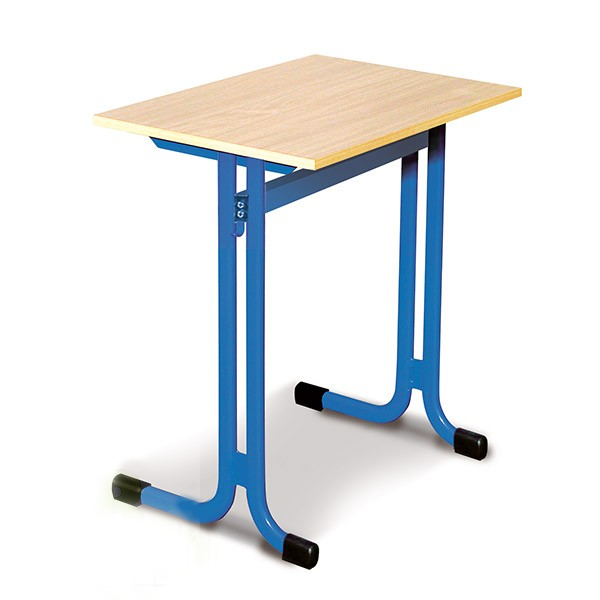

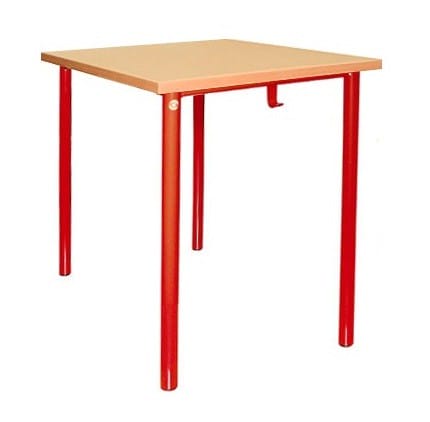
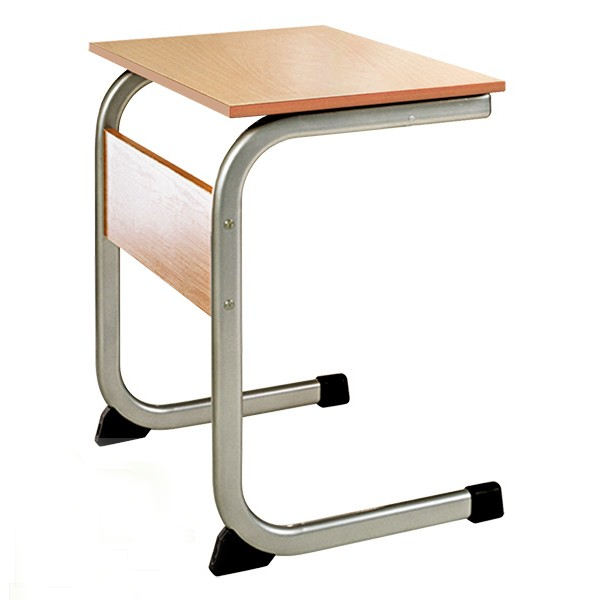
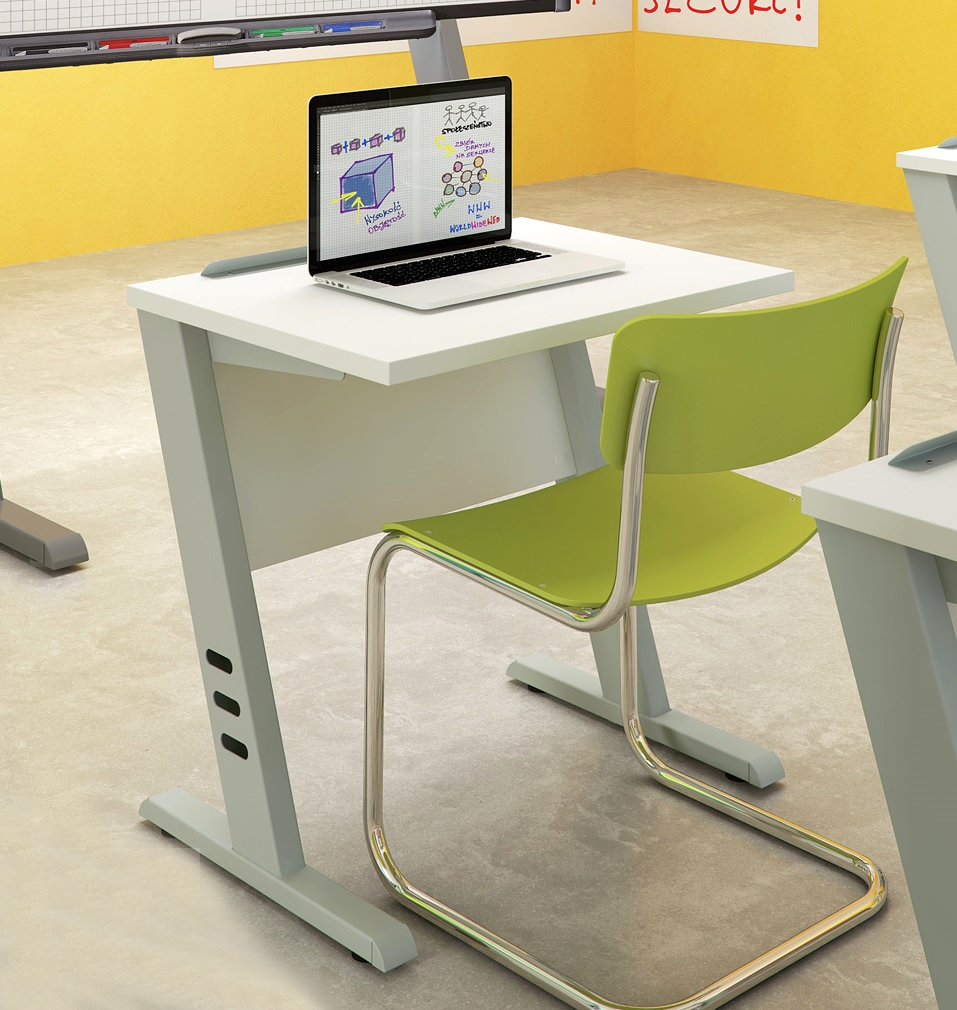
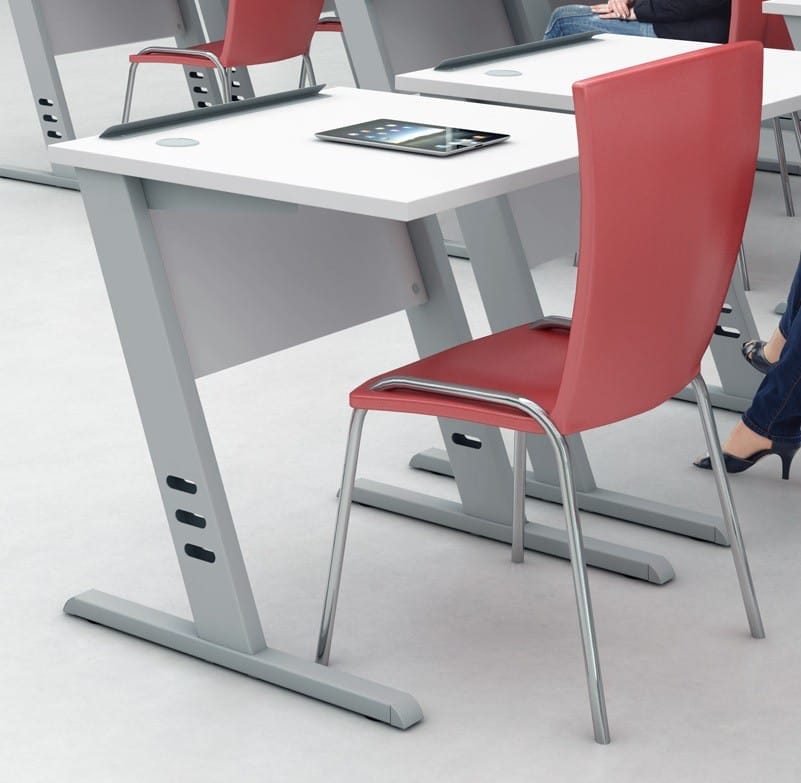
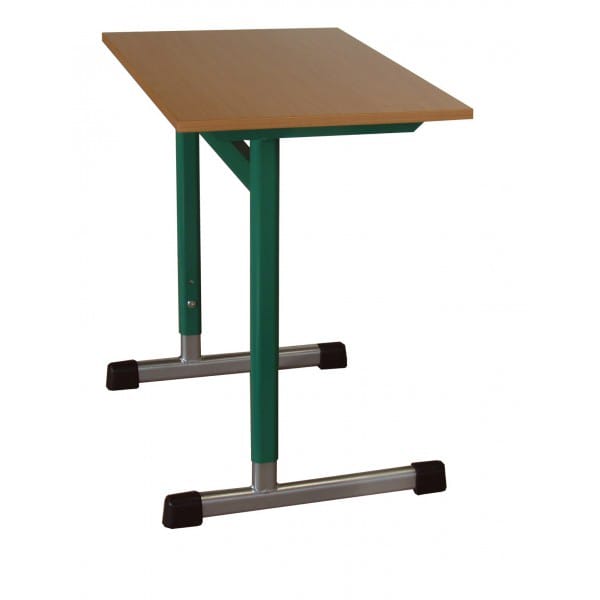
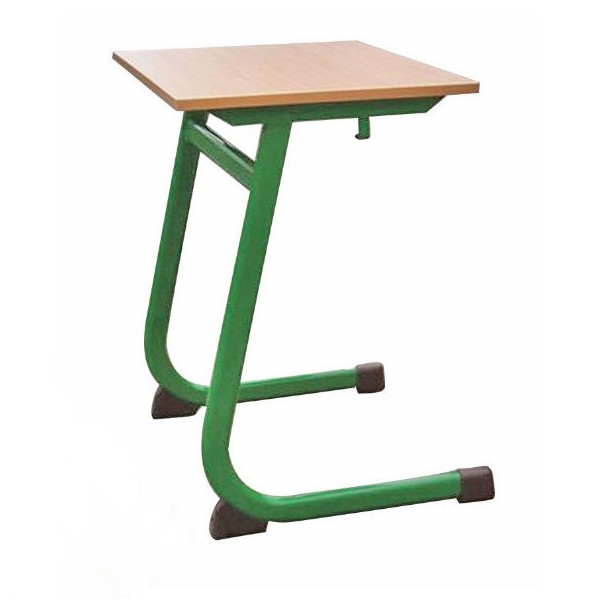
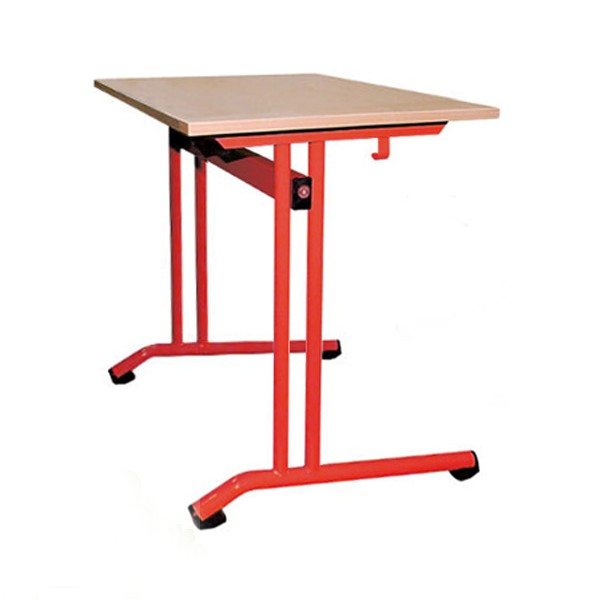
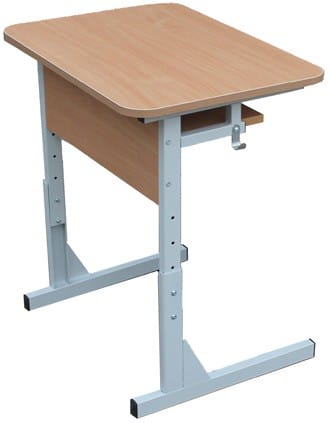
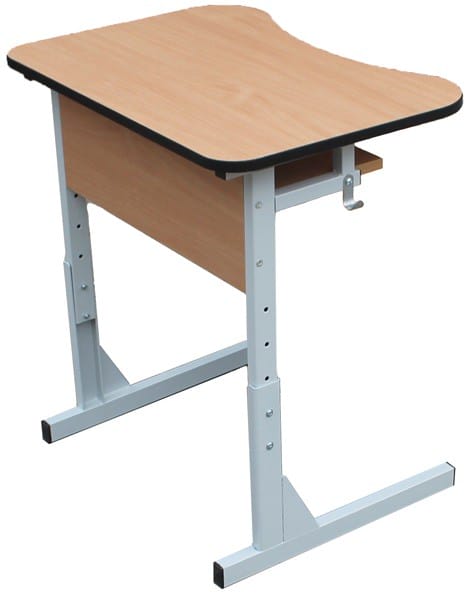
Adjustable school desks adapt to a pupil’s height over several years and are advantageous in classes with mixed ages or fast-growing pupils. Fixed-height desks are a more economical solution for single-age classes with a relatively uniform height range. The choice depends on the composition of the class, the budget and long-term procurement planning.
Adjustable school desks usually have a mechanical or screw-type height adjuster that allows the desk height to be changed over a wide range – depending on the model, approximately from 640 to 740 mm or even more – covering several LVS EN 1729 height groups with a single desk unit. This means an educational institution can purchase fewer different desk models and keep using them as the pupil composition changes from year to year. Fixed-height desks, on the other hand, are manufactured for a specific height that corresponds to one or two adjacent height groups, and schools usually purchase them in sets – several different heights within one classroom, or separately by classroom according to pupils’ age. The main characteristics of both solutions are summarised below:
Criterion | Adjustable desk | Fixed-height desk |
Adaptation to height | Several LVS EN 1729 height groups with a single desk | One or two adjacent height groups |
Service life without replacement | Longer – follows the pupil’s growth over several years | Shorter – replacement must be planned as pupil composition changes |
Initial cost | Usually higher | Usually lower |
Construction | Adjustment mechanism, more moving parts | Simple and stable construction |
Best suited for | Mixed-age classes, fast-growing pupils | Single-age classes with a stable height range |
In practice, many schools combine both solutions – choosing adjustable desks for primary school classes, where pupils’ height changes fastest, and fixed-height desks for secondary school classes with a more stable height range.
The correct school desk height ensures that the pupil sits with a straight back, elbows bent at approximately a 90-degree angle, and feet fully supported on the floor. The LVS EN 1729 standard used in Latvia defines seven height groups for desks and chairs, allowing furniture to be precisely matched to a pupil’s height.
The LVS EN 1729 standard divides school desks and chairs into seven height groups, with each group corresponding to a specific range of pupil height – for example, height groups 3-4 are generally intended for pupils with a height of approximately 119 to 159 cm, while groups 5-6 are for pupils from 146 to 188 cm. Pupils whose height differs by no more than about 10 cm can comfortably sit within the same size group. The height of the desk surface should correspond to the height of a seated pupil’s elbow joint, so that the forearms can rest comfortably on the desk while the back is supported against the chair’s backrest. It is recommended to leave a gap of roughly a hand’s width – about 3-5 cm – between the pupil’s body and the back edge of the desk, to allow free movement and easy standing up. For some desk models, a slight surface tilt, usually within 12-15 degrees, is also useful, as it improves visibility when reading and writing, although horizontal desks are more common nowadays because they are more versatile for a wide range of learning activities. By observing these parameters, an educational institution can be confident that the furniture meets not only visual but also health and safety requirements.
When choosing school desks, first assess the age and height range of the pupils in the class, then the size and layout of the room, and finally the available budget and delivery deadlines. Together, these three factors determine whether adjustable or fixed-height desks will be more advantageous and how many different size models will be needed.
When choosing school desks for an educational institution, it is advisable to take the following criteria into account:
Educational institutions purchasing furniture through public procurement can contact the VVN team to receive a detailed technical specification and an individual offer that meets the requirements and deadlines of the specific procurement.
The optimal height corresponds to the pupil's height range according to the seven height groups of the LVS EN 1729 standard - for example, pupils with a height of 119-159 cm are usually suited to groups 3-4, while pupils from 146 to 188 cm fit groups 5-6. The desk surface height should correspond to the height of a seated pupil's elbow joint.
Yes, adjustable desks often pay off in the long term, as they adapt to the pupil's growth over several years and allow the school to purchase fewer different models. Their initial cost is higher than that of fixed-height desks, but this is often balanced out over their longer service life.
For school conditions, laminated chipboard 16-25 mm thick, which is resistant to scratches and moisture, combined with a powder-coated metal frame, is best suited. Rounded corners and edges further reduce the risk of injury in an active classroom environment.
The warranty period may vary depending on the specific desk model, material and type of construction. When purchasing furniture from VVN, the exact warranty terms and period are stated in the technical specification of each specific offer, so the school can take them into account when planning procurement and its long-term budget.
Yes, VVN provides delivery, assembly and disassembly services in Latvia and the other Baltic states, as well as in Finland, Sweden, Norway and Denmark. This allows schools to receive fully ready furniture without any additional effort from the educational institution's staff.
| Cookie name | Active |
|---|
Uzraksti mums.