
Every day, in the warehouses, production facilities and stockrooms of hundreds of Latvian and Baltic companies, the same process takes place: goods need to move from point A to point B – quickly, safely and without unnecessary losses. This process rarely makes it into a company’s strategic presentations, yet it forms the foundation on which customer service speed, employee safety and, ultimately, company profit all rest. In this article, we look at how correctly chosen warehouse equipment – specifically pallet trucks and pallet stackers – can become a tool that not only makes everyday work easier but also delivers a measurable competitive advantage.
Intralogistics – the movement of goods and materials within a company – is often treated as a given, a secondary function. In reality, it is one of the areas where inefficiency turns fastest into real financial losses.
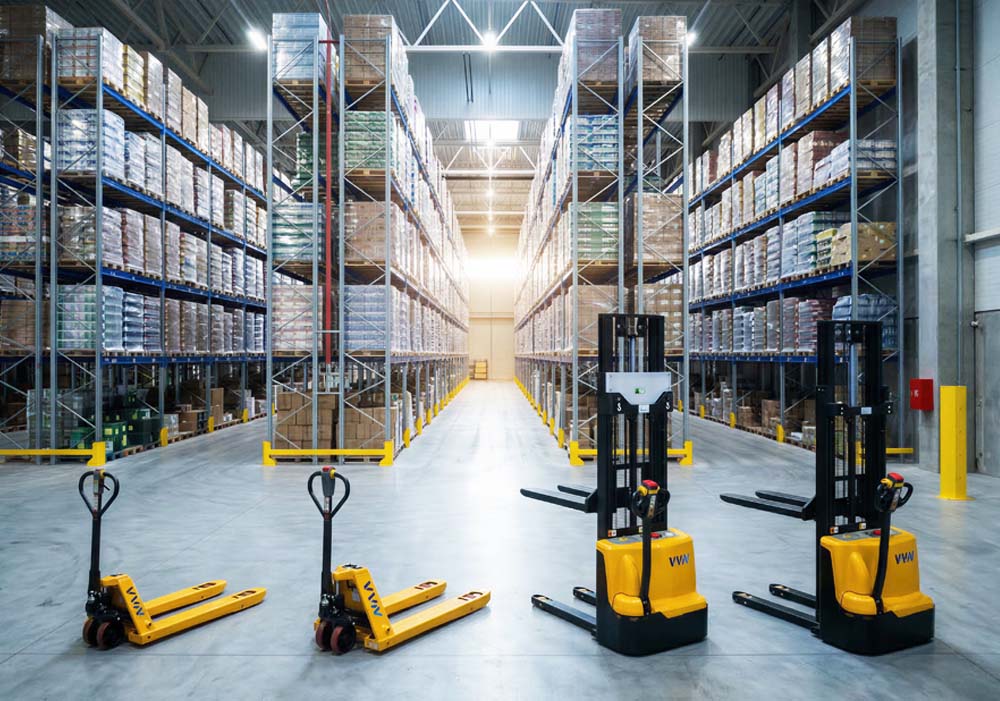
Every minute an employee spends manually pushing an excessively heavy load, or waiting for a colleague to clear a passage, is a minute that isn’t working for the company. Multiply that by dozens of employees and hundreds of working days a year, and it becomes clear why the world’s largest logistics and retail companies invest in intralogistics equipment as carefully as they do in marketing or IT systems.
In today’s market conditions, where supply chains have become longer and more complex while customer expectations demand shorter delivery times and more precise order fulfilment, the ability to move goods around a warehouse quickly and safely determines how competitive a company really is. Pallet trucks and pallet stackers are the category of warehouse equipment that touches literally every stage: goods receiving, shelf placement, order picking and dispatch. These are types of equipment without which it is hard to imagine a functioning warehouse, production facility or hypermarket.
At the same time, it should be acknowledged that choosing warehouse equipment is not a one-size-fits-all matter – what suits one company perfectly may be excessive, or conversely insufficient, for another. That’s why, before purchasing, it’s worth understanding what the different equipment categories offer – from simple manual pallet trucks to fully electric pallet stackers capable of working several metres up. Below we look at each of these categories in detail, based on the product range offered by VVN (SIA “Viss veikaliem un noliktavām”).
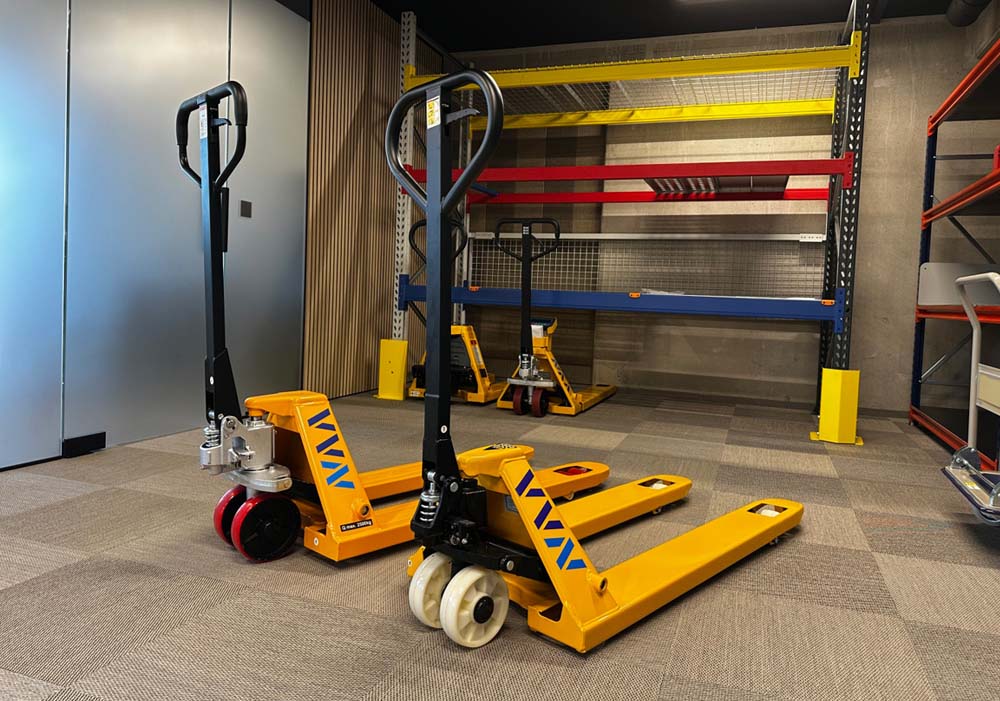
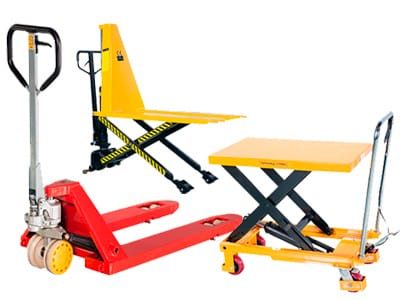
Manual, or hand-pump (mechanical), pallet trucks are one of the longest-proven and most reliable types of warehouse equipment. Their operating principle is simple: a hydraulic pump mechanism, activated by moving the handle, raises the forks a few centimetres, lifting the pallet off the floor and making it movable. Despite this apparent simplicity, it is precisely this category of equipment that handles the majority of everyday load-moving operations in warehouses, shops and production facilities worldwide.
The main advantage of manual pallet trucks is their independence from electricity and batteries – they’re ready to work at any moment, need no charging, and practically never “run out of power” mid-shift. The simplicity of their construction also means low maintenance costs and a long service life – with correct use and upkeep, these trucks can last 7–10 years or more. They are compact, easy to manoeuvre in tight spaces, and suitable for both indoor use and, depending on the wheel material, outdoor conditions.
VVN offers a wide range of manual pallet trucks, allowing every business to find a solution suited exactly to its needs. The MH1, MH2, MH3 and MH4 models are built on a durable alloy-steel frame designed for moving heavy loads in warehouses, production facilities and retail centres:
In addition to the MH series, VVN offers a broad MPT (Manual Pallet Truck) model line – MPT1 to MPT9 – each addressing a specific application need. MPT1, MPT2, MPT5 and MPT7 are classic hand pallet trucks for everyday work with standard EUR pallets (1,200 × 800 mm) and FIN pallets (1,200 × 1,000 mm). The MPT3 model stands out with a built-in weighing display that lets the load weight be read directly during transport – a valuable feature for businesses where weight control is part of the daily process, such as in manufacturing or raw-material tracking. The MPT4 is equipped with a quick-lift pump that reduces the number of handle strokes needed to reach full lift height, speeding up work in situations involving frequent raising and lowering of pallets. The MPT6 is a manual lift table – a somewhat different solution designed for raising loads to a more comfortable working height rather than purely horizontal movement.
Two specialised models deserve particular mention, as they address the needs of specific industries: the VVN MPT8 is a galvanised pallet truck model whose anti-corrosion coating makes it a suitable choice for companies working in damp or outdoor conditions – such as building-materials warehouses or agricultural produce stores. The VVN MPT9, meanwhile, is made of stainless steel and is designed for industries with elevated hygiene requirements – food production, pharmaceuticals, medical equipment handling – where corrosion resistance and easy disinfection are a mandatory requirement rather than an added convenience.
Manual pallet trucks are a smart choice for companies with moderate load turnover, where distances between handling points are relatively short and load lifting is infrequent – mainly just to raise the pallet off the floor. They are also an excellent complement to electric equipment – even in warehouses where electric pallet trucks or stackers handle the bulk of the work, manual trucks often remain a “backup” or auxiliary tool for specific tasks where using electric equipment would be disproportionate. They are also a logical first step for companies that are just starting to organise their intralogistics processes and want to invest cautiously without losing flexibility.
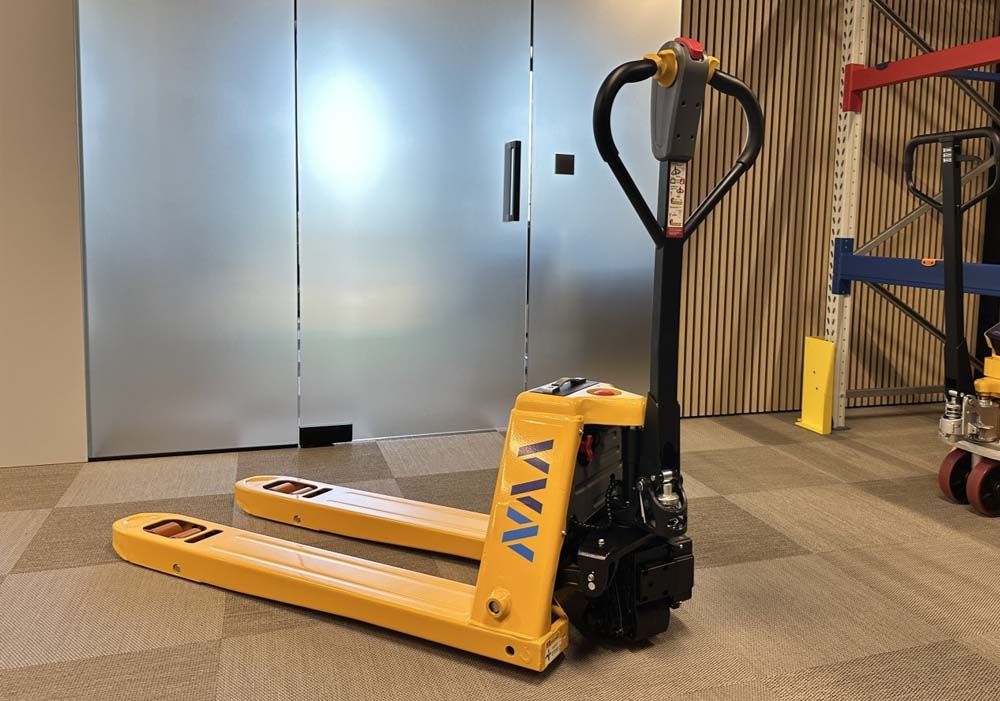
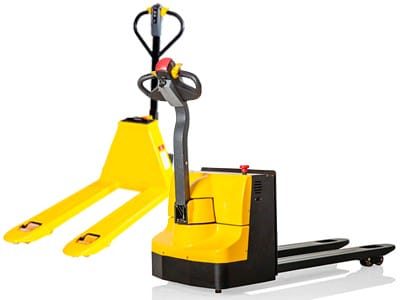
If manual pallet trucks are the reliable foundation, the electric pallet truck is the step that raises that foundation to a new level of efficiency. The electric pallet truck (often also called an electric pallet lifter) uses a battery-powered motor both to move the load and, in many models, to lift it as well, freeing the operator from the physical effort needed to push a heavy load. As a result, a single employee can move considerably larger loads with less fatigue and greater speed than when working with the manual version.
Unlike manual trucks, where transport speed and distance are limited by the operator’s physical capacity, an electric pallet truck allows a steady work pace to be maintained throughout the entire shift. This is especially important in large warehouses, where distances between the goods-receiving area, shelving rows and dispatch gates can add up to hundreds of metres a day per employee. Electric drive also means less strain on the handle mechanism over the long term, which can positively affect the equipment’s service life when it is operated and maintained correctly.
VVN’s electric pallet truck (EPT – Electric Pallet Truck) line offers several models for different warehouse needs. The EPT1 is a basic electric pallet truck designed for EUR pallets and mesh crates in warehouses, loading and unloading ramps, and production areas – an efficient aid for everyday load handling without the need for heavier, more expensive equipment. The EPT3 and EPT4 extend this functionality, offering greater power and durability for companies with more intensive load turnover, where the equipment is used almost continuously throughout the working day.
The EPT5 model deserves particular mention – a semi-electric pallet truck that combines electric transport and/or lifting with a thoughtful safety design. This model is intended for handling large volumes of cargo in hypermarkets, logistics centres, production shops and warehouses, and can be used both as a pallet stacker and as a lifting platform. The EPT5’s hydraulic valve technology provides automatic descent-speed control – the lowering rate stays stable regardless of load weight, preventing potential load damage or hazardous situations. When the forks are lowered to their minimum height, the front support roller and adjustable stabiliser automatically extend to the ground, ensuring optimal stability and braking effectiveness during operation. The ergonomic handle makes everyday work more comfortable and reduces operator fatigue during long shifts.
The switch from manual to electric pallet trucks is often assessed purely through the lens of speed, but its impact on employee health is at least as significant. Regularly pushing and pulling heavy loads is one of the most common causes of back, shoulder and joint strain in warehouse work. Over the long term, such strain increases sick leave, staff turnover and the risk of work-related injuries – costs that often go unnoticed because they don’t appear directly in a company’s profit-and-loss statement, yet affect it indirectly.
An electric pallet truck significantly reduces this strain, since the electric motor takes over most of the physical work. The employee is left with a control and supervisory role rather than heavy physical labour. This means not only a lower risk of injury but also the ability for employees to maintain higher productivity throughout the day, as fatigue builds up more slowly. For companies that take staff retention and wellbeing seriously, introducing an electric pallet truck often proves to be just as compelling an argument as the purely financial benefit of faster load handling.
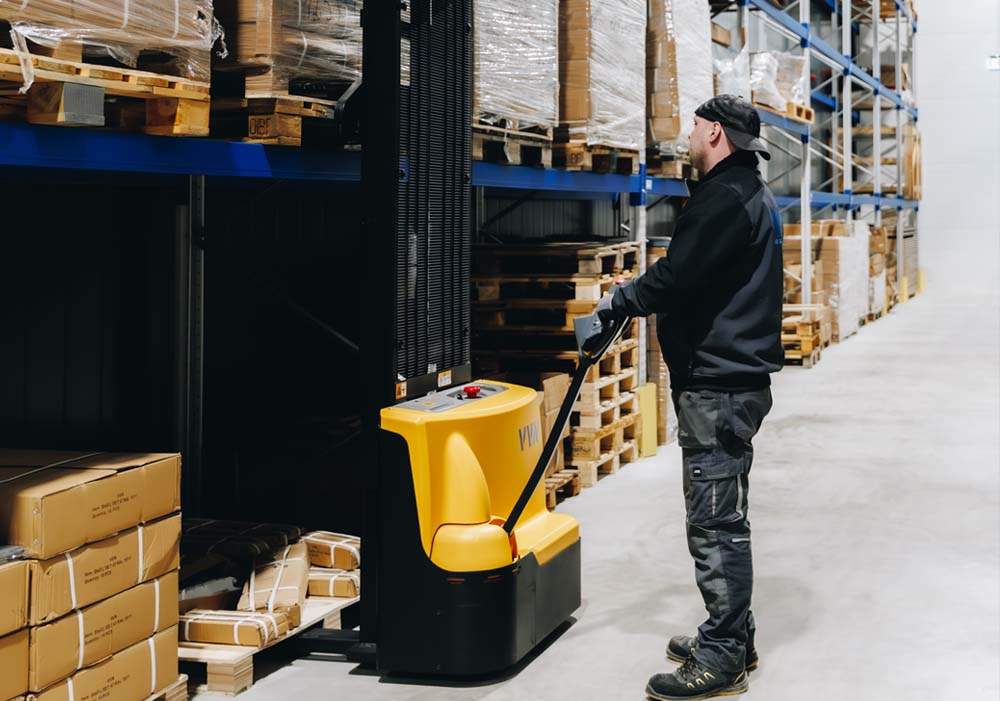
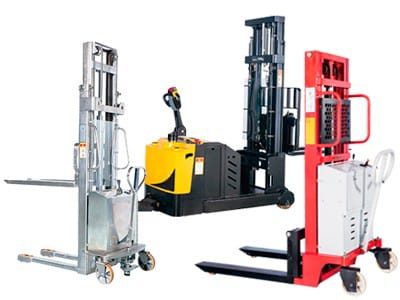
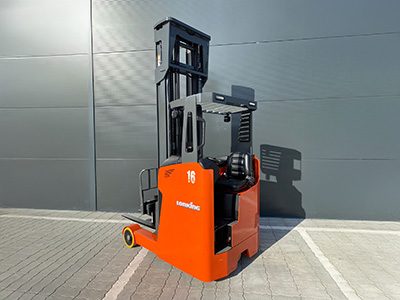
While the main function of pallet trucks and electric pallet trucks is horizontal load movement, pallet stackers address a different task – vertical lifting and placement of loads in shelving systems. This is the equipment category that becomes indispensable once a warehouse starts using multi-tier shelving systems, since floor space is a limited and expensive resource. An electric pallet stacker allows a lifted load to be placed several metres up, letting a company make use not only of floor area but of the warehouse’s vertical space as well.
Compared with forklifts, pallet stackers are typically more compact, easier to manoeuvre in narrow aisles, and cheaper both to buy and to maintain. This makes them the optimal solution for companies that don’t need the full power and outdoor mobility of a forklift but do need to work safely and efficiently with shelving systems indoors.
VVN offers one of the widest ranges of pallet stackers (EPS – Electric Pallet Stacker) on the Baltic market, allowing the choice of equipment to be precisely matched to the required load capacity, lift height and working environment:
This wide model range lets a company choose exactly the load capacity, lift height and construction material that match the real specifics of its warehouse work – rather than overpaying for features that will never be used, or, conversely, buying underpowered equipment that slows down the workflow.
One of the most significant, yet often under-appreciated, benefits of pallet stackers is their ability to optimise the use of warehouse space. Floor space in a warehouse is a limited and expensive resource – especially in cities or logistics centres with high rent per square metre. A pallet stacker solves this problem vertically: by moving from using one or two shelving tiers to three, four or more, a company can multiply its storage capacity without increasing the footprint of the warehouse building.
In practice, this means that investing in a pallet stacker is often significantly cheaper than expanding a warehouse or renting new premises, while also delivering additional benefits – faster access to goods, a clearer shelf-labelling system and an easier stock-taking process. For companies planning growth but not wanting to invest immediately in new premises, an electric pallet stacker often becomes one of the most cost-effective ways to gain additional storage capacity in the short and medium term.
Given how wide the range is across manual pallet trucks, electric pallet trucks and pallet stackers alike, the natural question arises: how do you choose exactly what a specific company needs? In practice, the right choice rests on several interrelated factors.
The first and most important question is: how heavy are the typical loads, and how often do they need to be moved? A company with small, irregular load turnover often finds manual pallet trucks sufficient, such as VVN’s MH1 or MPT-series models. If load volume and handling frequency increase, an electric pallet truck – such as the EPT1, or the more powerful EPT5 – significantly reduces time and physical effort. If, on the other hand, a warehouse uses multi-tier shelving systems and loads need to be lifted several metres up, the need for a pallet stacker – from the compact EPS 1 or EPS 8 to the more powerful EPS 10, EPS 13 or EPS 19 models – becomes clear.
The second important factor is the working environment in which the equipment will be used. In damp or outdoor spaces, such as building-materials warehouses, it’s advisable to choose galvanised models, such as the VVN MPT8, which resist corrosion. In industries with elevated hygiene requirements – food production, pharmaceuticals, medical and veterinary fields – stainless-steel models, such as the MPT9 or EPS 26, are an almost mandatory choice, as they’re easy to clean, resistant to disinfectants and don’t corrode in damp conditions. Floor surface also matters: smooth, sensitive floors are better suited to polyurethane wheels, while rougher industrial floors call for more durable nylon wheels.
Finally, the available budget significantly influences the choice, but it’s worth viewing not just as an initial purchase price but as a long-term investment. Manual pallet trucks require the smallest initial outlay and practically zero running costs, but they don’t deliver the time and labour savings that electric equipment provides. Electric pallet trucks and stackers require a larger initial investment, but often pay for themselves within a few years through a faster workflow, reduced employee fatigue and a lower injury risk. A practical recommendation is to start with an analysis of real everyday work processes – how often, how heavy and how far loads are moved, and how many employees carry out this work – and then, in consultation with industry specialists, choose equipment that matches actual, rather than theoretical, need.
Warehouse equipment – from simple, reliable manual pallet trucks to powerful electric pallet stackers working several metres up – is far more than just equipment. It is infrastructure that determines, day in and day out, how quickly your company can serve customers, how safely your employees work, and how efficiently every part of your warehouse space is used. The right equipment – whether that’s the VVN MH1 series of manual pallet trucks for everyday work, the EPT5 electric pallet truck for intensive load handling, or the EPS 19 pallet stacker for working with multi-tier shelving systems – pays off not only financially, but also in terms of employee wellbeing and company reputation.
VVN (SIA “Viss veikaliem un noliktavām”) offers one of the widest ranges of warehouse equipment on the Baltic and Scandinavian markets – from basic manual pallet trucks to specialised stainless-steel and galvanised models, from semi-electric pallet trucks to powerful pallet stackers for working at height. Our specialists are ready to help assess your company’s real needs – load volume, lift height, working environment and budget – and to offer exactly the solution that will bring the greatest benefit to your everyday work.
Don’t put off improving your company’s efficiency until later. Contact VVN’s specialists today, or visit vvn.lv to explore the full product range and receive a tailor-made offer suited exactly to the specifics of your warehouse or production facility. The right investment in warehouse equipment is an investment that works for you every working day.
| Cookie name | Active |
|---|
Uzraksti mums.