
The modern retail landscape is changing faster than ever before. Shoppers expect shelves to be fully stocked at all times, the product range to be broad, and service to be prompt. At the same time, businesses face rising labour costs, increasing rental prices, and the need to make the most of every square metre. Integrated shelving systems are the solution that turns these challenges into advantages – combining warehouse logistics and retail display in a single, intelligent structure.
In this article, we take a detailed look at what integrated shelving systems are, why they are becoming the standard solution in modern retail businesses, how to choose between NX and NR systems, what the actual ROI looks like, and why VVN is the most trusted partner for this type of project in Latvia.
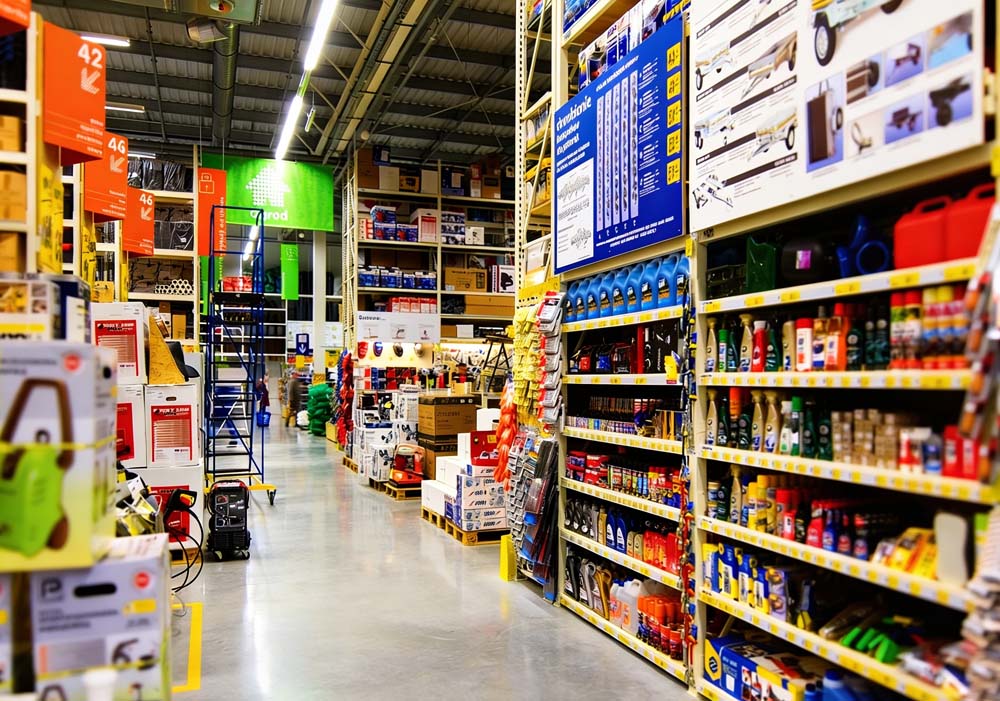
To fully understand the concept of integrated shelving systems, it is worth starting with the traditional model and its shortcomings.
In the classic retail model, there is a clear physical and logical boundary between the warehouse and the sales floor. Goods are received, sorted, and stored in the warehouse. Employees then regularly – often several times a day – transport products: using warehouse trolleys, forklifts, or manual pallet trucks, they move boxes and pallets from the warehouse to the retail shelves. Each such journey takes time, consumes human resources, and creates potential risks – product damage, misplacement, and inventory errors.
The integrated shelving system overturns this paradigm. It is a multi-level structure in which:
As a result, the warehouse and the store become a single unified system. Stock replenishment happens vertically – from top to bottom – rather than horizontally through separate rooms. A forklift operator places a full pallet at the upper level, and the bottom level visible to customers is automatically ready for replenishment without lengthy transport routes.
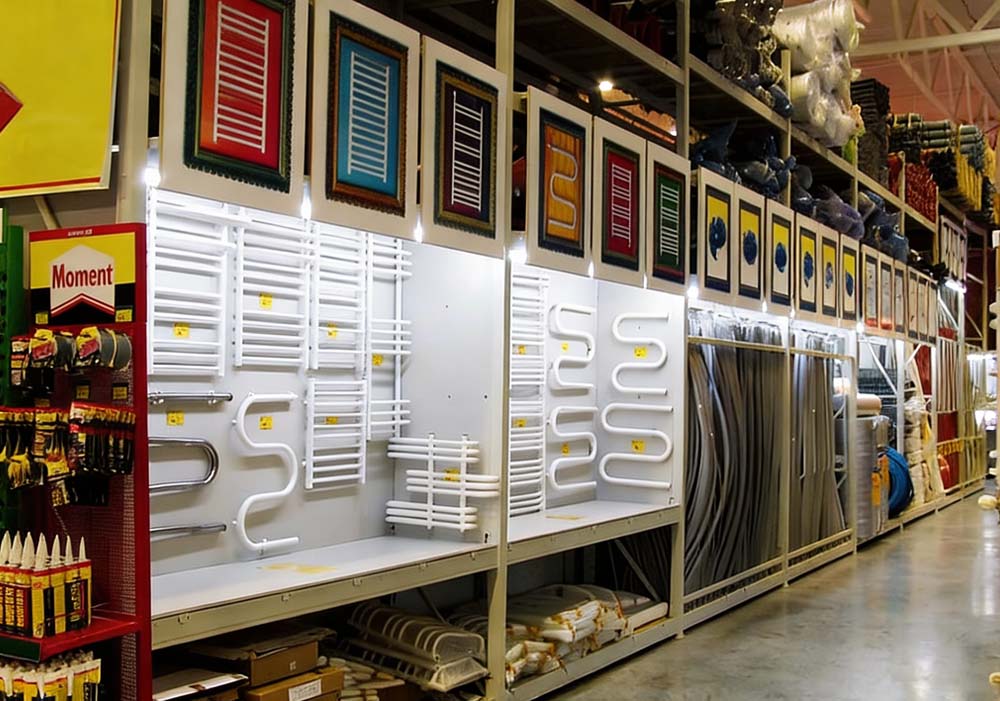
The world’s leading retailers – from IKEA to Leroy Merlin – have long since adopted this principle in their large-format stores. In Latvia and the Baltic region, this model is spreading rapidly in DIY stores, building material centres, food supermarkets, and even specialised retailers.
The reasons are both economic and practical. Land and buildings are expensive – paying for separate warehouse space that could be used more efficiently is financially unjustifiable. Labour costs are rising – every saved work process directly affects profit margins. Customer expectations are growing – empty shelves mean lost sales and dissatisfied customers.
Before examining specific products, it is important to understand that integrated shelving systems are not a one-size-fits-all product with a single standard configuration. They are designed individually, taking several variables into account.
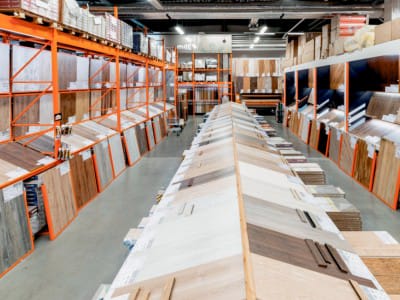
In this model, one and the same shelving row serves both retail (at the bottom) and storage (at the top). This is the classic solution for DIY stores and supermarkets with high ceilings (at least 5–6 metres).
In certain cases, integration is achieved horizontally: the rear zone is equipped with heavy pallet racking for stock, while the front features lighter retail display structures. A transition system between the two zones optimises the flow of goods.
The most advanced solutions combine both approaches – a tall vertical rack with retail and storage levels, complemented by a horizontal “storage zone” for faster-moving goods.
VVN offers two main shelving system series that are optimal for integrated solutions. Choosing between them is one of the most important decisions in the project planning phase.
Parameter | NX Shelving System | NR Shelving System |
Load per bay | Up to 4,000–6,000 kg | Up to 1,500–2,500 kg |
Max. height | Up to 12 m | Up to 8 m |
Upright profile | Heavy-duty C/Z profile, thicker wall gauge | Standard C profile |
Beam pitch | Adjustable in 50 mm increments | Adjustable in 50 mm increments |
Suited for | Pallets, heavy boxes, building materials, metal products | Packaged goods, electronics, textiles, food products |
Typical clients | DIY stores, builders’ merchants, automotive parts, logistics | Supermarkets, drugstores, household goods, retail |
Integration potential | ✅ High – ideal for full warehouse + store integration | ✅ Good – best for pure retail with limited buffer stock |
Forklift requirement | Required from 4 m height | Required from 3.5 m height |
Safety requirements | EN 15512, mandatory floor anchoring, structural calculation | EN 15512, standard anchoring |
Aesthetic design | Industrial, robust, functional | Cleaner appearance, better suited to pure retail environments |
Colour options | Orange/black, grey, or RAL on request | Blue/grey or RAL on request |
Service life | 20+ years with proper use | 15–20 years with proper use |
Additional accessories | Wire mesh decks, wooden boards, plastic dividers, safety nets | Wire mesh decks, wooden boards, wire baskets, label holders |
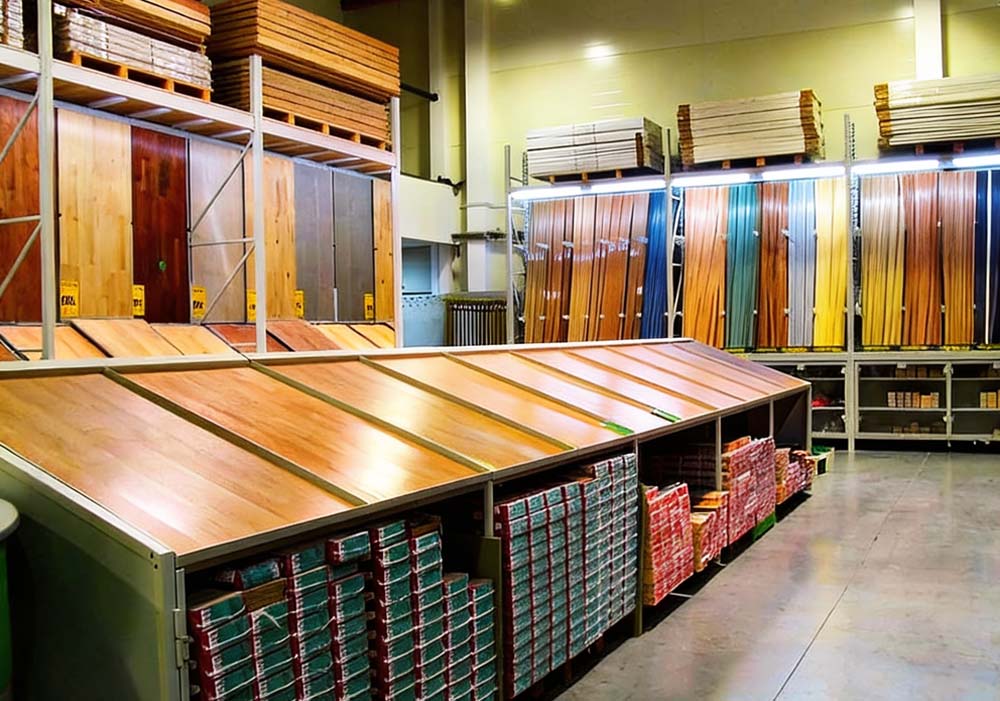
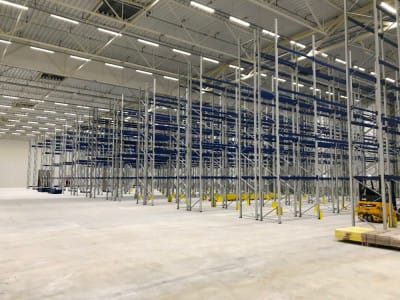
The NX system is the right choice if your business handles heavy products – building materials, tools, metal goods, large-format items, or full pallets. Its high load capacity and robust construction mean that NX can serve as a fully functional warehouse on the upper levels while simultaneously providing retail display space at the bottom.
If you plan to use the full height of your premises – above 6–8 metres – NX is the only safe choice that complies with safety standards at such load levels.
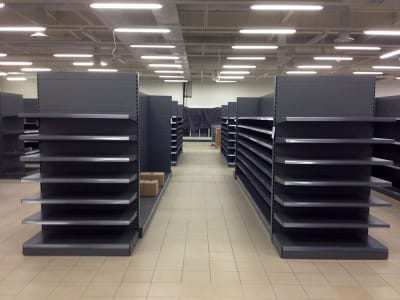
The NR system is optimal for supermarkets, drugstores, electronics retailers, and any business whose product range consists primarily of lighter goods with loads of up to 2,500 kg per bay. NR provides better visual appeal in a retail environment – it looks “cleaner” and more contemporary, which matters when shelving is in the direct line of sight of shoppers.
To illustrate the real-world impact of an integrated system, let us examine a detailed case study reflecting a typical VVN client profile.
Imagine a regional DIY store with the following parameters:
Following a VVN expert site visit and a needs assessment, a project was developed with the following parameters:
Project investment: approximately EUR 38,000 (system + installation + lighting + floor markings).
Monthly savings + additional revenue: ~EUR 6,000–7,000.
Full return on investment: 6–7 months.
The world of retail and logistics is moving towards greater efficiency, lower resource consumption, and smarter use of space. Integrated shelving systems are not a trend – they are a logical response to real business challenges: rising costs, space shortages, and growing customer expectations.
Businesses that invest in this infrastructure today gain a competitive advantage that pays back many times over. A store where shelves are always stocked, staff work efficiently, and space is used to its full potential is not only more profitable – it also delivers a better experience for every customer.
Book Your Free Expert Site Visit Today
Let a VVN specialist assess your premises and prepare a tailored solution. The visit is free of charge, with no obligation – you will receive specific recommendations and calculations for your business.
Why wait? Every month without an integrated system is a month of unnecessary costs.
Projects are implemented throughout Latvia. Consultation – free of charge. The decision – is yours.
| Cookie name | Active |
|---|
Uzraksti mums.