
In a warehouse, every second counts – and when you need to move 200 pallets in a single day, even a seemingly minor equipment difference becomes a real competitive advantage. The MPT4 hydraulic pallet truck with quick-lift pump changes the game: not through electronic complexity, but through a simple, measurable improvement whose impact is felt from the very first day of work.
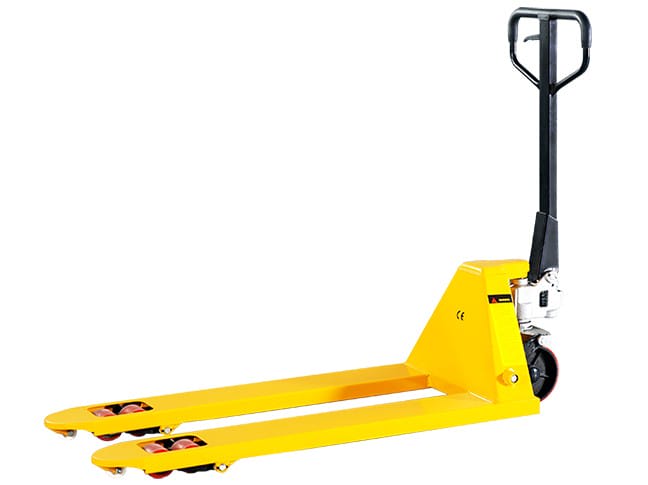
Hydraulic pallet trucks – also commonly known as pallet jacks – are manually operated warehouse equipment that uses a hydraulic pump to lift pallets and ensure safe load handling. The MPT4 with quick-lift pump reaches working height in just 3 pump strokes, compared to approximately 13 strokes for a standard pallet truck – delivering up to 3× faster lifting and significantly less physical strain on the operator. A load capacity of up to 3,000 kg, fork dimensions suited to standard European pallets, and the option to choose wheel material for different floor types make the MPT4 an adaptable solution for both small warehouses and large logistics centres.
You get a better offer?
Hydraulic pallet trucks are manually operated warehouse equipment that uses a closed hydraulic system to lift pallets and move them safely – without electricity, without complex electronics, without charging downtime. They are the most widely used type of warehouse equipment in Latvia and worldwide: straightforward to operate, reliable, and economical.
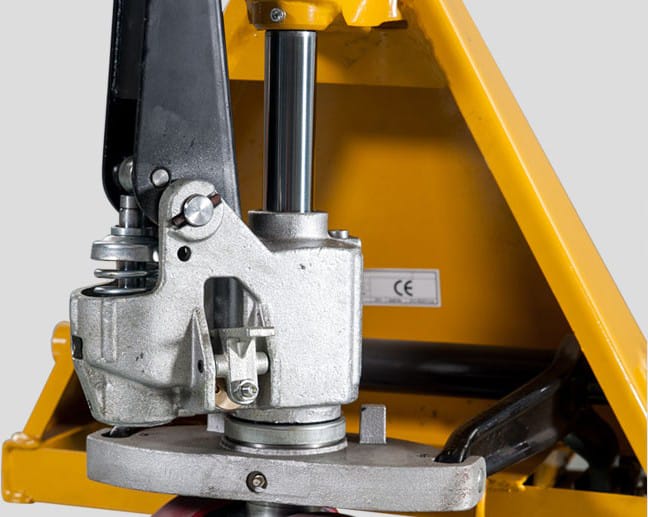
Hydraulic pallet trucks are based on Pascal’s law: the pressure generated by the pump is transmitted uniformly to the hydraulic cylinder through a closed oil system. The operator works the handle up and down – each stroke cycle pumps oil and builds pressure. The cylinder raises the forks together with the pallet. To lower the load, the control lever on the handle opens the release valve: pressure drops, oil returns to the reservoir, and the forks descend smoothly.
The system contains no electronic components – which means fewer possible failures and simpler maintenance.
The MPT4 quick-lift pump reaches full working height in just 3 handle strokes – a standard pallet truck requires approximately 13 strokes to reach the same height. This difference directly affects three critical warehouse efficiency metrics: working speed, operator fatigue, and overall throughput per shift.
Numbers speak more precisely than general claims. Suppose one operator handles 200 pallets per day:
Parameter | Standard pallet truck | MPT4 with quick-lift pump |
Pump strokes per pallet | ~13 | 3 |
Total strokes for 200 pallets | 2,600 | 600 |
Approximate time to lift one pallet | ~10 sec. | ~3 sec. |
Total lifting time per day | ~33 min. | ~10 min. |
Time saved per day | – | ~23 min. |
Time saved per month (22 working days) | – | ~8.5 hours |
8.5 hours per month – that’s nearly a full working day that the operator gains and can dedicate to order picking, organising, and other productive tasks.
The cumulative strain from repetitive hand and shoulder movements is one of the most common causes of musculoskeletal injuries among warehouse workers. By reducing the number of pump strokes from 2,600 to 600 per day, the load on joints and the shoulder girdle decreases by approximately 77%. This directly affects:
The MPT4 is not just a faster tool – it is an ergonomic solution whose benefits are felt both individually and in the company’s financial statements.
The MPT4’s specifications are precisely suited to standard European warehouse conditions: a fork width of 540 mm and length of 1,150 mm match the EPAL European pallet (1,200 × 800 mm), and a load capacity of up to 3,000 kg covers the majority of industrial loads.
Parameter | Specification |
Load capacity | 2,500 kg or 3,000 kg (depending on model) |
Fork length | 1,150 mm |
Width of single fork | 160 mm |
Total fork width | 540 mm |
Minimum lifting height | 85 mm |
Maximum lifting height | 205 mm |
Quick-lift pump | Yes – full lift in 3 strokes |
Wheel material | Nylon / polyurethane / rubber (optional) |
Wheel configuration | Single pair or tandem configuration |
Frame material | Steel with protective coating |
CE certification | Yes |
Model / year | MPT4, 2025 |
Weight | Please confirm with a VVN consultant |
Warranty | In accordance with VVN warranty terms |
Other fork sizes and configurations are also available to meet specific requirements. Contact VVN to learn about the full range of models.
Choosing the right hydraulic pallet truck comes down to four criteria: load weight, floor type, aisle width, and working environment. The cheapest model is often not the most economical – the wrong choice leads to faster equipment wear, higher maintenance costs, and lower productivity.
Determine your average and maximum load weight. If pallets weigh up to 1,500 kg, a 2,500 kg model provides a good safety margin. If you regularly handle heavier goods – beverages, metal, building materials – opt for the 3,000 kg variant. For intensive load handling (more than 100 pallets per shift), the MPT4 quick-lift pump shifts from being a convenience to a production necessity.
The floor type directly determines the most appropriate wheel material. The wrong wheel type causes unnecessary noise, increased rolling resistance, and damages the flooring or the truck itself:
The MPT4’s total fork width of 540 mm fits the majority of typical warehouse aisles. In narrower aisles (less than 1.5 m), also pay attention to the handle turning radius – it determines how compact the turning circle is. If you regularly work with non-standard pallets or special platforms, a VVN consultant can suggest alternative fork sizes.
Wheel material is one of the most important configuration choices for the MPT4, as it directly determines operating noise, rolling resistance, floor protection, and overall service life.
Wheel type | Advantages | Disadvantages | Ideal application |
Nylon wheels | Low rolling resistance; good wear resistance; easy to clean | Louder on hard floors; less cushioning | Smooth, dry concrete; heavy loads |
Polyurethane wheels | Quiet operation; protects floors; good grip | Slightly higher rolling resistance | Logistics centres; retail spaces; sensitive flooring |
Rubber wheels | Best cushioning; quiet on uneven surfaces | Faster wear under constant heavy loads | Outdoor areas; ramps; worn flooring |
Single pair of wheels | Simple construction; economical solution | Less stable on ramps and uneven surfaces | Standard warehouses with smooth floors |
Tandem (double) wheels | Better load distribution; easier to navigate ramps and uneven surfaces | Slightly higher price | Intensive work; ramps; uneven surfaces |
MPT4 hydraulic pallet trucks comply with CE marking requirements and are manufactured in accordance with EU Machinery Directive 2006/42/EC. The CE mark is not merely a label – it is confirmation that the product has been tested, risk-assessed, and meets the mandatory European Union safety and quality requirements.
Latvian occupational safety law and EU legislation require that all work equipment used in EU member states must be CE-compliant. For the warehouse operator, this means three practical guarantees:
Additional safety requirements for manual industrial trucks are defined by standard EN ISO 3691-1, which specifies hydraulic, mechanical, and stability requirements. By purchasing CE-certified hydraulic pallet trucks, you know these requirements have been met.
CE certification ensures a safe product – safe operation is ensured by the operator. Key guidelines:
With regular maintenance, high-quality hydraulic pallet trucks last 10–15 years or more – even under intensive daily use across multiple shifts. The MPT4 is designed with a minimal-maintenance principle, but small, systematic checks significantly extend its service life and prevent costly emergency repairs.
Recommended maintenance schedule:
Frequency | Action |
Every shift | Visual inspection: forks, frame, wheels, signs of oil leakage |
Weekly | Check wheel wear; unusual noises or vibration |
Monthly | Check hydraulic pump operation (smooth lift, no leaks); lubricate moving parts |
Annually | Check hydraulic oil level and quality; full technical inspection |
Most common operating errors:
Delayed maintenance – a minor leak becomes a full pump replacement.
VVN is a Baltic and Northern European warehouse equipment specialist with market experience spanning more than seven countries – meaning every product selection is based on real customer projects across diverse working conditions, not just catalogue descriptions.
Key reasons why Latvian warehouses choose VVN:
Hydraulic pallet trucks - also known as pallet jacks - are manually operated warehouse equipment that uses a hydraulic pump to lift pallets and move loads at low height. By operating the handle, the operator builds pressure in the hydraulic system, which raises the forks together with the pallet. They are the most widely used type of warehouse equipment in Latvia - simple, reliable, and suited to both small warehouses and large logistics centres.
The MPT4 quick-lift pump reaches working height in just 3 handle strokes - a standard pallet truck requires approximately 13 strokes for the same lift. With 200 pallets per day, this difference means 2,000 fewer strokes and a time saving of approximately 23 minutes per day. Over a month, that amounts to around 8.5 additional productive working hours.
The MPT4 is available in two variants: 2,500 kg and 3,000 kg load capacity, depending on the selected model. Both versions cover the majority of standard warehouse loads. When choosing a model, consider not only the average load weight but also the maximum anticipated weight - with a small safety margin above it.
Nylon wheels are the best choice for a smooth, dry concrete floor - they offer the lowest rolling resistance and a long service life. If the warehouse has tiled flooring or quiet operation is a priority, polyurethane wheels are the better option, as they run more quietly and protect the surface. A tandem configuration is recommended if the warehouse has ramps or uneven surfaces.
Yes. The MPT4 complies with CE marking requirements in accordance with EU Machinery Directive 2006/42/EC and the industrial truck safety standard EN ISO 3691-1. The CE mark confirms that the product has been tested, risk-assessed, and meets EU safety, health, and environmental requirements - a mandatory condition for any warehouse equipment in EU member states.
Manual hydraulic pallet trucks such as the MPT4 rely on the operator’s physical effort and a hydraulic pump - they are simple, inexpensive to purchase, require no charging, and are easier to maintain. Electric pallet trucks use an electric motor, which substantially reduces physical strain and increases productivity in very high-intensity warehouses, but come at a higher purchase price, require regular battery charging, and involve more complex maintenance. The MPT4 with its quick-lift pump represents a practical middle ground - significantly faster than a standard pallet truck, but without the cost and complexity of electric models.
High-quality hydraulic pallet trucks with regular maintenance - weekly visual inspections, monthly hydraulic checks, and proper lubrication - last 10–15 years or more. The main causes of premature wear are exceeding load capacity, inappropriate wheel material, and delayed maintenance. The MPT4’s steel frame and reliable hydraulic pump are designed for intensive daily use across multiple shifts.
Manual hydraulic pallet trucks do not require mandatory government certification in Latvia, unlike electric or elevated-load vehicles. However, under the Occupational Safety and Health Law, employers are obliged to provide workers with instruction on the basic principles of safe operation: maximum load capacity, correct load placement on the forks, and appropriate floor type. VVN can provide operating instructions and guidance materials upon request.
| Cookie name | Active |
|---|
Uzraksti mums.