
Imagine your warehouse suddenly becoming twice as large – not physically with new walls, but through one clever engineering solution. This is exactly what a mezzanine promises – a steel intermediate floor platform that utilizes every unused cubic meter above your head. And it’s not just a promise; there are hundreds of installed projects across the Baltics and beyond where, after mezzanine installation, companies have actually doubled or even tripled their usable area without investing in new construction or renting additional space. In this article, we will explore what a two-story mezzanine means in practice, based on real projects implemented in Latvia and Scandinavia, VVN’s technical experience of over 10 years, and an honest look at the strengths and weaknesses in various conditions.
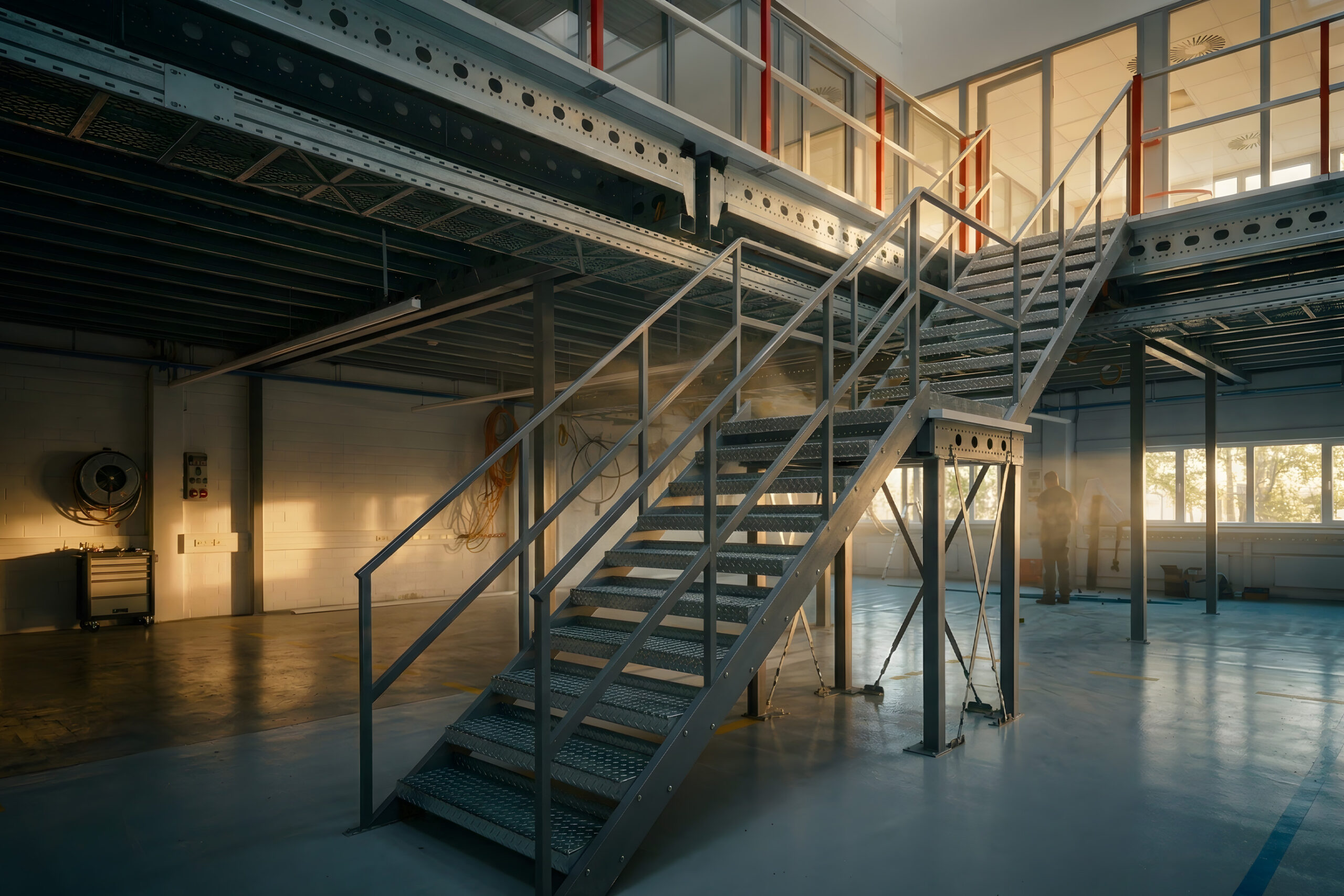
The word “mezzanine” comes from the Italian “mezzano” – middle. In the logistics world, it refers to a steel or combined structure installed within existing premises, creating a new working or storage level above the first floor. This is not a new idea – two-story warehouses have existed for centuries. However, the advantage of modern mezzanines lies in their modularity, quick installation, and CE certification, allowing for high-quality projects without capital construction work. In Latvia, a typical warehouse is 6 to 8 meters high. Goods are mostly stored only at a height of 2–3 meters, meaning that on average 50–70% of warehouse cubic space remains unused. A mezzanine fundamentally changes this situation: with one additional floor, 80–100% additional space is immediately gained – without reconstruction, without new walls, and in many cases, without building permits.
VVN, the leading supplier of warehouse equipment in Latvia, confirms in its projects that mezzanines can increase usable area by 100–200%. This is an engineering-based calculation, evidenced by dozens of projects completed in Latvia, Norway, Finland, Sweden, and Denmark.
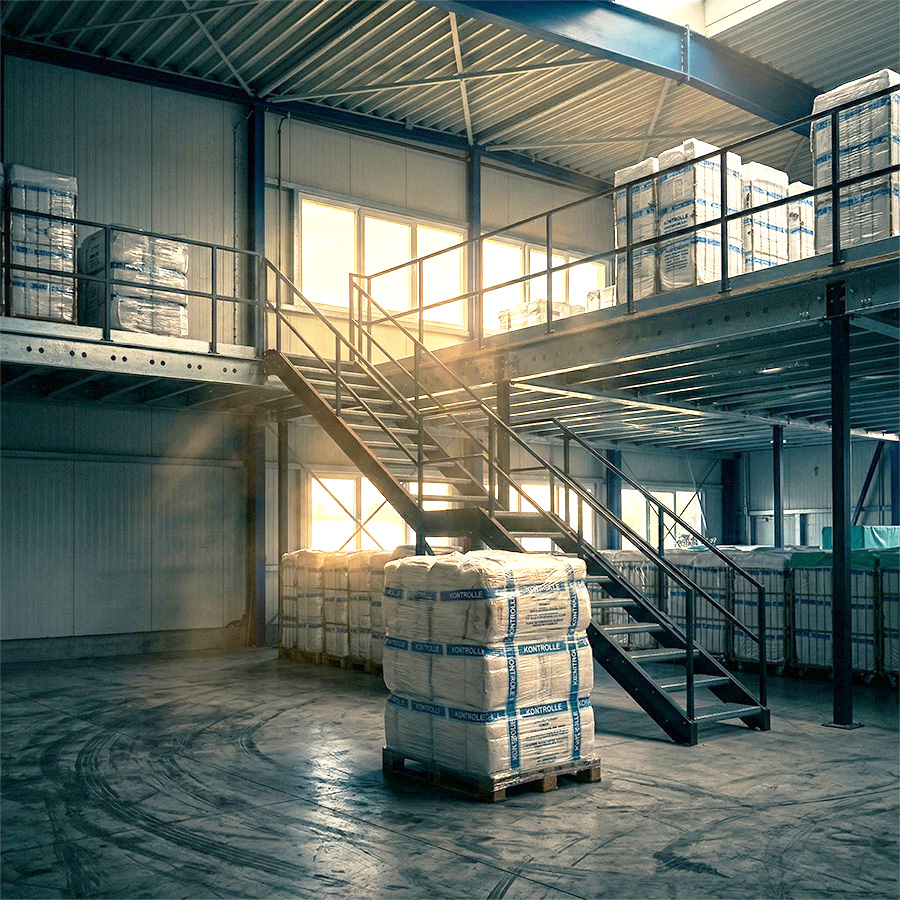
To understand why some mezzanines cost less while others offer greater flexibility, one must know that there are three fundamentally different structural approaches.
This is the classic form: an autonomous steel structure with its own load-bearing columns that stands completely independent of the warehouse walls or shelving systems. The columns support a beam system upon which the floor covering – chipboard, steel grating, or plywood – is laid. Suitable for large spaces where complete flexibility of use is required, especially in situations where storage needs may change in the future and the mezzanine might need to be dismantled or relocated.
VVN’s free-standing mezzanines can reach widths of up to 16 meters without center support columns – an excellent indicator that ensures wide, unobstructed work zones underneath.
Advantage: absolute independence from other systems, easier future reorganization.
Weak point: higher costs compared to integrated solutions, as a full load-bearing system is required from scratch.
In these projects, the existing pallet racking structure also serves as the load-bearing element for the mezzanine. The platform floor is built between the rows of racks, creating an additional storage or picking level without the need to purchase a new load-bearing system.
Suitable for companies that already have pallet racks installed and want to increase capacity with minimal investment.
Advantage: more cost-effective, faster to implement.
Weak point: limited flexibility – if the pallet racking system is changed in the future, the mezzanine may need to be rebuilt.
A specific solution where the mezzanine floor is directly built into the pallet racking structure, combining high-level storage with easy access on both levels. This solution is popular in compact warehouses where every square meter is particularly valuable.
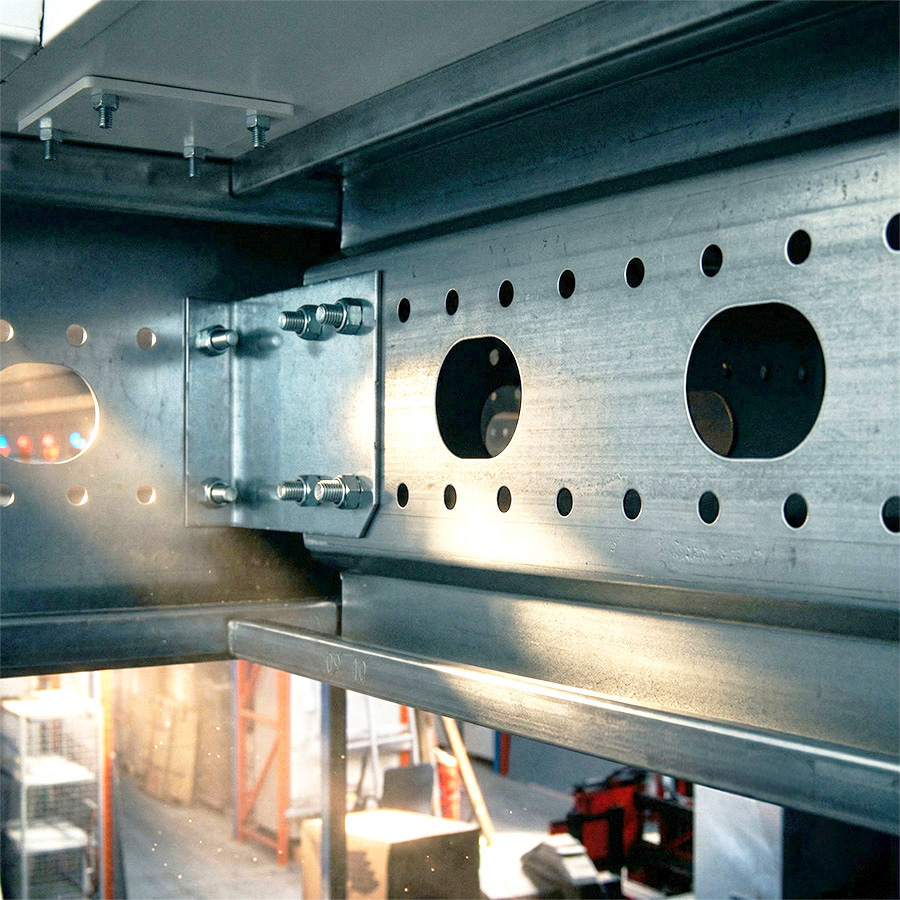
The quality of a mezzanine is determined not just by the floor covering, but by the engineering precision of the entire steel skeleton. VVN uses three main types of cold-rolled profiles.
A universal choice for medium to heavy loads. These profiles combine excellent stiffness properties with material efficiency. VVN offers C-profiles from 180 mm to 350 mm in height, with thicknesses from 1.5 mm to 4 mm. They are ideal for standard configurations where regular traffic of vehicles or pedestrians and medium storage loads are expected.
The unique omega shape ensures the maximum stiffness-to-weight ratio – these profiles are applicable for large spans or particularly heavy loads. Sigma profiles from 250 mm to 360 mm in height are available, allowing for larger support intervals without adding extra columns. Practical advantage: fewer columns on the lower floor means freer movement for forklifts.
Double-laminated beams for extreme loads and particularly large spans. VVN offers I-profiles from 80 mm to 550 mm in height, with steel thicknesses from 1.5 mm to 5 mm. These profiles are used in projects where heavy equipment or production lines are intended to be placed on the mezzanine. All VVN metal profiles are made of S235JR or S355JR quality steel, are galvanized or powder-coated against corrosion, and calculated with a 2.5–3.0 safety factor. Each structure complies with EN 1090 and EN 15512 standards and bears the CE mark.
| Floor Type | Max. Load | Fire Resistance | Best Application |
| Chipboard (18–25 mm) | 1500 kg/m² | Class E | Light or medium load, office, archive |
| Galvanized steel grating (30–40 mm) | 2500 kg/m² | Class A1 | Ventilation, sprinkler systems, heavy goods |
| Premium plywood (21–27 mm) | 3500 kg/m² | Class D | Maximum durability, high-intensity retail |
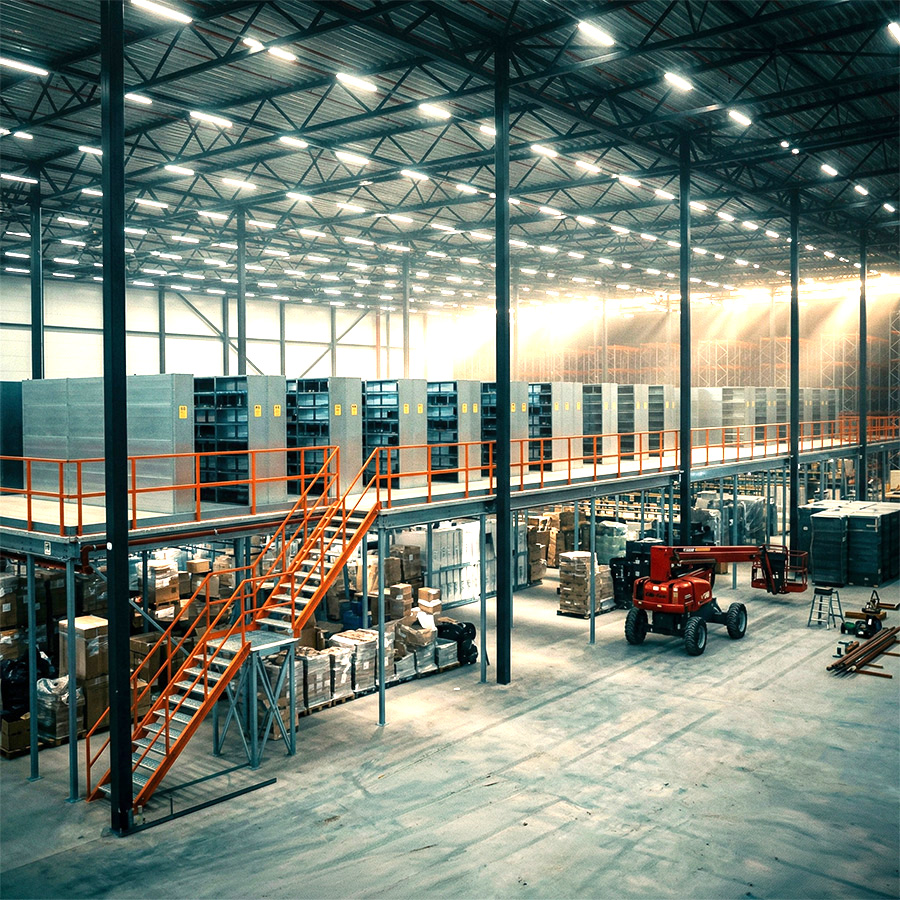
The mezzanine was designed to optimize the picking of high-turnover goods using a two-level logistics scheme: pallet storage with forklift access below, and a picking zone with metal shelving systems above. Result: operational efficiency increased by 40%.
A two-story warehouse with a mezzanine. Pallets are placed on the first floor for forklift movement, while metal shelving structures are installed on the second floor. This project demonstrates that for industrial companies, a two-story solution is not just extra storage space, but a fundamental logistics restructuring tool.
Scandinavian companies with high safety standards and strict occupational safety requirements choose VVN as a reliable partner. Mezzanines for the Scandinavian market face particularly high demands: full CE compliance, precise static calculation documentation, and strict operational safety.
Climatic conditions in Finland demand extra durability and corrosion protection. VVN’s galvanized and powder-coated profiles ensure long-term durability even in high humidity and temperature fluctuations. In Finland’s fast-growing e-commerce sector, mezzanines with steel grating floors provide load resistance, fire safety, and ventilation – critical factors in high-intensity workspaces.
A combination common in small and medium warehouses where the product range includes both large, heavy pallet items and smaller, lighter goods stored on manual shelves.
Fact: A 1000 m² warehouse with 7-meter height can gain an additional 800–900 m² of usable area by installing a single-level mezzanine. That’s approximately 80–90%, approaching the promised 100%.
Nuance: 100% gain is only possible if the mezzanine covers the entire warehouse area. Additionally, columns on the lower floor occupy some space, so the actual gain is slightly less than theoretically calculated.
Fact: VVN data confirms that installing a mezzanine costs significantly less than building new premises in Latvia.
Nuance: Costs may be higher in complex projects with heavy loads or non-standard configurations.
Fact: If annual warehouse rent is a significant sum, and the mezzanine investment is substantially less than long-term rental expenses, a payback period of 2–4 years is completely realistic.
– High space efficiency in logistics and fulfillment centers: Faster order processing, less employee movement, and more organized flow.
– Efficiency for industrial companies: Mezzanines solve the chronic problem of storing raw materials and finished products near production lines.
– Retail efficiency: Mezzanines are used in back-office storage areas for seasonal goods and slow-turnover assortments.
– International experience: VVN projects in Scandinavia confirm that mezzanines work excellently even in the strictest safety and building standard environments.
– Ceiling height requirements: At least 5–6 meters are needed for a standard two-story mezzanine.
– Floor load-bearing capacity: Mezzanine columns create concentrated loads. Older warehouses may require floor reinforcement.
– Heating and ventilation: Warm air rises, so it can be hotter on the upper level. Planning climate systems is essential.
– Fire safety and evacuation: Installation changes the fire safety plan; updated sprinklers and evacuation routes are necessary.
– Lighting: A mezzanine partially blocks natural light; additional LED lighting is a standard requirement.
– Forklift restrictions: Columns can limit forklift maneuvering; wide-span designs (up to 16m) help minimize this.
A two-story mezzanine is an excellent choice when space is high enough, the floor can withstand the load, and you need to significantly increase capacity without new real estate investments. VVN’s systems – with CE certification, loads up to 3500 kg/m², and spans up to 16 meters – offer a proven path from space shortage to space abundance. Real projects from ELVI Logistics to warehouses in Tampere and Oslo prove that this is a documented and practically tested solution that has helped hundreds of companies double their productivity without renting extra square meters.



| Cookie name | Active |
|---|
Uzraksti mums.