
The checkout zone is the heart of every store – it is the final point of contact between the customer and the business before the purchase is complete. A well-chosen checkout counter not only speeds up the service process but also projects a professional image, reduces cashier fatigue, and improves customer satisfaction. The market offers a wide range of options, and the decision of whether to purchase a checkout counter with or without a conveyor belt is one of the most important choices a store owner or manager will face during the equipment-planning phase.
This article examines both solutions in detail, analyses various commercial scenarios, and provides practical recommendations to help you make an informed decision – whether you are planning to open a small convenience store, a mid-sized grocery store, or a large self-service retail centre.
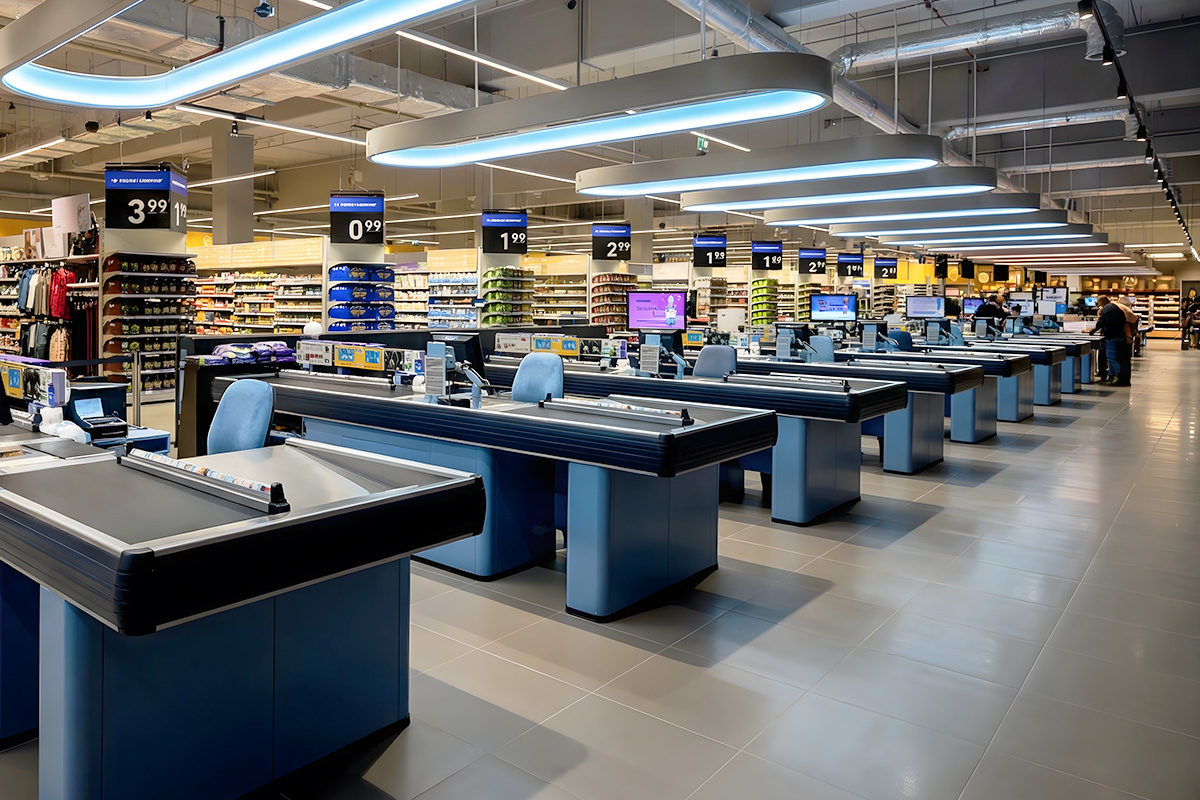
Many store owners believe that investments should be directed primarily toward shelving, display areas, and advertising, while a simpler solution is sufficient for the checkout area. This is a mistaken assumption. Research shows that customers evaluate their in-store experience as a whole, and long queues at the checkout or a slow pace of service can undermine even the most favourable impression formed while browsing the aisles.
Furthermore, the ergonomics of the cashier’s workstation directly affects employee productivity and long-term health. An unsuitable checkout counter – one that is too low, too narrow, or lacking appropriate accessories – can lead to back and joint problems, increase sick-leave frequency, and slow down service speed. Professional checkout equipment is therefore not merely a matter of comfort: it is an investment in the long-term, sustainable operation of the business.
VVN (SIA “Viss veikaliem un noliktavām”) is one of the leading manufacturers and suppliers of store and warehouse equipment in the Baltic states and Scandinavia, with an extensive partner network across Europe. The company offers a complete range of checkout-zone solutions – from checkout counters themselves to additional shelving for payment areas, entrance zones, and self-checkout tills – enabling any store to create a unified, functional, and aesthetically appealing retail space.
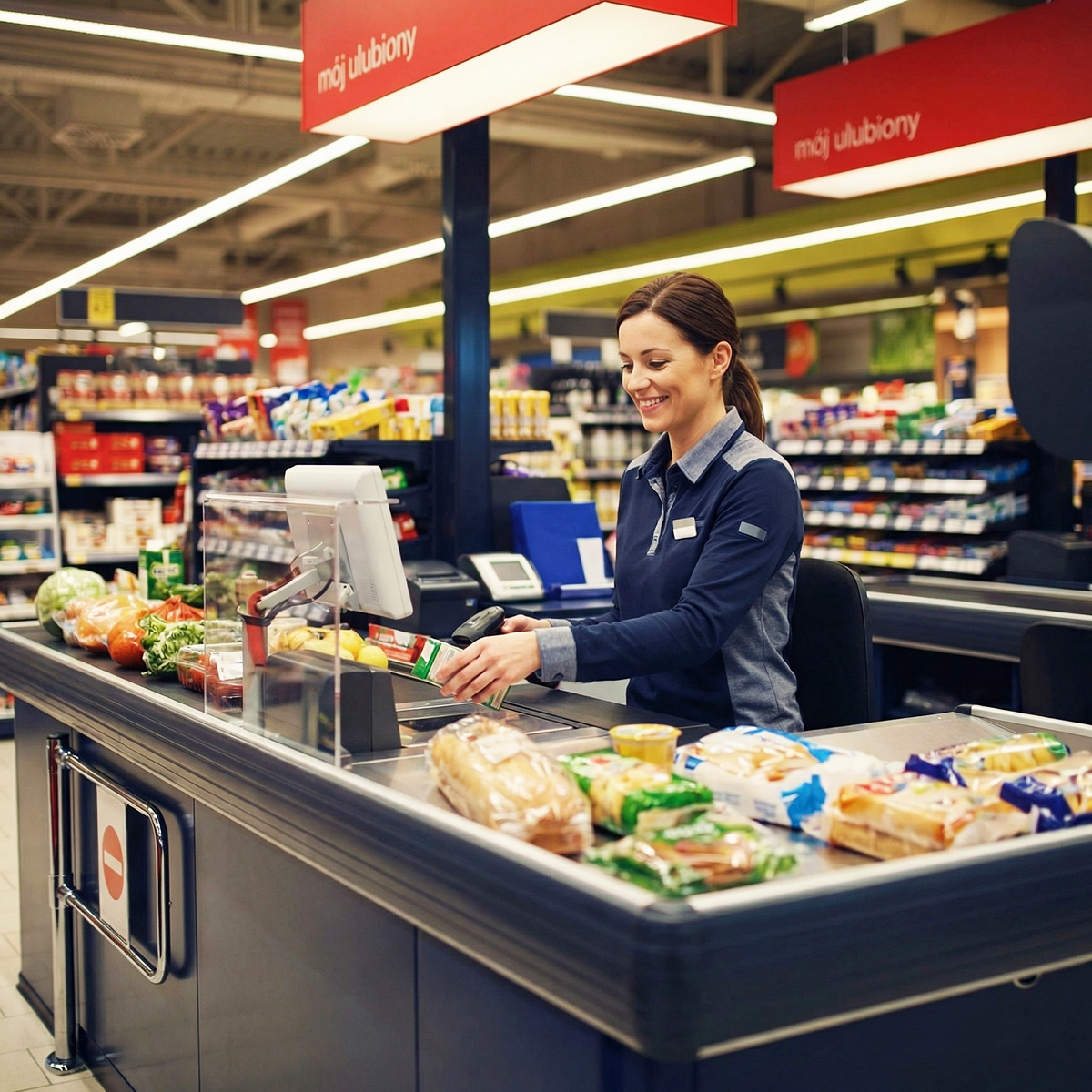
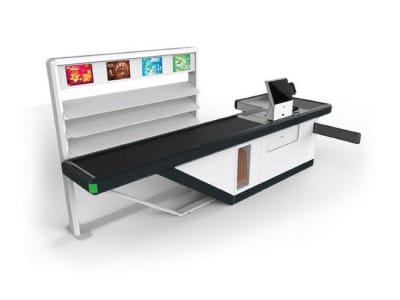
A checkout counter with a conveyor belt is the classic solution most commonly seen in large grocery stores and hypermarkets. The conveyor belt is a motorised sliding strip onto which the customer places items from their trolley or basket. The belt moves forward automatically, or under the cashier’s control, delivering the goods to the scanning zone.
VVN offers the MSG series of checkout counters with conveyor belts – the most modern checkout counter line, characterised by contemporary design and high-quality materials: aluminium and next-generation plastics. MSG checkout counters are available in more than 100 colours, giving store designers and owners extensive possibilities for coordinating the checkout zone with the rest of the interior.
The overall length of MSG-series counters ranges from 1,800 mm to 4,200 mm (14 different sizes), offering very broad configuration options. Each size is available in two conveyor-width variants – MSG-100 (wider belt) and MSG-050 (narrower belt) – as well as colour options BL (light) and BK (dark).
For example:
In addition to the MSG series, VVN offers the KSG series of checkout counters with conveyor belts, distinguished by their modular principle. KSG-line counters make it easy to configure the cashier’s workstation and adapt it to the layout of the space and individual requirements.
To simplify selection, VVN offers six standard spatial-layout variants: KSG-100, KSG-200, KSG-300, KSG-400, KSG-500, and KSG-600. Variants KSG-100, KSG-200, KSG-400, and KSG-600 can serve as independent, fully functional workstations, while KSG-300 and KSG-500 are intended primarily for forming checkout-counter sets – so-called ‘tandem’-type systems.
It is important to note that the only mandatory KSG base element is the cashier’s desk itself. All other components – including the conveyor belt, display stands, small-goods racks, and other accessories – are add-on elements that can be attached or removed as needed. This flexible approach means that the same KSG base can be used both with and without a conveyor belt.
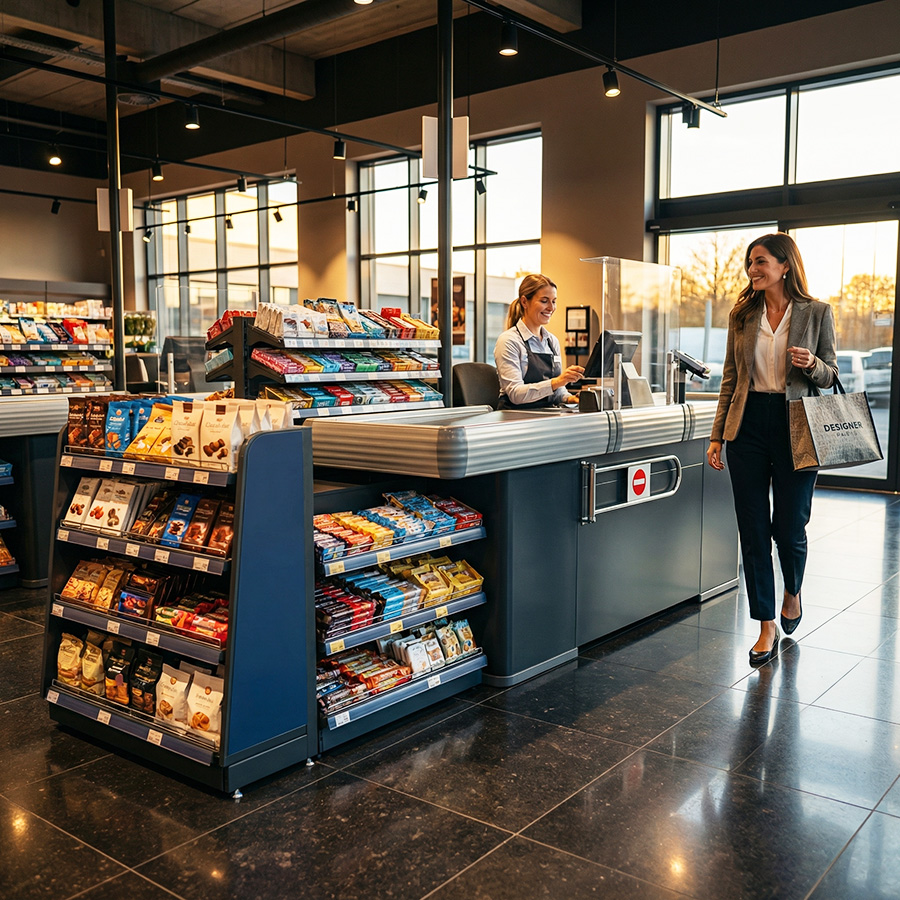
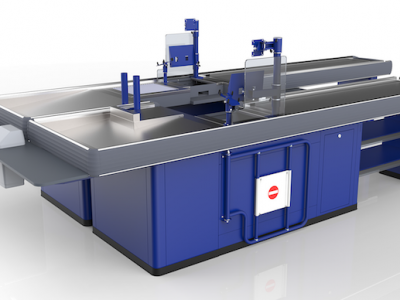
A checkout counter without a conveyor belt is a simpler construction – a cashier’s workstation with a product-placement surface onto which the customer places items directly on the countertop. The cashier picks them up, scans them, and moves them to the bagging area.
VVN offers this solution in a dedicated product category – ‘Checkout Counters Without a Conveyor Belt’ – intended primarily for smaller stores or specific commercial scenarios where a conveyor is not required.
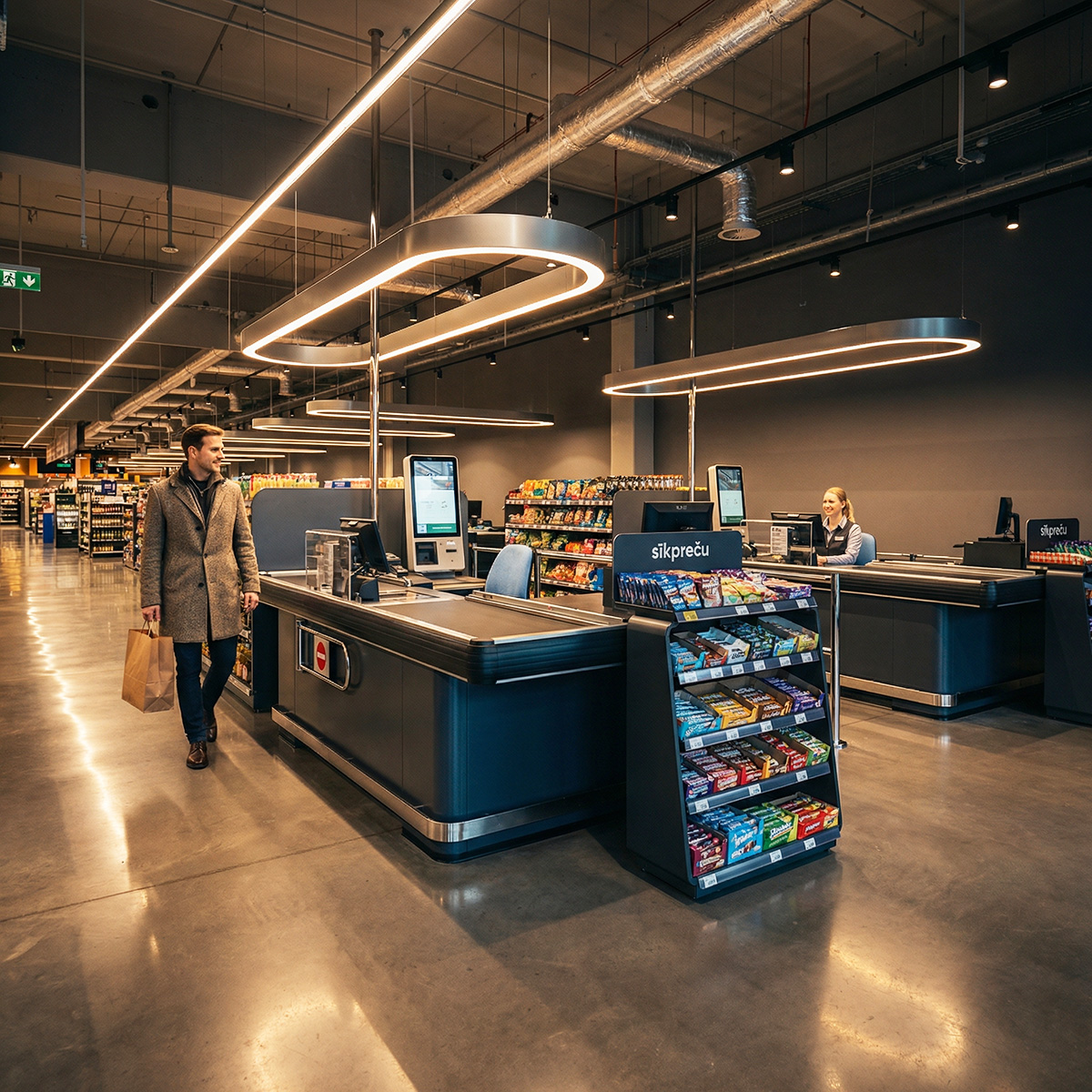
Situation: A small neighbourhood store with a floor area of 80–200 m², selling mainly food and everyday necessities. Customer flow is moderate, and the average purchase contains 5–15 items.
Recommendation: In this case, a checkout counter without a conveyor belt is a sufficient solution. The shopping volume is small enough for the cashier to manage without automatic item movement. It is more important to invest in a quality countertop material and the correct ergonomic height.
VVN KSG-series modular counters are an ideal solution in this context – they allow the workstation to be configured to match the room dimensions and the cashier’s needs, with the addition of extra shelves for small items or display elements for impulse purchases.
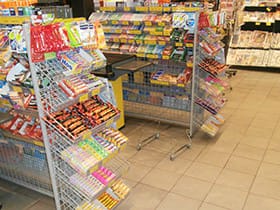
Additional recommendation: Choose VVN’s supplementary shelving for payment areas and small-goods racks near the checkout to increase the likelihood of impulse purchases.
Situation: A medium-sized store with a regular customer flow. Shoppers purchase an average of 10–25 items, frequently using trolleys. The busiest times are weekday evenings and weekends.
Recommendation: This is a classic case in which a checkout counter with a conveyor belt is a justified investment. The belt would significantly speed up the service process during peak hours and reduce the cashier’s physical workload.
VVN MSG-series counters with lengths of 2,200–3,000 mm and a conveyor belt would be the optimal solution. The aluminium and next-generation plastic construction ensures durability and ease of cleaning – important factors in food retail.
Consider also a ‘tandem’-type system: two KSG-300 or KSG-500 counters together form a compact yet productive checkout set that allows two cashiers to work with minimal use of space.
Situation: Retail floor space exceeds 800 m², large purchases frequently contain 30–80 items, and customer flow is intense throughout the day. Queues can be lengthy at weekends.
Recommendation: Here, checkout counters with a conveyor belt are a mandatory standard, not a matter of choice. The recommended counter length is 3,200–4,200 mm, providing sufficient space for the customer’s bagging area, the scanning zone, and placement of already-paid goods.
VVN’s largest MSG-series models – for example, the MSG-100BL229 or MSG-100BK229 – with an overall length of 4,000–4,200 mm are ideally suited to this format. It is also worth considering VVN’s self-checkout tills as a complement to traditional checkouts, to reduce queues and give customers a choice.
Important: also invest in quality entrance-zone equipment (VVN offers appropriate solutions) and trolley systems to ensure a smooth retail process from entrance to checkout.
Situation: A specialist store where the average purchase contains 1–5 items, but their value can be high. Customer flow is lower than in a grocery store, but the quality of each transaction matters.
Recommendation: A checkout counter without a conveyor belt is the optimal solution. In specialised stores, the cashier’s work is far more complex – it may be necessary to enter prices manually, process returns, issue warranty certificates, or gift-wrap items. A conveyor belt in this context is not only unnecessary but can create awkwardness and hinder the cashier’s workflow.
VVN checkout counters without a conveyor belt, equipped with appropriate accessories – such as a raised customer display screen, a cashier display stand, and additional shelves for receipts and carrier bags – will create a professional and efficient cashier workstation. Choose a size that fits the space: VVN’s smallest KSG-series models (KSG-100 or KSG-200) are ideal for this format.
Situation: A fast-food restaurant or café where the customer typically orders and pays without physically placing goods on the checkout counter.
Recommendation: In this case, a conveyor belt is not required. It is more important to equip the payment zone with quality display screens, payment terminals, and a compact checkout counter. VVN’s payment-zone solutions and compact checkout counters are the ideal choice for this segment.
Situation: A store where the cashier must check customers’ identification documents, handle alcoholic beverages, high-value goods, or cigarettes.
Recommendation: This situation often calls for specialist cashier workstation equipment – a raised cashier platform, protective glazing (for example, to mitigate robbery risk), and dedicated racks for restricted goods. VVN offers cigarette display stands and other specialist accessories that can be integrated with both conveyor-belt and standard checkout counters.
Criterion | With Conveyor Belt | Without Conveyor Belt |
Upfront cost | Higher | Lower |
Maintenance cost | Moderate (mechanism) | Low |
Service speed | Significantly faster | Sufficient for small volumes |
Cashier ergonomics | Excellent | Good (for less intensive work) |
Best-suited format | Large grocery stores | Boutique and specialist stores |
Space requirement | Larger area needed | More compact |
Design / colours | 100+ colours (MSG) | Wide range |
Modular solution option | KSG – highly flexible | High |
Suitable for self-checkout flow | Integrable | Less relevant |
Before choosing a checkout counter, clarify the precise dimensions of the space. A checkout counter with a conveyor belt requires not only a greater zone length but also a wider aisle for customer flow. The VVN MSG-series model at 4,200 mm in length (with available extensions) demands careful planning. Involve an architect or interior designer at the planning stage.
Target audience and shopping habits. Conduct an analysis: what is the average transaction value in your store? How many items does the average customer buy? Do your customers more often use baskets or trolleys? If the answers point to a small number of items (fewer than 10), a conveyor belt is most likely unnecessary. If customers regularly purchase more than 15–20 items, a conveyor belt is a justified investment.
Consider long-term costs. A cashier working with unsuitable equipment tires more quickly, takes more sick leave, and ultimately requires additional training or higher wages. Investment in a quality checkout counter – for example, in the VVN KSG or MSG series – quickly pays for itself through higher cashier productivity and lower staff turnover.
Today’s checkout counters must be designed with a forward-looking perspective – with the ability to integrate POS terminals, customer-facing screens, contactless payment devices, and even loyalty-programme scanners. The range of accessories for the VVN KSG series is very extensive, and if a particular add-on is not found in the catalogue, VVN can design it individually to the client’s requirements.
If your store’s customer flow varies sharply – increasing threefold during the season, for example – consider VVN’s modular solutions, which allow checkout capacity to be rapidly expanded or reduced. The KSG-300 and KSG-500 variants are specifically designed for tandem systems, making it easy to add an extra checkout workstation during peak periods.
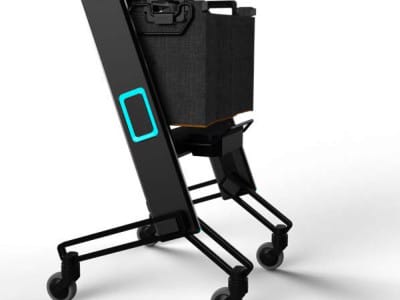
In closing, it is worth noting the market trend that is rapidly becoming a reality in many Baltic stores: self-checkout tills and hybrid solutions. In this area, VVN offers both fixed self-checkout tills and mobile ones – innovative solutions that allow a store to operate with fewer staff while simultaneously improving the speed of customer service.
These solutions are not merely replacements for checkout counters – they change the store’s entire operating model. Fewer staff at the checkouts means lower personnel costs; for the customer, it means shorter queuing times. However, self-checkout tills require additional investment in software, equipment, and staff training, making them most suitable for medium- and large-format stores with sufficient customer flow.
An interesting compromise is the hybrid solution – some checkouts staffed by cashiers (with or without a conveyor belt) and some self-service. Such a combination accommodates different types of shoppers: those who prefer personal service and those who wish to pay more quickly for small purchases.
A correctly chosen checkout counter is an investment that pays dividends for years – in improved customer satisfaction, cashier productivity, and the store’s overall efficiency. VVN’s extensive product range – from MSG and KSG-series checkout counters with conveyor belts to compact beltless solutions, from self-checkout tills to complete checkout-zone complexes – ensures that every store, regardless of format and budget, can find the solution that suits it best.
| Cookie name | Active |
|---|
Uzraksti mums.