
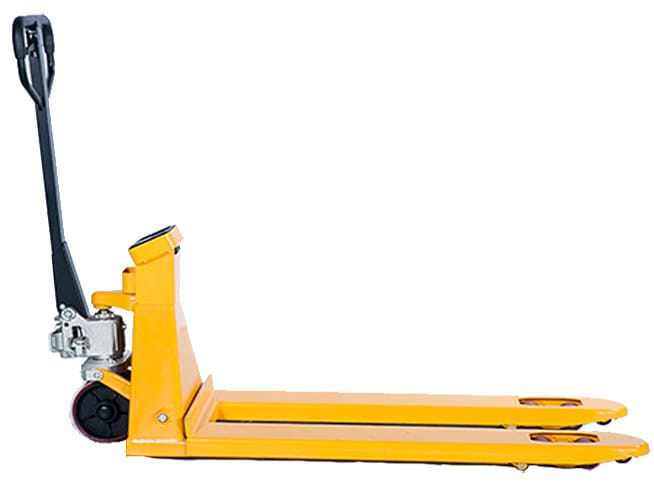
MPT3 pallet trucks with scales are a professional solution for warehouses and manufacturing facilities that need to move and accurately weigh loads of up to 2,500 kg in a single operation, without the use of separate weighing equipment. This mechanical pallet jack with built-in scales combines full hand truck functionality with high-precision weighing technology, significantly accelerating daily operations and reducing the risk of errors in stock records. You get a 2-in-1 solution – a pallet truck with integrated scales and a digital display showing the weight in real time, directly at the pallet.
For warehouse managers, the biggest challenge is often not a lack of equipment, but the excessive time and errors that arise when moving loads between different work zones and separate weighing stations. With MPT3 pallet trucks featuring a digital display and printer, you eliminate this extra step: the operator weighs the pallet exactly where it is lifted or received. As a result, the need for additional equipment is reduced, inventory tracking improves, and load data is always available exactly where it is needed.
The unique selling point of this model is its high weighing accuracy of ±0.05%, mechanical simplicity, and professional functionality that is typically found only in more expensive warehouse weighing equipment. You save time, reduce labour costs, and simultaneously obtain accurate data for transport and inventory management decisions, without expanding your equipment fleet. The price of €674.76 excl. VAT (€816.46 incl. VAT) makes this pallet truck with printer solution particularly attractive in the Latvian market.
MPT3 price 598,40 eur + VAT

You get a better offer?
Load Capacity | Fork Dimensions (L × W) | Min.–Max. Lift Height | Wheels | Weighing Accuracy | Price* |
2,500 kg | 1,150/1,220 mm × 160 mm (overall width: 540/680 mm) | 77–197 mm | Polyurethane | ±0.05% | €598.40 |
*Price stated excl. value added tax (VAT).
In traditional warehouses, loads are first moved by standard pallet trucks to stationary floor or platform scales, and then transported again to the storage or loading area – resulting in double handling and wasted time. Every additional transfer also increases the risk of errors and damage, especially when dealing with fragile or high-value goods. Pallet trucks with scales solve this problem, as weighing occurs simultaneously with transport – with no need to queue at a separate weighing station.
By using pallet trucks with built-in scales, you eliminate several “unnecessary movement” stages that would otherwise occur every day – particularly in warehouses with high pallet turnover. In practice, this means saving several minutes per pallet handling cycle, which adds up to significant time savings over the course of a day. At many European warehouses, integrated weighing solutions have been shown to save up to several dozen percent of the time previously spent on repeated load movements and waiting at fixed weighing stations.
If your warehouse processes, for example, 80–120 pallets per day, reducing the handling time per pallet by 1–2 minutes equates to savings of up to 2–3 hours per shift. This allows you either to handle more orders with the same team, or to reduce overtime without any loss in customer service levels. In addition, accurate pallet scales reduce errors in documentation and stock records, as data is captured immediately at the point of the load and, if needed, printed on the spot.
The MPT3 pallet jack with scales allows you to accomplish in a single movement what would otherwise require two or even three separate operations – lifting a pallet, transporting it to the scales, weighing it, and moving it on. With this solution, the operator lifts the pallet, moves it to the receiving, picking, or loading area, and simultaneously performs weighing using sensors integrated into the forks and the digital display. The result is a significant reduction in idle time, queuing at scales, and unnecessary movement around the warehouse.
If your warehouse handles 100 pallets per day, and moving each pallet to a separate weighing station takes 1.5–2 minutes, that adds up to 150–200 minutes of unnecessary work per day. Using pallet trucks with a digital display, this stage can be practically eliminated, saving up to 2–3 hours per working shift. The time saved can be redirected to processing additional orders, more precise picking, or improved quality control – all of which directly impact turnover and customer satisfaction.
Furthermore, the fewer pieces of equipment and workstations involved in handling a single pallet, the easier it is to optimise warehouse flow and implement clear processes. The simple and intuitive “lift–move–weigh” approach reduces employee training time, minimises the likelihood of errors, and simplifies shift planning. This is particularly important during seasonal peak periods, when new staff need to be trained and every minute counts.
When considering the purchase of pallet trucks with scales, it is important to look not only at the purchase price but at the total cost of ownership and return on investment over several years. The cost of purchasing separate stationary scales, along with their installation, maintenance, and inspection, plus additional pallet trucks and working time to operate all this equipment, often exceeds that of an integrated solution. The MPT3 model at €674.76 excl. VAT offers an exceptionally good price-to-functionality ratio compared with many other professional pallet trucks with scales on the market.
For example, if a set consisting of separate platform scales and a standard pallet truck costs around €900–1,000 combined, then an integrated pallet jack with scales delivers two functions in one unit at a lower overall cost. Labour costs must also be factored in: if previously handling one pallet required two people or multiple operations, it can now be managed by a single operator without interrupting the workflow. This means lower staffing costs per pallet processed and higher productivity without the need for additional human resources.
Taking into account the time savings, reduced risk of damage and errors, and the ability to calculate transport costs more accurately based on actual weight, this type of investment typically pays for itself in approximately 8–12 months. The higher the pallet throughput and the more loads are charged by weight, the sooner your pallet trucks with scales will generate returns rather than simply covering costs. This perspective allows you to view warehouse equipment as a revenue-generating asset rather than merely a cost item.
The MPT3 pallet trucks with built-in scales provide weighing accuracy of up to ±0.05%, which is one of the highest performance ratings in this segment. This means that even for large loads of up to 2,500 kg, deviation will be minimal and fully compliant with professional requirements in manufacturing, logistics, and trade. This level of accuracy is particularly important where loads are charged by weight or where strict control of raw materials and finished goods is required.
For example, when shipping goods via courier or freight services, charges are often calculated on the basis of actual weight or weight bands, so accurate pallet scales help avoid overpayment due to excess weight. In manufacturing facilities, precise weighing helps control raw material consumption, identify deviations, and improve process efficiency. Weighing directly in the warehouse – at the goods receiving or picking area – reduces the risk of data entry errors and ensures transparent inventory records.
Accuracy is also critical during stock-takes, when actual balances need to be reconciled with accounting records. Using pallet trucks with a digital display and printer, you can quickly weigh pallets, attach weight receipts to stocktaking records, and maintain a verifiable data trail. This simplifies both internal controls and external audit processes, and reduces the risk of disputes with suppliers or customers.
Less manual lifting and rehandling of loads means a lower risk of injuries for employees who work with heavy goods on a daily basis. The MPT3 pallet jack with scales allows operators to make fewer unnecessary movements with the load, as there is no need to repeatedly lift and place pallets onto stationary scales. This reduces strain on the back, arms, and joints, and is fully compliant with modern occupational health and safety requirements in warehouse and manufacturing environments.
Precise weight control helps identify potential overloading before a load is moved or loaded onto a vehicle. If the operator can see that the weight reading is approaching the maximum load capacity, the load can be redistributed in time or alternative equipment deployed, thereby reducing risk to both the equipment and the workforce. This approach is in line with best practice in occupational safety and reduces the risk of unplanned downtime due to accidents or equipment damage.
In addition, the simple and familiar operation of hand pallet trucks means that most warehouse employees are already comfortable with the equipment, keeping any additional learning curve to a minimum. The digital display clearly shows the weight and status, while printed receipts serve as an additional control mechanism when weighing results need to be documented. These safety and control elements help create an orderly and transparent working environment.
By choosing pallet trucks with scales, you no longer require separate stationary scales that take up valuable warehouse floor space and demand additional investment. This is a significant advantage, particularly in smaller warehouses and retail storage areas where every square metre matters. By combining the lifting and weighing functions in a single unit, you reduce the total number of items of equipment, simplify maintenance, and lower repair costs.
A smaller equipment inventory also means a simpler maintenance schedule and reduced expenditure on calibration and periodic inspections. An integrated pallet jack with scales allows you to concentrate investment in a single reliable solution, rather than spreading it across multiple items of equipment with different service schedules. It also reduces the risk of a business-critical item of equipment failing precisely during the peak season, resulting in costly downtime.
Parameter | Value / Description |
Load capacity | 2,500 kg – suitable for most standard and heavier pallet loads |
Fork length × width | 1,150/1,220 mm × 160 mm – supports standard EUR pallets and various formats |
Overall fork width | 540/680 mm – choice depending on pallets and manoeuvrability requirements |
Lift height | 77–197 mm – for easy pallet entry and secure lifting |
Wheel material | Polyurethane – quiet, floor-friendly, and durable movement |
Weighing accuracy | ±0.05% – high-precision professional weighing class |
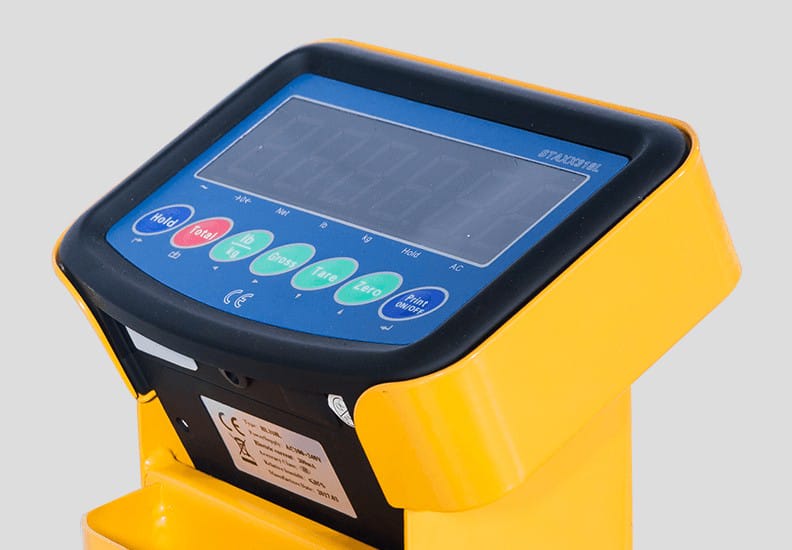
Display | Digital LCD display with clear and easily readable readings |
Printer function | Option to print weight receipts (MPT3 model with printer) |
Power supply | Built-in rechargeable battery for scales electronics |
Equipment weight | To be confirmed with sales consultant depending on configuration |
Warranty | Manufacturer’s warranty in accordance with VVN.LV terms |
These technical parameters are tailored for typical warehouse and manufacturing environments where both reliable load handling and precise weighing are required. The fork length of 1,150/1,220 mm allows safe operation with standard EUR pallets (1,200 × 800 mm) and the most widely used 1,000 × 1,200 mm format, which are predominant in Latvian and European warehouse practice. The 2,500 kg load capacity provides an adequate safety margin for heavy construction materials, metal products, and other dense loads.
Polyurethane wheels are the ideal choice for businesses seeking to combine quiet, easy movement with floor surface protection. Unlike hard nylon wheels, they absorb shocks more effectively, cause less damage to concrete, epoxy, or tiled floors, and generate less noise – significantly improving working comfort. Compared with softer rubber wheels, polyurethane offers higher wear resistance and better rolling performance under heavy loads, which is why it is widely used in professional pallet trucks with scales.
Weighing accuracy of ±0.05% is a highly competitive specification in the professional segment, as many standard models offer only ±0.1% or less. This means the MPT3 can be used with confidence not only for approximate checking, but also in situations requiring precise decisions regarding transport costs and inventory management. This combination – 2,500 kg capacity, high accuracy, and a convenient digital display – is optimal for the majority of warehouses and logistics centres in Latvia.
The MPT3 pallet trucks with digital display are based on a proven mechanical design in which load cell sensors are integrated inside the forks to detect changes in load. When the pallet is lifted, the sensors measure the force acting on the forks, and the electronics convert this signal into a precise weight reading. The result is displayed in real time on an LCD screen positioned at a conveniently reachable and clearly visible location for the operator.
The working cycle is simple and intuitive:
To ensure long-term accuracy, the weighing system requires periodic calibration in accordance with the manufacturer’s requirements and applicable regulations. The calibration procedure is typically carried out by certified specialists using certified reference weights and appropriate equipment, ensuring that the pallet trucks with scales maintain correct readings throughout their service life. The battery powering the electronics is charged using a mains charger, and in practice, a single charge is typically sufficient for at least one full intensive working shift.
Warehouses and logistics centers are the environment where pallet trucks with scales demonstrate their value most rapidly, given the high pallet throughput. In the goods receiving area, the actual weight can be compared immediately with the data on the delivery note, recording any discrepancies promptly and reducing the risk of supplier disputes. In the dispatch area, accurate weighing enables correct calculation of transport costs and compliance with carrier requirements.
In logistics centres handling courier shipments or weight-sensitive cargo types, pallet trucks with a digital display significantly streamline operations. For example, when picking orders for multiple destinations, each pallet can be quickly weighed without disrupting the flow or creating bottlenecks at fixed weighing stations. This is especially important for companies seeking to maintain high throughput and short delivery lead times.
In manufacturing facilities, pallet trucks with built-in scales are an excellent tool for tracking raw materials and finished goods. In the raw materials warehouse, the quantity issued to production lines can be accurately recorded, while in the finished goods warehouse, the weight and quantity of produced goods can be monitored. This helps identify deviations early, improve production planning, and reduce waste.
A pallet jack with scales can also be used to monitor the weight of semi-finished goods at various stages of production, which is especially useful in the food, chemical, and metalworking industries. Efficient on-line weighing enables rapid response to changes and consistent product quality. This results in reduced defect rates, more precise use of raw materials, and improved overall process transparency.
In the logistics of large retail chains, wholesale warehouses, and regional distribution centres, receiving and issuing goods by weight is a daily routine. Pallet trucks with scales allow the actual weight to be checked at the moment of receipt and any discrepancies recorded immediately. This ensures fair settlements with partners and reduces financial risk.
During order picking, weight control helps ensure that the quantity dispatched to the customer precisely matches what was specified in the contract or invoice. Weighing during the picking process prevents situations where discrepancies are only discovered at the final stage or at the customer’s end. Furthermore, printed weight receipts are a convenient addition to shipping documents and help build trust between supplier and customer.
In the food and pharmaceutical sectors, weighing accuracy and traceability are among the most critical requirements. Pallet trucks with a printer allow loads not only to be weighed but also for weight receipts to be printed immediately, ready to be attached to batches, delivery notes, or quality control documents. This helps ensure regulatory compliance and simplifies the audit and inspection process.
In these industries, the tare function is also particularly important, as it allows precise separation of packaging weight and product weight. By using a pallet jack with scales for both raw material and finished goods flows, full traceability of the weight data chain can be maintained – from raw material through to handover of the finished product to the customer or distributor. This strengthens the quality management system and compliance with international standards.
The first step is to assess what types of loads you handle daily and what their maximum weight is. It is generally recommended to choose pallet trucks with scales whose load capacity is at least 20–30% higher than the most frequently encountered maximum load, in order to provide a safety margin. The MPT3 model with a 2,500 kg capacity is the optimal solution for the majority of warehouses, logistics operations, and manufacturing businesses in Latvia.
If your loads regularly approach or reach 2,000–2,300 kg, this margin ensures safe operation and reduces strain on both the mechanism and the wheels. This extends the equipment’s service life and reduces the risk of frequent repairs. On the other hand, if most loads are lighter, this capacity provides flexibility to respond to seasonal peaks or the introduction of new product lines.
Standard EUR pallet dimensions (1,200 × 800 mm) and 1,000 × 1,200 mm pallets are the most common in Latvian warehouses, making the MPT3’s fork length of 1,150/1,220 mm particularly well suited to these formats. The 160 mm fork width provides a good support area, while the overall fork width of 540/680 mm allows you to select the most suitable version for your pallets and racking configuration. This flexibility matters when working with pallets of various sizes or non-standard packaging.
A narrower overall width is advantageous in warehouses with tight aisles, where maximum manoeuvrability between racking is essential. A wider configuration provides better stability for non-standard or wider pallets. The MPT3’s compatibility with standard European pallets makes it a reliable choice for businesses operating in both domestic and international supply chains.
Wheel material is directly related to movement comfort, floor surface protection, and equipment longevity. The polyurethane wheels with which the MPT3 is equipped provide quiet and smooth movement even under heavy loads, while protecting the floor surface. They are ideally suited to concrete, smooth industrial, epoxy, and tiled floors, which are found in the majority of modern warehouses.
By comparison, nylon wheels are often louder and harder, better suited to very heavy loads, but can damage more delicate floor surfaces. Rubber wheels are softer and quieter, but typically less durable under heavy loads and may generate greater rolling resistance. Polyurethane offers a good balance of quiet running, high durability, and good manoeuvrability, which is why it is widely found in professional pallet trucks with scales.
When selecting pallet trucks with built-in scales, particular attention should be paid to the accuracy class and display functionality. If approximate monitoring is the primary need and high precision is not required, devices rated at ±0.1% or even ±1% may suffice. However, for businesses working with weight-based transport tariffs or carrying out precise raw material accounting, the ±0.05% accuracy provided by the MPT3 offers a significant advantage.
The digital LCD display is easy to read in various lighting conditions and allows the operator to instantly verify the weight of a load. Additional functions such as tare, totalisation, or unit switching (e.g., kilograms) help tailor the system to specific operational requirements and record-keeping needs. The simpler and more intuitive the user interface, the fewer errors occur and the faster employees can be trained.
The MPT3 model with a printer is ideal for businesses that wish to document weighing data on site. The printer function allows weight receipts to be printed with key parameters such as date, time, weight, and additional information as required. These receipts can be attached to delivery notes, stocktaking documents, or quality control records, ensuring transparency and traceability.
If your business has strict documentation requirements (for example, in the food, pharmaceutical, or international logistics sectors), the printer function helps save time and reduce manual recording errors. In cases where detailed printing is not mandatory, it is possible to choose the model without a printer; however, most professional warehouses appreciate the ability to print a verifiable weight confirmation in the long run.
Parameter | VVN MPT3 | Competitor A | Competitor B |
Price | €674.76 | ~€840 | ~€695 |
Accuracy | ±0.05% | ±0.1% | ±1 kg |
Load capacity | 2,500 kg | 2,500 kg | 2,000 kg |
Wheels | Polyurethane | Nylon | Rubber |
Warranty | Per VVN.LV | Subject to supplier | Subject to supplier |
Several manufacturers and models of pallet trucks with scales are available on the Latvian market, but not all offer as good a balance of price and functionality as the MPT3. Some competitors focus on the lowest price point, sacrificing accuracy or wheel quality – which can result in higher operating costs over time. Others position themselves as premium solutions at a higher price, yet with similar or even lower accuracy.
The MPT3 offers greater accuracy than many standard models rated at ±0.1% or with a 1 kg resolution, which are common in professional product ranges. At the same time, its price remains lower than some well-known brands of hand pallet trucks with scales, delivering a strong return on investment. Polyurethane wheels as standard equipment represent an important advantage over nylon or cheaper rubber alternatives, particularly where working comfort and floor protection are priorities.
The MPT3 pallet trucks with scales are designed for professional use, and the weighing system can be calibrated in accordance with the manufacturer's requirements and applicable regulations. If your industry requires the use of verified measuring equipment (for example, for weight-based commercial transactions), you should check the specific requirements and ensure that the appropriate metrological verification is carried out. In practice, calibration is usually performed by certified specialists using certified reference weights and appropriate equipment.
The scales electronics are powered by a built-in rechargeable battery designed for use in an intensive warehouse environment. Under typical conditions, a single full charge cycle is sufficient for at least one working shift, depending on the frequency of weighing and the intensity of display use. The battery is charged using the charger supplied with the unit; it is recommended to follow the manufacturer's instructions to maximise battery service life.
To achieve the declared accuracy, weighing should be performed when the pallet is stable and the truck is stationary. After lifting the pallet, the system stabilises the weight reading within a short time and displays the precise value on screen. Readings may be unstable when the truck is in motion, so it is always advisable to come to a brief stop before reading the final weight or printing a receipt.
The MPT3 pallet trucks with scales come with a manufacturer's warranty in accordance with the terms of Viss veikaliem un noliktavām (VVN.LV). The warranty generally covers manufacturing defects and electronics malfunctions not related to misuse or mechanical damage. Exact warranty terms and conditions will be provided in the quotation and contract documents, and can also be confirmed with a VVN.LV adviser prior to purchase.
The calibration frequency depends on your industry's requirements, the intensity of use, and your internal quality management policy. Many businesses opt for preventive calibration annually, or more frequently if the scales are used for commercial transactions or control of critical processes. It is advisable to develop a precise schedule in consultation with a metrological specialist, taking your specific business requirements into account.
Pallet trucks with scales may also be used outdoors, provided that the manufacturer's instructions are followed and the permissible environmental limits are not exceeded. Floor surface quality, moisture, precipitation, and temperature must all be taken into account to avoid damaging the wheels and electronics. For extended intensive outdoor use, it is advisable to seek advice on additional protective measures or specialist versions of the equipment.
| Cookie name | Active |
|---|
Uzraksti mums.