
The VVN Manual Pallet Truck MPT1 is a professional manual pallet handling solution for warehouses, manufacturing facilities, and logistics centres where heavy loads of up to 5,000 kg are moved on a daily basis. This is the highest load capacity among VVN’s manual models, making the MPT1 the preferred choice in situations where a standard pallet truck with a 1,000–2,500 kg capacity is insufficient.
In warehouses handling heavy goods – metal products, large-volume chemical or food items, building materials, or machinery – an electric pallet truck is often an unnecessary expense or simply impractical: there may be no suitable electrical installation, the work takes place in cold rooms, or in outdoor areas without a power supply. In such conditions, the MPT1 is a rational and reliable alternative. Its 5-tonne load capacity, the simplicity of the hydraulic mechanism, and the two wheel material options allow flexible adaptation to a wide range of working environments.
This page provides an overview of the MPT1’s advantages, full technical specifications, a comparison with its electric counterpart, application scenarios, and answers to frequently asked questions – everything needed to make an informed purchasing decision for warehouse equipment in Latvia.

You get a better offer?
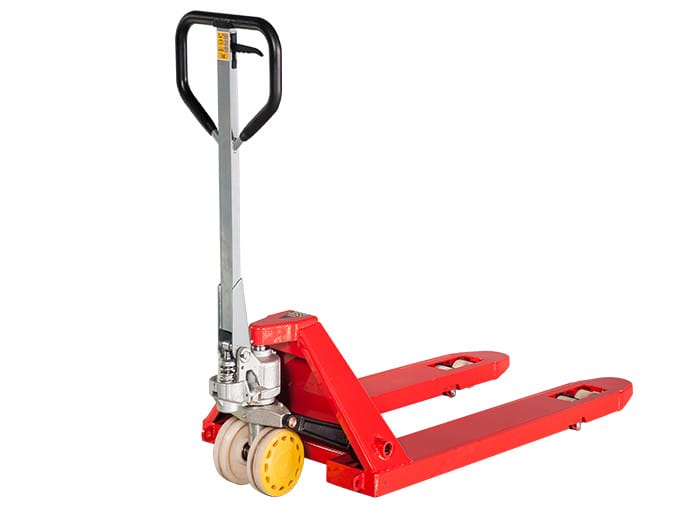
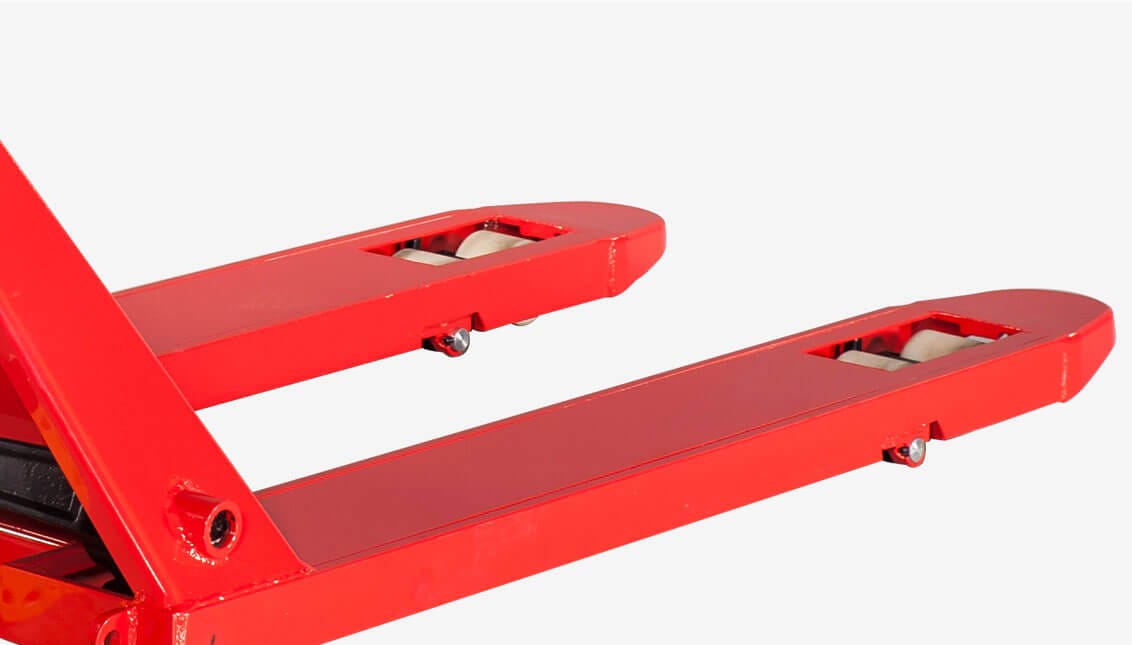
Parameter | Value | What it means in practice |
Load capacity | 5,000 kg | Suitable for the heaviest pallet loads – up to 5 tonnes; covers virtually all typical warehouse load categories |
Fork length × width | 1,150/1,220 mm × 180 mm | Compliant with the EUR pallet standard; two length options – choice depends on the pallet specifications used in the warehouse |
Total fork width | 550 mm or 685 mm | Two options ensure compatibility with different pallet types and narrower or wider warehouse aisles |
Lifting height | 85–200 mm | Sufficient ground clearance for transporting loads above the floor; standard working range of a hydraulic pallet truck |
Wheel material | Cast iron or nylon (selectable) | Cast iron – greater durability on rough surfaces; nylon – floor protection and reduced noise in working spaces |
Weight | 113–130 kg | Depending on configuration; comparatively compact for a mechanical 5-tonne class model – good manoeuvrability in narrow aisles |
When choosing between a manual and an electric pallet truck, there is no universally correct answer – each solution is optimal under certain conditions. The table below provides an objective assessment of which model is better suited to a given application scenario.
Criterion | MPT1 (Manual) | Electric Pallet Truck |
Purchase price | ✅ Considerably lower – smaller upfront investment | ❌ Higher initial cost; several times more expensive depending on the model |
Annual maintenance costs | ✅ Low; no service contract or battery replacement required | ❌ High; battery maintenance/replacement, electronics diagnostics |
Required infrastructure | ✅ None – operates anywhere without electrical supply | ❌ Charging station, electrical installation, secure storage point |
Suitability for cold storage | ✅ Excellent – hydraulics are temperature-independent (with suitable oil) | ⚠️ Limited – battery capacity decreases at low temperatures |
Readiness to work (without charging) | ✅ Immediate – no waiting required | ❌ Depends on charge level; a partially charged battery limits output |
Suitability for heavy loads (>3 t) | ✅ Excellent – MPT1 load capacity of 5,000 kg is specifically designed for this purpose | ✅ Depends on model; high-capacity electric trucks are also available |
Operator training required | ✅ Minimal – intuitive hydraulic handle; no specialist training required | ⚠️ Higher – training in safe operation of electrical equipment is necessary |
Lifting height | ⚠️ 85–200 mm – sufficient for transport, not suited to high stacking operations | ✅ Many models offer a greater lifting range – better suited for racking heights |
Physical effort required from operator | ⚠️ Higher – manual pump operation and pulling/pushing of load required | ✅ Lower – electric motor moves loads with minimal physical effort |
Conclusion: The MPT1 is an economically and practically sound choice where the main priorities are high load capacity, minimal infrastructure requirements, and low operating costs. An electric pallet truck is the better option for intensive, continuous use where operator ergonomics and greater lifting height are decisive factors.
The MPT1 is not a universal solution – but in certain scenarios it is the optimal choice of warehouse equipment.
Low-temperature storage – frozen food facilities, pharmaceutical cold chains, frozen goods logistics – creates a specific problem for electric pallet trucks: the battery loses charge capacity, shift duration shortens, and service frequency increases. The MPT1 is structurally simple – hydraulic oil with a low-temperature specification and metal mechanics operate reliably at −20 °C and below. No battery degradation, no unexpected downtime – in a cold-storage warehouse, the MPT1 is a more dependable daily workhorse than its electric counterpart.
Not all storage and logistics facilities have an electrical supply in the working area. In yards, container terminals, construction site stores, or temporary storage locations, charging an electric pallet truck is logistically complex or simply impossible. The MPT1’s hand-operated hydraulic drive allows heavy loads to be moved entirely independently of electrical power – all that is required is an operator and a reasonably flat working surface.
Even in warehouses that use electric pallet trucks for everyday operations, the MPT1 is valuable as a backup solution. Electric equipment may be in for repair, on charge, or in use by another operator at the other end of the warehouse – in such moments, the movement of heavy pallet loads must not stop. With its 5,000 kg load capacity, the MPT1 handles any load without compromise. It is not a “simple backup tool” but a fully capable working machine that is ready for immediate use without charging or preparation.
In manufacturing facilities, material handling often takes place between machines where the available aisle width is restricted. The MPT1’s compact dimensions and manual control enable precise manoeuvring in narrow working zones where larger electric trucks cannot fit or would create a risk of collision with fixed equipment. The manual pallet truck also gives the operator complete control over speed and direction – important in facilities where people and expensive machinery are working in close proximity.
The maximum load capacity of the MPT1 is 5,000 kg - the highest figure in VVN's range of manual pallet trucks. This makes the MPT1 suited to the heaviest pallet loads in industrial, logistics, and manufacturing environments. It is important to note that the rated load capacity applies to an evenly distributed load across both forks on a stable floor surface - irregular load placement may affect stability.
The MPT1 is available with cast iron or nylon wheels - the choice is made at the time of ordering, in accordance with the requirements of the working environment. Cast iron wheels are more durable and better suited to rough concrete or asphalt surfaces requiring high rolling resistance. Nylon wheels are recommended for polyurethane or tiled floors where surface protection is important, as well as for spaces where noise levels are regulated. The wrong wheel material can accelerate wear on both the equipment and the floor surface.
The MPT1 is a manual pallet truck - the operator activates the hydraulic hand pump to lift the forks and pulls or pushes the truck by hand. An electric pallet truck uses an electric motor for both lifting and travel, which reduces physical effort and increases output capacity for intensive use. The MPT1's main advantages over an electric model are a significantly lower purchase and maintenance cost, independence from electrical power, suitability for cold-temperature conditions, and immediate readiness for use. The advantages of an electric pallet truck are lower physical demand on the operator, a greater lifting height on certain models, and greater efficiency in intensive, continuous use.
The MPT1 is designed for use on hard, relatively smooth surfaces - concrete, asphalt, or warehouse flooring. Minor floor irregularities (joints, small raised sections) are generally acceptable, but highly uneven or gravelled outdoor surfaces can increase rolling resistance and reduce the equipment's service life. The cast iron wheel option is more resilient on rougher surfaces, while nylon wheels provide better protection for sensitive floor finishes. If there is any doubt about the suitability of the floor surface, please consult VVN specialists before placing an order.
Yes - the MPT1 is available in several configurations, differing in two main parameters: total fork width (550 mm or 685 mm) and wheel material (cast iron or nylon). The fork length option (1,150 mm or 1,220 mm) allows the equipment to be more precisely matched to the pallet standard used in the specific warehouse. If a smaller load capacity or additional functionality (such as built-in weighing scales) is required, the VVN range also includes models MPT3, MPT5, MPT7, and MPT9 - a consultation with VVN specialists will help you select the most suitable solution.
| Cookie name | Active |
|---|
Uzraksti mums.