
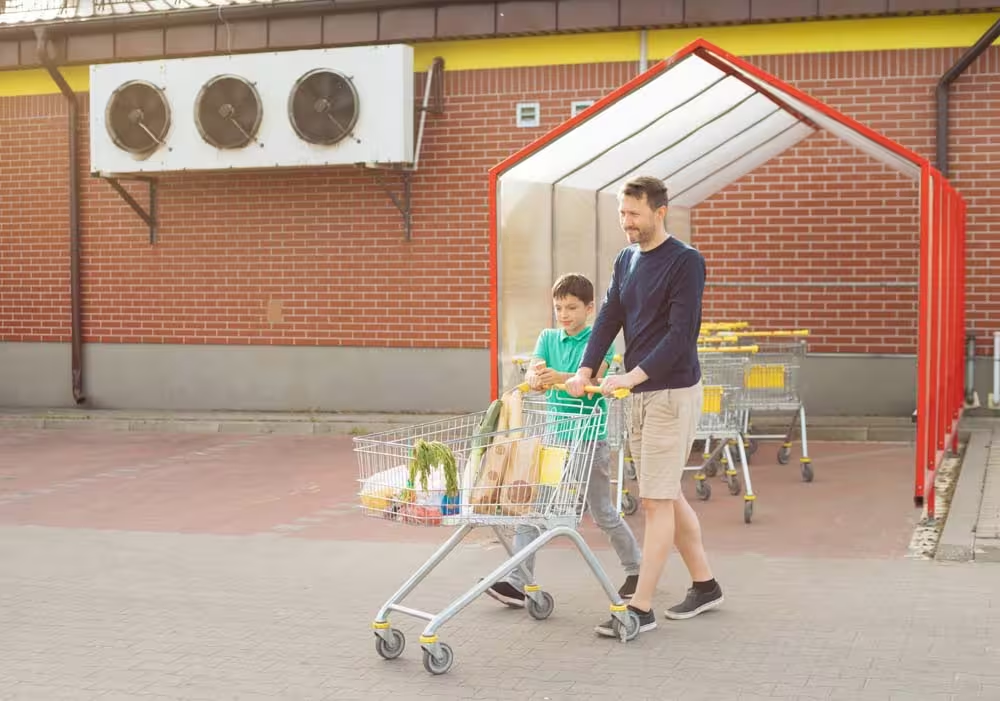
A customer’s experience with a shop or shopping centre doesn’t begin at the till, or even at the entrance – it begins in the car park. The moment someone steps out of their car, they start forming an impression of how well-organised, safe and trustworthy the business is. If shopping trolleys are scattered haphazardly across the car park, blocking accessible parking bays or standing out in the rain, that first impression counts against the business before the customer has even had a chance to read the promotional poster on the shop sign. Conversely, a tidy, well-positioned and visually appealing shopping trolley shelter immediately signals that customers are cared for and that the site is managed with attention to detail.
The same applies to bicycle shelters. More and more people are choosing to travel by bicycle – commuting to work, running errands or simply for leisure. If a building has no safe, convenient place to leave a bicycle, a potential visitor will simply choose another destination where that provision exists. This means a modern retail site, office building or public space can no longer rely on a spacious car park alone – it needs well-thought-out outdoor infrastructure that covers cars, shopping trolleys and bicycles alike.
This article looks at why shopping trolley shelters and bicycle shelters have become an essential part of modern retail and public environments, what types of shelter are available, how to choose the right solution, and why, when selecting a partner to install this kind of equipment, it pays to rely on an experienced supplier such as VVN.
Shopping trolleys are one of those elements that, when positioned correctly, go almost unnoticed – the customer simply takes one, uses it and returns it without a second thought. But if there’s no clear, easily reachable place to leave trolleys, they start to drift across the car park: rolling into parked cars, blocking traffic lanes, and getting damaged by gusts of wind. The result is not just reduced customer satisfaction, but damage to the shop’s image and, potentially, to safety as well.
A trolley shelter solves this by creating clearly marked, easily recognisable zones where trolleys can be left and collected with ease. This reduces the time customers spend searching for a free trolley or a free parking space, while also creating a sense of order and reliability that shapes how customers judge the shop itself.
Shopping trolleys represent a significant capital investment – a large shopping centre or supermarket’s trolley fleet can run into the hundreds of units, each costing a substantial sum. Trolleys left outdoors around the clock, exposed to rain, snow, frost and UV radiation, wear out considerably faster: corrosion sets in, wheel mechanisms fail, and plastic components fade and crack. A roofed shelter or a fully enclosed structure significantly extends the working life of trolleys by protecting them from precipitation and direct sunlight.
A second important consideration is protection against theft and unauthorised use. Shopping trolleys left unattended outside the shop premises often fall victim to vandalism or theft – taken home, used for other purposes, or simply abandoned somewhere in the city. A lockable trolley shelter with gates that can be secured allows shop staff to control access to trolleys outside opening hours, significantly reducing losses and the need to keep replenishing the fleet with new units.
An organised trolley storage system also reduces the risk of physical accidents. An empty trolley blown by the wind can damage a car or injure a pedestrian. A clearly defined, securely anchored trolley shelter prevents such incidents by keeping trolleys in one place, unable to roll freely around the car park. This matters especially in large shopping centres, where hundreds of visitors and dozens of manoeuvring cars can be present at the same time.
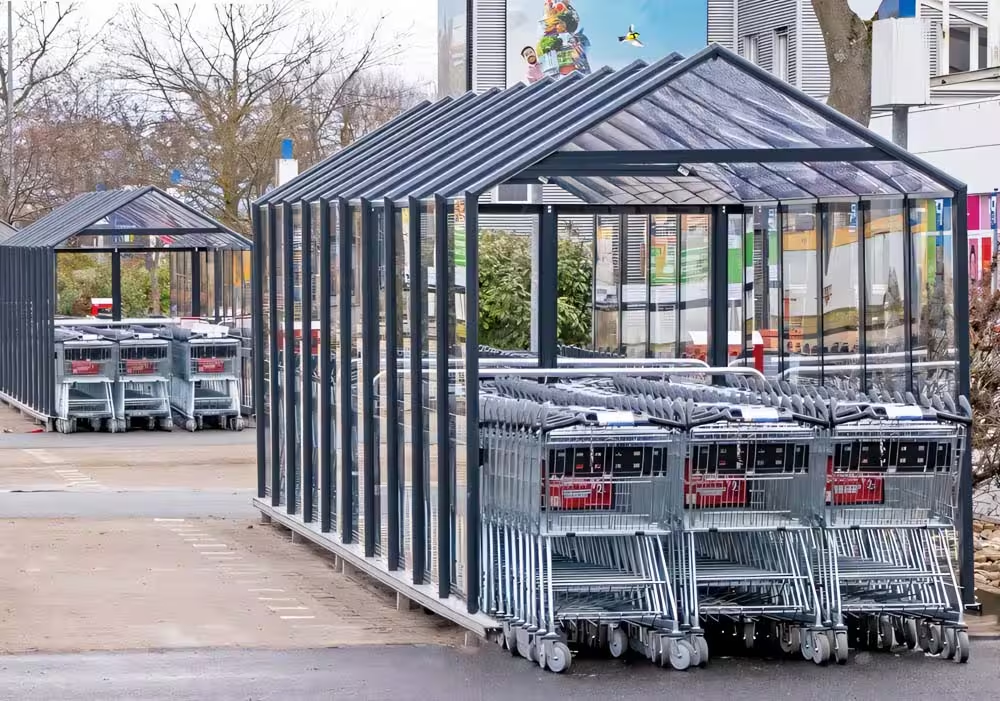
When choosing a trolley shelter, it’s important to understand that one solution doesn’t suit every situation. The type of shelter needs to be matched to the specific site, climate conditions, trolley numbers and budget. VVN offers several shelter types covering a broad range of needs – from economical open-type solutions to fully lockable, climate-adapted structures.
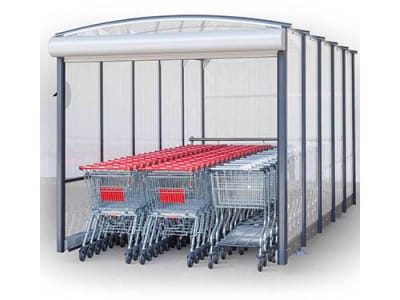
An open-type trolley shelter, such as the VVN LPR2, is the optimal choice for anyone who needs to organise a trolley storage area quickly and with a relatively modest investment.
This type of structure typically consists of a metal frame and a roof covering that protects trolleys from precipitation, but without side walls or lockable doors. This makes the open-type shelter a highly flexible solution – it’s easily accessible from any side, allows large numbers of trolleys to be loaded and unloaded quickly, and requires no additional staff involvement for unlocking or supervision.
This solution is particularly well suited to sites with a steady stream of customers and a lower theft risk – for example, smaller shops, rural retail locations, or sites where the trolley shelter falls within CCTV coverage and is close to the shop entrance. An open-type shelter is also an excellent option for businesses that want to test how an organised trolley area affects customer flow before investing in a more complex lockable structure.
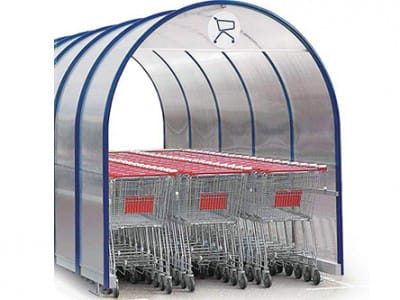
An arched trolley shelter, such as the VVN LPR3, combines practical functionality with a modern, visually appealing design. The curved, arched roof shape isn’t purely an aesthetic choice – it ensures efficient drainage of rain and snow, preventing water from pooling on the roof surface and reducing structural load during the winter months, when a significant amount of snow can accumulate on the roof. This shape also complements the architecture of modern shopping centres, creating the impression of a thoughtfully and carefully planned retail environment.
Arched shelters are often chosen by shopping centres and supermarkets for whom it matters that the trolley shelter blends harmoniously into the building’s overall visual concept, rather than looking like an attached structure that is functional but aesthetically out of place. At the same time, this solution retains practicality – a spacious loading zone, a durable structure, and the ability to adapt dimensions to the specific number of trolleys required.
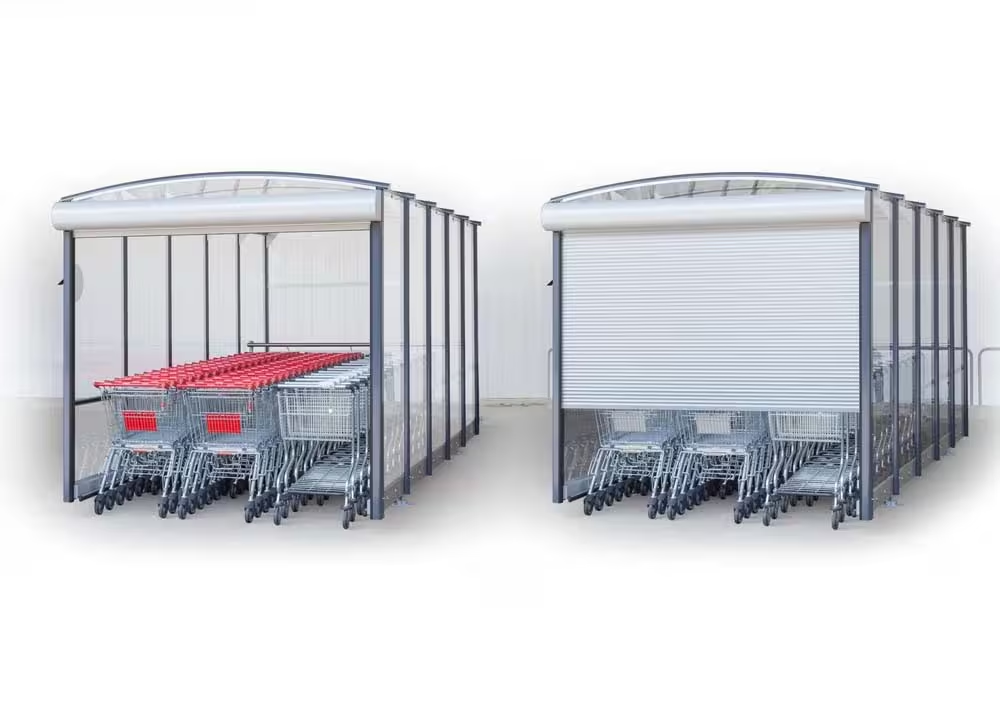
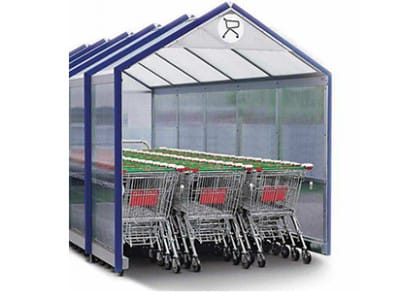
Supermarkets and shopping centres with high visitor numbers and a large trolley fleet often need a solution that combines protection from the weather with security against unauthorised access. An enclosed trolley shelter with a rounded roof, such as the VVN LPR5, is exactly that solution – it includes side walls, lockable gates and a rounded roof structure that ensures efficient drainage of snow and rain, even in the harsh Baltic winter.
This type of shelter allows shop management to fully close off access to the trolleys at night or outside opening hours, preventing vandalism, theft and unauthorised use. During the day, when the shelter is open, it continues to perform its main function – providing tidy, convenient trolley storage for customers.
The rounded roof shape also helps reduce snow build-up, which is particularly relevant across the Baltic region in winter, where snow and ice loading on roof structures can be considerable.
Not every retail site uses only one type of trolley. Supermarkets offering standard shopping trolleys alongside smaller basket-style trolleys, or specialist trolleys for bulky purchases or building-materials retail, need a versatile solution. The VVN LPR6 is a lockable, universal shelter designed to comfortably accommodate trolleys of different types and sizes in a single location.
This universal approach makes better use of the available space – there’s no need for several separate shelters for each trolley type, and shop staff find it easier to oversee and keep the entire trolley fleet in order. Universal lockable shelters are particularly useful for large building-materials retailers, hypermarkets and shopping centres with multiple tenants, where different shops may use different trolley types but share a common storage area.
In recent years, the bicycle has become a genuine everyday mode of transport, not just a leisure pursuit. City councils are actively developing cycling infrastructure, more and more employees are choosing bicycles as a convenient, environmentally friendly alternative to cars, and this trend continues to grow. Against this backdrop, a bicycle shelter at an office, shop, educational institution or residential complex is no longer an added extra – it’s a basic requirement that an ever-growing share of visitors and employees expect.
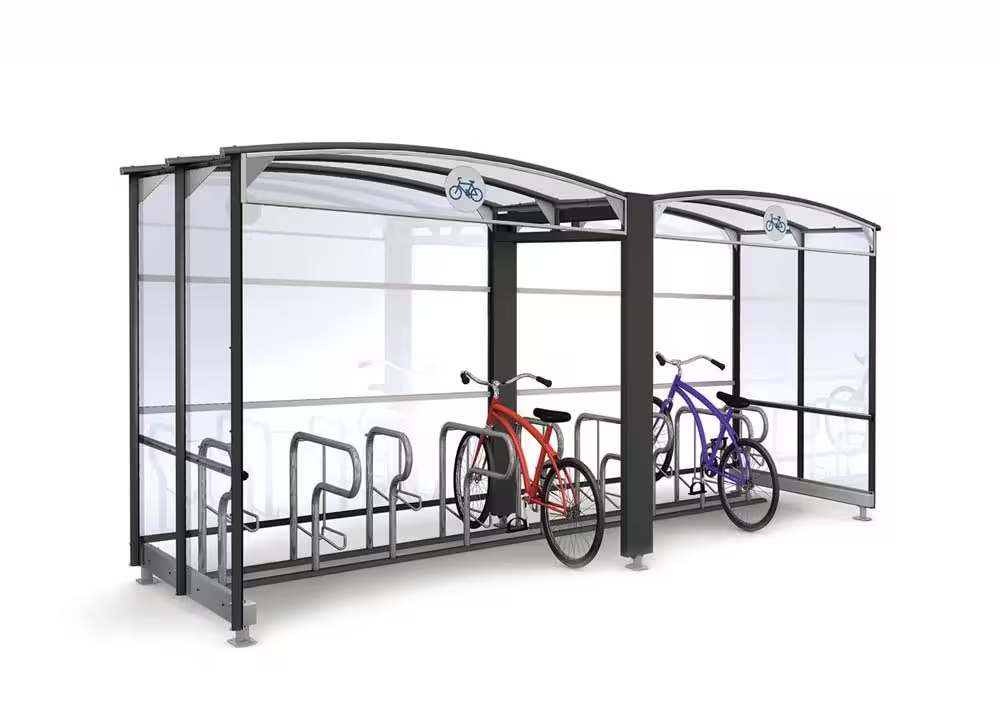
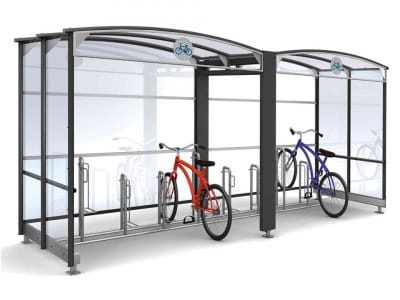
The solution offered by VVN, such as the VVN BS1, is designed to provide a secure, stable and easy-to-use place for storing bicycles. A quality bicycle shelter includes sturdy stands that allow a bicycle to be locked by the frame, not just the front wheel, reducing the risk of theft and keeping the bicycle from toppling over while parked.
Office buildings. Businesses that care about employee wellbeing and want to encourage sustainable commuting are increasingly fitting bicycle shelters near office entrances or in underground car parks. This is particularly relevant for large office complexes, where hundreds of employees look for a convenient, safe place to leave their vehicle every day.
Educational institutions. Schools and universities located in city centres or areas with well-developed cycling infrastructure face growing demand for secure bicycle shelters for pupils, students and staff. A bicycle shelter on school grounds eases parents’ concerns about their child’s bicycle being safe, while also encouraging an active, healthy lifestyle from an early age.
Residential complexes. Modern residential developers increasingly include bicycle shelters as part of a complex’s infrastructure, much like car parking.
For residents, this means they no longer have to store a bicycle in a stairwell or on a balcony – which isn’t always practical or safe – and instead have a dedicated, weatherproof space in the courtyard or by the entrance.
Retail sites and public spaces. For shops and shopping centres too, a bicycle shelter is becoming a competitive advantage – it attracts customers who choose to shop by bicycle, and demonstrates the business’s responsible attitude towards the environment and the local community.
Installing a bicycle shelter isn’t just a practical step – it’s also part of a company’s or a local authority’s sustainability strategy. Businesses that visibly invest in cycling infrastructure strengthen their image as responsible, future-focused participants in society, which matters especially when communicating with a younger audience that cares about environmental issues.
The Baltic climate places specific, unchanging demands on any outdoor structure: long, damp, snowy winters; frequent temperature fluctuations around freezing that cause frost and ice build-up; and the road salt used for gritting, which accelerates metal corrosion. A shelter not designed with these factors in mind can start to rust, warp or lose structural integrity within a few years. That’s why choosing the right materials is one of the most important decisions when selecting a shopping trolley or bicycle shelter for long-term use.
Aluminium is one of the most suitable materials for outdoor structures in the Baltic climate, thanks to its natural resistance to corrosion – unlike steel, which begins to rust after just a few cycles of damp weather if not properly coated. The anodising process further strengthens the aluminium surface by creating a protective oxide layer, making the material even more resistant to scratches, UV radiation and chemical exposure, including exposure to salt during winter. Anodised aluminium retains its appearance and functionality for many years, requiring practically no maintenance, which reduces the structure’s overall running costs over its lifetime.
Beyond its durability, aluminium is also a relatively lightweight material, which makes the structure easier to assemble and allows for more elegant, visually lighter design solutions without compromising structural strength.
Polycarbonate and acrylic glass (Perspex) are widely used for shelter roofing and, in some cases, side panels. These materials are considerably lighter than traditional glass, yet retain high impact resistance – important given that the structure may be exposed to hailstones, fallen branches or other mechanical impact. Polycarbonate performs well in low temperatures, remaining resistant to becoming brittle in frost, while still letting through enough natural light to keep the shelter from feeling dark or gloomy during the day.
Acrylic glass, meanwhile, is often chosen where optical clarity and aesthetics matter most – for example, at more prestigious shopping centres, where the trolley shelter needs to look visually high-quality and match the design of the building’s façade. Both materials are resistant to UV-induced yellowing when good-quality, manufacturer-approved products are used.
Beyond material choice, the engineering of the structure itself carries significant weight – frame fixings, foundation design and roof shape. In the Baltic region, where winter can bring a substantial build-up of snow and summer storms can bring powerful gusts of wind, the structure needs to be calculated according to real load figures, not simply designed to look attractive. When choosing a supplier, it’s therefore worth checking whether the shelter on offer has been designed and tested specifically for this region’s climate conditions, rather than simply imported from a warmer country without adaptation.
There’s no one-size-fits-all answer – the right choice depends on several factors that are worth assessing at the very start of the planning process.
Size and available space. Before choosing a shelter, you need to establish how much space is available on the site and where the shelter should ideally be positioned in relation to the building entrance, pedestrian flow and vehicle movement. The shelter needs to be close enough to the entrance for customers to use it, but must not obstruct pedestrian or vehicle traffic.
Capacity. The number of trolleys or bicycles a shelter needs to hold should be calculated with an eye not only on current visitor numbers, but also on anticipated future growth. Insufficient capacity creates exactly the problem the shelter was meant to solve – chaos and disorder around an overflowing shelter.
Security requirements. For sites with a higher risk of theft or vandalism – such as large shopping centres or sites without permanent CCTV coverage – a lockable solution such as the VVN LPR5 or VVN LPR6 is recommended. Smaller sites with lower risk are often well served by an open or arched shelter.
Design and architectural fit. A shelter shouldn’t look like a foreign object against the building’s overall appearance. Modern shopping centres and office buildings are increasingly focused on ensuring that every outdoor element – including trolley shelters and bicycle shelters – fits harmoniously into the overall visual concept.
Budget and long-term costs. The cheapest solution in the short term isn’t always the most cost-effective over time. It’s worth weighing up not just the initial installation cost, but also anticipated maintenance costs, the expected lifespan of the materials, and the potential losses that can result from inadequate protection against weather or theft.
Climate suitability. As already noted, the structure and materials need to be adapted specifically to the Baltic region’s climate – snow, ice, moisture and the road salt used for gritting.
When choosing a trolley shelter or bicycle shelter, what matters isn’t just the product itself, but also the supplier’s ability to manage the whole process – from initial idea through to a finished, fully functioning structure. VVN offers exactly this kind of comprehensive approach.
Consultation. VVN’s specialists assess the specifics of the site – available space, visitor flow, climate conditions and security requirements – and help select the most suitable shelter type and size, taking into account both functional requirements and budget constraints.
Design. Every site is different, so VVN takes an individual approach to structural design, adapting dimensions, shape and material choice to the requirements of the specific location and the building’s architecture.
Installation. VVN provides professional installation, adhering to all technical requirements and safety standards, so the shelter performs reliably and lasts for years, withstanding the climate loads of the Baltic region.
Maintenance. VVN remains on hand for clients after installation too, offering maintenance and servicing solutions that keep the shelter functioning well and looking good for the long term.
This full service is available not only in Latvia, but across the whole Baltic region, allowing VVN to work with both local businesses and larger retail chains that need a consistent solution across multiple sites in multiple countries.
Trolley shelters and bicycle shelters are often seen as a minor, secondary infrastructure element compared with the fit-out of the shop or office itself. Yet, as the above makes clear, well-organised outdoor infrastructure has a direct impact on customer and employee experience, the working life of company assets, safety, and even overall public image. A trolley shelter that protects a valuable trolley fleet from the weather and theft, and a bicycle shelter that supports an active, sustainable lifestyle, are investments that pay off both directly and indirectly – through reduced maintenance costs, more satisfied customers and a stronger brand image.
VVN offers a broad range of solutions – from economical open-type shelters to fully enclosed, secure structures adapted specifically for the Baltic climate – and provides a complete service from consultation through to maintenance, across Latvia and the wider Baltic region.
If you’d like to find out which solution would best suit your site – whether that’s a shopping centre car park, an office building, an educational institution or a residential complex – get in touch with VVN’s specialists for a tailored proposal that matches your needs, visitor numbers and budget. Investing in organised, secure, durable infrastructure today means fewer headaches and happier customers tomorrow.
| Cookie name | Active |
|---|
Uzraksti mums.