
Imagine this scenario: a customer walks into your store, sees bent, worn-out shopping trolleys with wheels that won’t turn properly, and immediately makes a decision – “I’ll grab only the essentials and leave.” This isn’t a hypothetical scenario. It happens every day in thousands of retail locations around the world, and it directly affects sales volumes.
Shopping baskets, trolleys, and storage racks are far more than simple accessories. They are an integral part of the shopping experience – the first physical point of contact between a customer and your brand. Research shows that customers who use shopping trolleys spend, on average, 40–60% more than those who shop empty-handed or with small baskets. This statistic alone makes it clear why choosing the right equipment is a strategic decision, not merely a matter of logistics.
In this guide, we will take a detailed look at everything a store owner or manager needs to know – from choosing trolley materials to the importance of bicycle racks and the criteria for selecting a supplier.
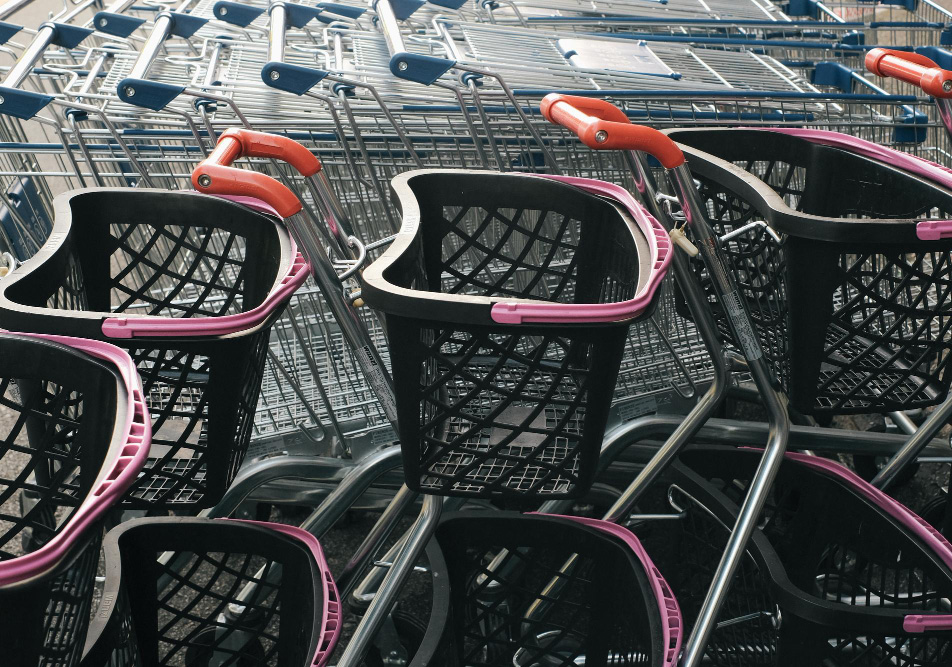
The goal is simple: to help you make informed decisions that will improve customer satisfaction and positively impact your revenue.
Shopping trolleys are the most familiar yet most underestimated piece of equipment in retail. We are so accustomed to their presence that we often forget they are actively working for us – or against us. A good trolley encourages customers to stay longer, take more items, and return. A poor one does the opposite.
In modern retail, where e-commerce increasingly competes with physical stores, the customer experience has become the primary differentiating factor. People return to brick-and-mortar shops not because it is more convenient than online shopping, but because they want a tangible, enjoyable experience. A quality, easy-to-manoeuvre shopping trolley is part of that experience.
There is a direct correlation between trolley capacity and average purchase value. Larger trolleys visually “call” to be filled – a customer subconsciously feels that a half-empty trolley looks incomplete and adds another item. This is not manipulation; it is a natural psychological process confirmed by numerous consumer behaviour studies.
In practice, this means the following: a hypermarket with a wide product range and large floor space benefits from high-capacity trolleys (150 to 212 litres), while a neighbourhood grocery or specialist shop will get more value from compact 55–100 litre models. It is also important that trolley capacity matches aisle width – oversized trolleys in narrow aisles create discomfort and can reduce the impulse to keep shopping.
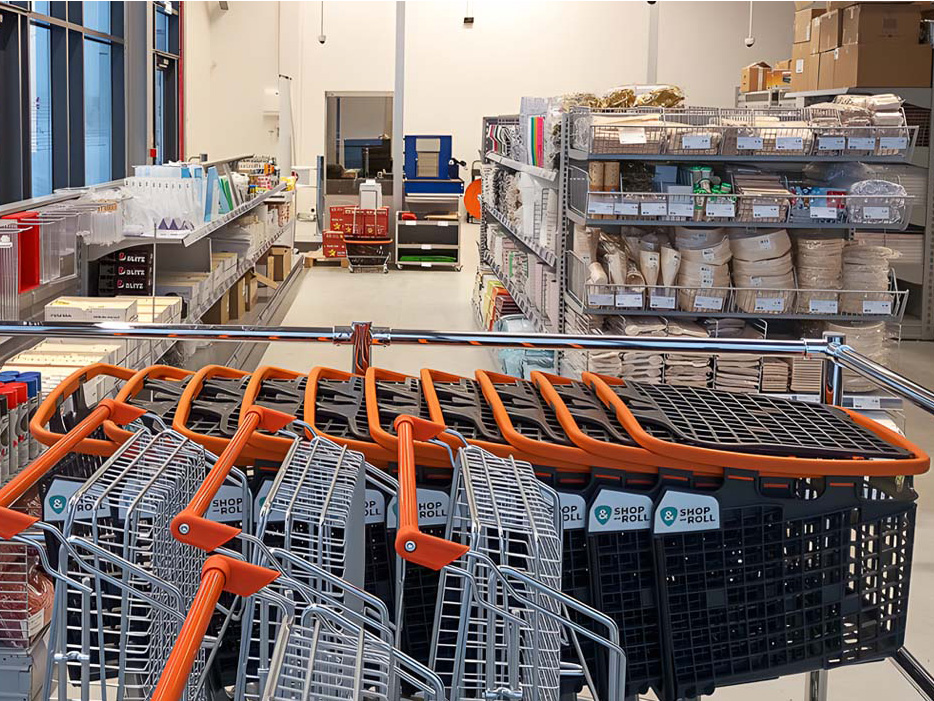
When choosing trolley materials, three key factors must be considered: durability, aesthetics, and operating environment.
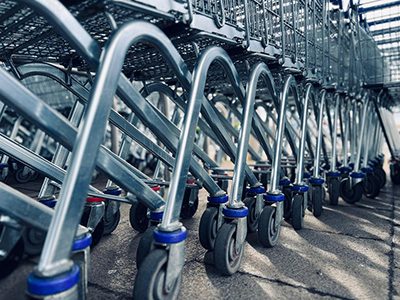
Metal trolleys – both chrome-plated and galvanised – are the traditional choice. They are robust, handle intensive daily use well, and are easy to clean. With proper maintenance, a metal trolley can last 10–15 years. The downside: they are heavier, and if damaged, can corrode – particularly in humid environments or outdoors.
Plastic trolleys are lighter, rust-free, and come in a wider range of colours, making them a popular choice for brands with a strong visual identity. However, plastic can become brittle over time, and a damaged plastic trolley looks significantly worse than a damaged metal one.
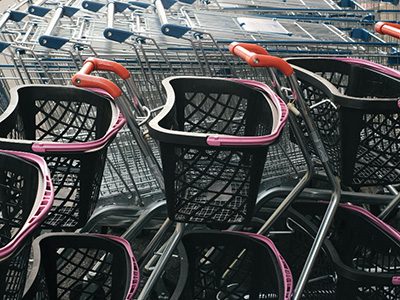
Combination models – a metal frame with a plastic or polypropylene basket – are currently the most popular choice, as they combine the strengths of both materials: the durability of metal and the lightness and aesthetics of plastic.
The capacity range on the market is remarkably broad – from 22-litre compact “City” models to 212-litre giants for hypermarkets. How do you navigate this?
Modern trolleys offer far more than a simple basket on wheels. These details often determine customer satisfaction:
Colour is the first thing a customer notices. Stores with a strong brand identity choose trolleys in their corporate colours – this not only reinforces brand recognition but also makes the retail environment visually coherent and professional. It has been shown that in a harmonious visual setting, customers feel more at ease and spend more.
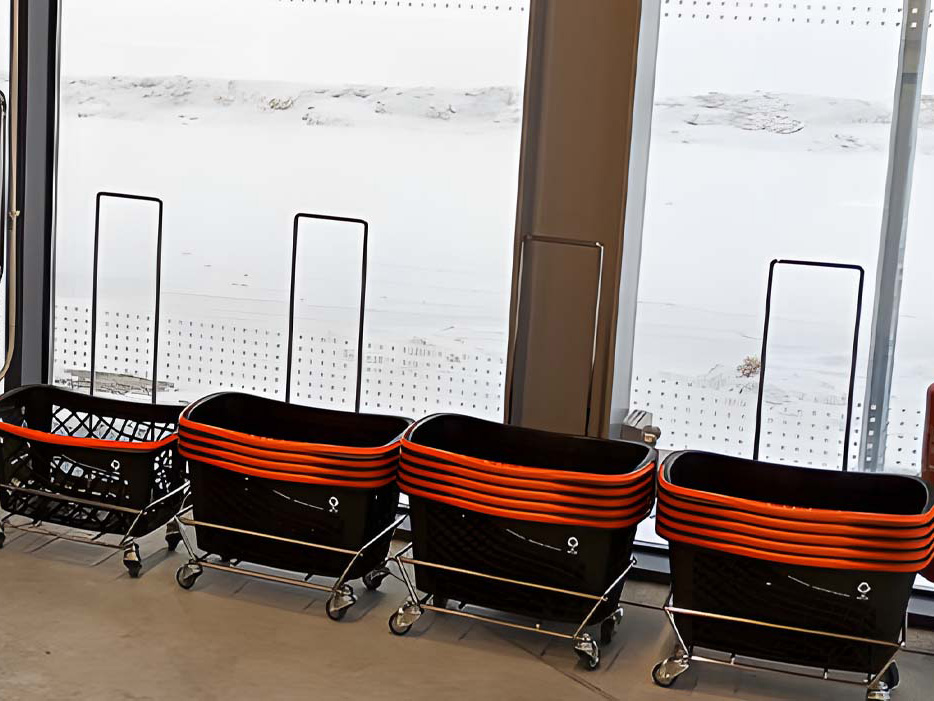
The psychology of the shopping basket is fascinating. A customer picks up a basket when they have a specific, limited shopping list. But there is also a second scenario: the customer comes in “just to browse” and suddenly finds several items they want to buy. If a basket is nearby, they keep adding products. If there is nothing to hand, they start carrying items – and soon give up on additional purchases because their arms are full.
For this reason, accessible baskets must be available not only at the entrance but also deeper within the store – near the most popular sections and in impulse-purchase zones. A customer who picks up a basket halfway through their shopping trip statistically buys more than one who has nowhere to put their items.
For baskets, the choice of material is also strategic:
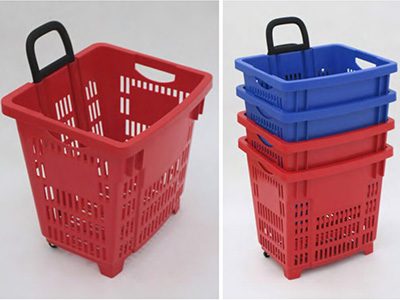
Plastic baskets are lighter, can come in bright colours, and are more hygienic – smooth plastic surfaces are easier to clean. However, they are less resistant to mechanical damage, and with prolonged use, plastic often becomes brittle or cracks.
Galvanised metal baskets are more durable, sturdier, and aesthetically pleasing – they convey a “premium store” feel suited to higher-end retail outlets. Metal baskets also handle intensive commercial use better and retain their shape far longer.
For many stores, the optimal strategy is to combine both: plastic baskets for lighter everyday use and metal baskets as the primary stock at the entrance.
Shopping basket capacity is not a trivial consideration.
Basket stands or racks at the store entrance serve two purposes. First, they ensure visual order – baskets are not scattered on the floor but neatly arranged and within easy reach. Second, they communicate to the customer: “This is a pleasant place to shop. Everything is in its place.” This is an effective way to create a positive first impression.
When positioning basket stands, consider the direction of customer flow. A stand should be placed exactly where the customer “enters” the active shopping area – not too far from the entrance, but not so close that it obstructs the passageway.
Impulse purchases account for an average of 20–40% of total grocery store revenue. A customer with free hands rarely adds an impulse item – but a customer with a basket does so far more often. By ensuring baskets are conveniently accessible throughout the store, you are effectively investing in higher sales volumes.
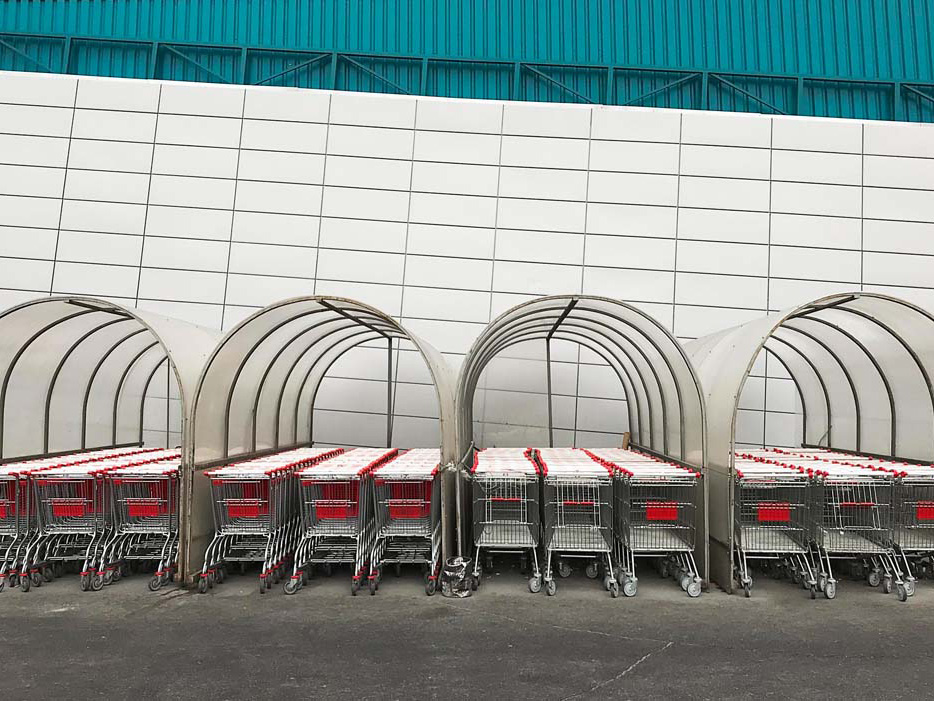
Many store owners tend to focus their attention on fitting out the sales floor, forgetting that the customer experience begins much earlier – the moment a shopper approaches the building. The car park, the entrance area, trolley and bicycle racks – all of this shapes the first impression, which influences mood and even the readiness to buy.
An outdated, neglected, or damaged trolley fleet at the entrance sends a message: “This place is disorganised.” By contrast, a tidy, clean rack with clearly visible trolleys says: “Everything is in order here. This is a place you can trust.”
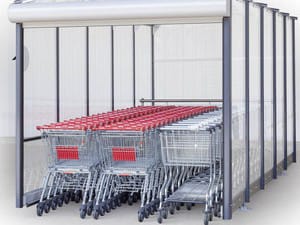
Open trolley storage is suited to environments with a low risk of theft – small towns, private premises, and managed shopping centres. It is more convenient for customers and less expensive to maintain.
Lockable enclosed storage with a blocking system or docking stations are recommended for stores in larger cities, where the risk of trolley theft or loss is higher. These systems can be integrated with a coin-return mechanism that encourages customers to bring trolleys back.
Docking stations and corralling barriers also help to organise trolley storage – trolleys are not left anywhere and everywhere, but are returned to a designated area. This reduces the time staff spend collecting trolleys and increases their availability for customers.
Trolley losses are a real and costly problem. For an average supermarket, theft or customers taking trolleys home can amount to thousands of euros per year. The solution is not complicated – it is systematic:
When choosing an equipment supplier, price is only one factor – and not always the most important one. The cheapest supplier can turn out to be the most expensive if the equipment fails quickly or deliveries prove unreliable. The main criteria include:
A “best-price guarantee” is a commercial commitment by the supplier to offer the most competitive price on the market. If you find an identical product at a lower price elsewhere, the supplier undertakes to match or review their price. Such a guarantee saves you the time and effort you would otherwise spend on lengthy price comparisons – and it also signals the supplier’s confidence in the competitiveness of their offer.
VVN is one of the most experienced suppliers of retail equipment in Latvia, the Baltic States, and the broader Scandinavian region. With over a decade of activity in the sector, VVN has accumulated extensive experience serving retail formats of every kind – from small grocery shops to large shopping centres across the Baltic and Scandinavian markets.
VVN’s offering goes beyond product sales to encompass a complete service cycle: free consultations, a tailored project for each store’s specific needs, delivery, and installation. This means you do not need to be an equipment expert – it is enough to know your store’s requirements and let experienced specialists recommend the best solution.
Before spending money on new equipment, evaluate what you already have:
How do you determine how many trolleys and baskets you need? A rough calculation:
For example, a store with 400 m² of retail floor space needs approximately 40–50 trolleys and 70–80 baskets. Before the Christmas season, it is advisable to increase these figures by 30–40%.
Seasonality affects not only sales volumes but also equipment wear. During holiday periods – Christmas, Easter, Midsummer – customer footfall can increase two to three times. This means greater demand on trolleys and baskets, faster wear, and a higher risk of losses.
Recommendation: carry out an equipment review and place replacement or top-up orders every year in September or October – before the Christmas season begins. If major sales events or promotions are anticipated, plan for reserve trolleys and baskets well in advance.
Many store owners wonder how quickly an investment in new equipment pays off. The calculation is relatively straightforward:
If purchasing new trolleys (say, 50 trolleys at an average of €80 each = €4,000) increases the average purchase value by €5 per customer, and 200 customers use trolleys each day, the additional revenue amounts to €1,000 per day, or €30,000 per month. Of course, the real uplift will be more modest, but even a conservative 2–3% increase in the average transaction value will deliver a full return on investment within a matter of weeks.
Additional savings come from reducing the time staff spend repairing worn equipment and collecting damaged trolleys, as well as from a decline in customer complaints.
A store’s success is not built on product range and pricing alone. It is built on the overall experience – from the moment a customer pulls into the car park to the moment they leave carrying a full bag of shopping. Baskets, trolleys, and storage racks are the physical backbone of that experience.
If your store currently has outdated, damaged, or insufficient trolleys and baskets, you are losing potential revenue every single day. Every customer who left with a half-empty basket simply because the handle was bent or the wheels squealed is a missed opportunity.
The good news is that the solution is available, and the investment pays off faster than you might expect. Start with a small step – assess your store’s equipment this week. Count, inspect, and identify where the biggest shortcomings lie.
VVN is a trusted partner that will support you from the very first step through to a complete solution. With over 10 years of experience in the Baltic and Scandinavian markets, a comprehensive product range, and a professional consultancy service, VVN specialists will help you find exactly the right solution for your store – the right size, the right functionality, and the right budget.
Contact VVN today and find out how the right equipment can transform your store’s results. Your customers will notice. And your revenue will reflect it.
| Cookie name | Active |
|---|
Uzraksti mums.