
Walk into any successful grocery store and you will notice one consistent pattern: fruit and vegetables are typically positioned right at the entrance or within the first zones a shopper passes through. This is no accident – it is a calculated strategy rooted in decades of marketing research and behavioural economics.
Studies show that shoppers who begin their visit with fresh produce – fruits, vegetables, flowers – go on to spend 20–25% more than those who head straight to canned goods or dry products. This phenomenon operates as a psychological “licence”: having bought something healthy, a person feels entitled to also purchase less nutritious items. However, this effect only materialises if the fruit and vegetable section looks appealing, is correctly positioned, and is equipped with the right display fixtures.
This article examines in detail how display fixture design – its shape, height, angle, material, and placement in the space – directly affects sales volume, reduces product losses, and shapes the customer experience. We will explore various retail scenarios: from the constraints of small stores to the possibilities of large supermarkets, and from traditional grocery shops to BIO and Premium retail formats.
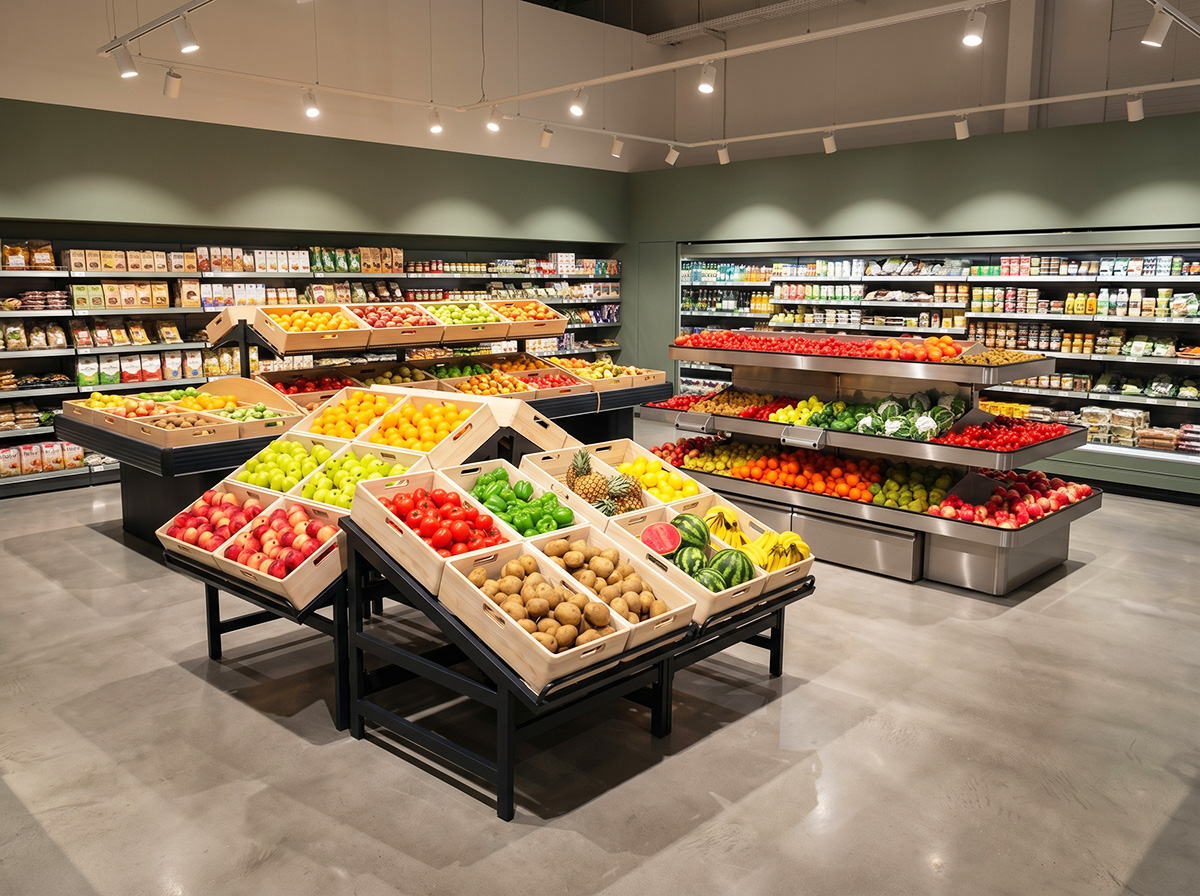
Before discussing specific fixture models, it is important to understand shopper psychology. Human vision and the brain operate according to principles that are directly applicable in retail.
Visual abundance builds trust. Researchers have found that shoppers subconsciously associate full, colourful fruit and vegetable displays with freshness and quality – even before inspecting the product. Partially empty shelves, on the other hand, create a negative impression: the shopper wonders, “Why haven’t others bought this? Is the quality poor?”
Inclination drives sales. Fixtures with shelves angled at approximately 15–25 degrees allow shoppers to see the product from a distance, while gravity ensures that items automatically slide forward as units are taken from the crate. This design feature reduces the time staff spend repositioning products and simultaneously maintains a continuously well-stocked appearance.
Height matters. Ergonomic research shows that products at eye level (approximately 120–160 cm) sell 30–40% better than those on lower or upper shelves. This is precisely why the most frequently purchased and well-known items are often placed higher or lower, to “insert” higher-margin or newer products at eye level between them.
Unobstructed access removes purchase barriers. If a shopper has to reach over a structure or search for products behind others, that is a purchase barrier. Each additional obstacle reduces the likelihood of an impulse buy.
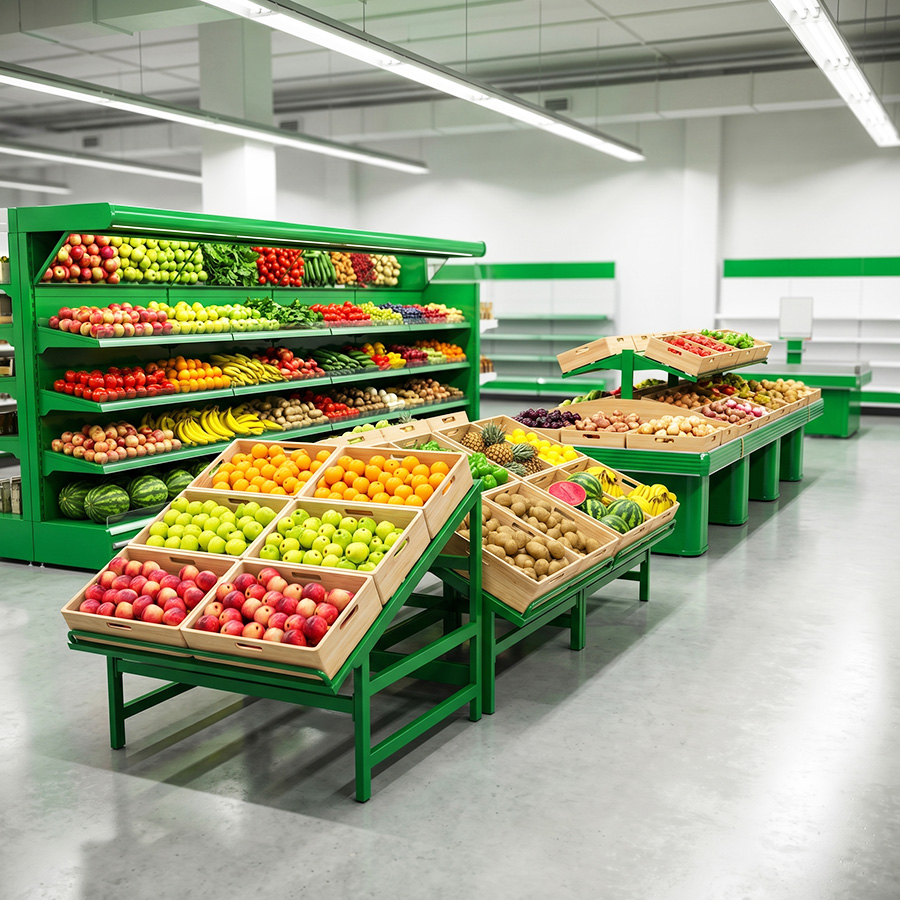
Situation overview. A small store operates within a limited space and a relatively modest equipment budget. The fruit and vegetable range is typically smaller – seasonal local produce and a few exotic lines. Customers are predominantly local residents who shop frequently but in smaller quantities.
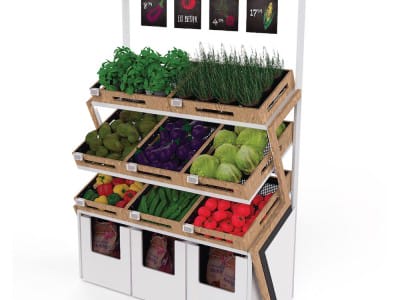
Strengths with the right equipment. Small stores have the opportunity to create an intimate, personal atmosphere. If the fruit and vegetable display is compact yet visually rich, it creates a subconscious impression of “everything is fresh, just delivered.” The VVN Simple Vegetable Rack (645×658×1320 mm, 4 levels, 25° angled shelves) is the ideal solution for this scenario. Its compact dimensions allow it to be placed in narrow aisles or corners, the angled shelves provide good product visibility from a distance, and its high mobility (the fixture can be easily moved) enables swift changes to the store layout – for example, moving it closer to the main aisle at weekends and returning it to its regular position on weekdays.
Weaknesses and risks. The main challenge in small stores is timely restocking. If the fixture is too small, inventory runs out quickly and the customer leaves dissatisfied. If it is too large, products sit too long, spoil, and create losses. For this reason, a modular approach is recommended for small stores: start with one or two compact fixtures and expand as turnover grows.
Practical tip. A small store can often generate additional revenue by placing fresh produce right at the entrance – even outside during the summer season. The VVN Fruit and Vegetable Stands from the catalogue, with standard widths of 900–1200 mm, are compact enough not to obstruct the entrance while being wide enough to create a strong visual impression. The RAL 6018 (green) colour finish enhances the visual appeal of fresh produce.
Situation overview. A large store can dedicate an entire section to fruit and vegetables – sometimes more than 150–200 m² of floor space. The range is broad: local products alongside exotic ones, organically certified next to conventional, loose items next to pre-packaged. Shoppers spend more time in the store but are also more discerning and better informed about prices.
The main challenge – navigation and flow. In a large space, shoppers can easily become disoriented or bypass entire product groups. For this reason, large stores are advised to use Modular Vegetable Islands or Free-Standing Vegetable Islands in the fruit and vegetable section, creating a clear, intuitive route.
The VVN Free-Standing Vegetable Island (L-3760 × D-1550 × H-1500 mm) is designed precisely for this purpose. It features three levels of angled shelves with depths of 480–730 mm and wheeled pull-out drawers in 1200×400 mm format. Products can be displayed in standard 600×400 mm crates or placed directly on the angled shelves. The system accommodates additional modules, meaning a store can begin with the base configuration and expand it seasonally.
What works in large stores. Double-sided fixtures that allow access from both sides maximise floor space usage. The VVN Double-Sided Vegetable Stand (L-1280 × D-700 × H-1720 mm) is an ergonomic solution: it accommodates 600×400 mm crates that can be positioned horizontally or vertically, and the units can be joined back-to-back to form long rows. This is both cost-efficient and visually effective.
Weaknesses in large stores. A large section demands significant labour: products need to be restocked more frequently, damaged items removed regularly, and the larger floor area kept clean. If a store has cut staffing, the fruit and vegetable section can quickly look neglected, directly affecting turnover. Fixture design that allows for rapid restocking and easy cleaning is therefore especially important here.
Practical tip. Large stores benefit greatly from so-called “cross-category merchandising” – combining fruit and vegetables with complementary products. For example, mozzarella cheese and fresh basil are placed beside tomatoes; caramel and nuts beside apples. The VVN Accessory Stand with Grid (L-600 × D-500 × H-1800 mm) is a versatile fixture for this type of addition: it features a frame for promotional materials, allowing recipes or special offers to be displayed.
Situation overview. The BIO and Premium segment is unique: customers are willing to pay considerably more, yet their expectations regarding the environment, presentation, and information are higher. Visual design here is not merely functional – it is part of the brand promise.
What this customer expects. The Premium and BIO store shopper expects:
The VVN catalogue includes solutions specifically designed for this segment. The Mobile Bio Island (L-1235 × D-1132 × H-1280 mm) features a wood-effect surface finish, characteristic organic-glass side elements with optional backlighting, and a display tray for additional products. This is a solution that visually communicates “naturalness” before the shopper even touches the product. Using such a fixture in a Premium store is an investment in brand identity.
The Bio Island Extension (L-645 × D-645 × H-820 mm) is intended for situations where fruit or vegetables are sold by weight – the customer selects and weighs the quantity themselves. This is a typical BIO store model, evoking the feeling of market or farm freshness in an urban setting. The mobile construction allows products to be quickly restocked and rearranged as needed.
Strengths in the Premium segment. High average transaction value, loyal customers who visit regularly, and the ability to charge premium prices for well-presented produce. Studies show that in Premium stores, shoppers pay 15–25% more for the same product solely on the strength of its presentation and surroundings.
Weaknesses. Premium presentation demands precision – a single damaged piece of fruit or a dirty fixture undermines the experience far more rapidly than in a standard store. In addition, maintaining wood-effect materials is more costly and demanding than cleaning standard metal structures.
Practical tip. BIO and Premium stores benefit greatly from product rotation and storytelling. A small sign beside the apples reading “From Inga’s farm, Zemgale region” can increase sales. The fixture design should accommodate this kind of communication: frames for notices, horizontal rails for price tags, and space for POS materials.
Situation overview. Farmers’ markets, outdoor retail points, and seasonal stands (for instance, outside supermarkets in summer) operate according to a different logic. There is no permanent infrastructure, stock changes frequently, and customer expectations are shaped by the “market experience”.
What these conditions require from a fixture. Mobility is the primary criterion – the fixture must be quick to assemble and disassemble, easy to transport, and its construction must withstand both direct sunlight and adverse weather. Carrying capacity is equally important: market settings typically involve large volumes of stock that cannot be stored for long.
The VVN Vegetable Stand on Wheels (L-1250 × D-1125 × H-1560 mm) is an excellent solution for this scenario. It is designed for product display in standard 600×400 mm crates, the structure is panel-clad, and provision is made for mounting advertising signs. Wheels enable rapid repositioning across the market floor, and the generous size allows a substantial volume of produce to be displayed.
Strengths in outdoor settings. Natural light is the best illumination for fruit and vegetables: colours appear true and appealing, and the products “speak for themselves.” Furthermore, outdoor market shoppers are primed for naturally fresh goods, are less sensitive to the aesthetic refinement of the fixture, and place greater emphasis on product quality.
Weaknesses and risks. High temperatures, direct sunlight, and rain accelerate product deterioration. This means that stock rotation is critical in outdoor retail: damaged produce must be removed immediately, as the deterioration of the visual impression happens far more rapidly outdoors. Outdoor fixtures must also have a robust, corrosion-resistant construction.
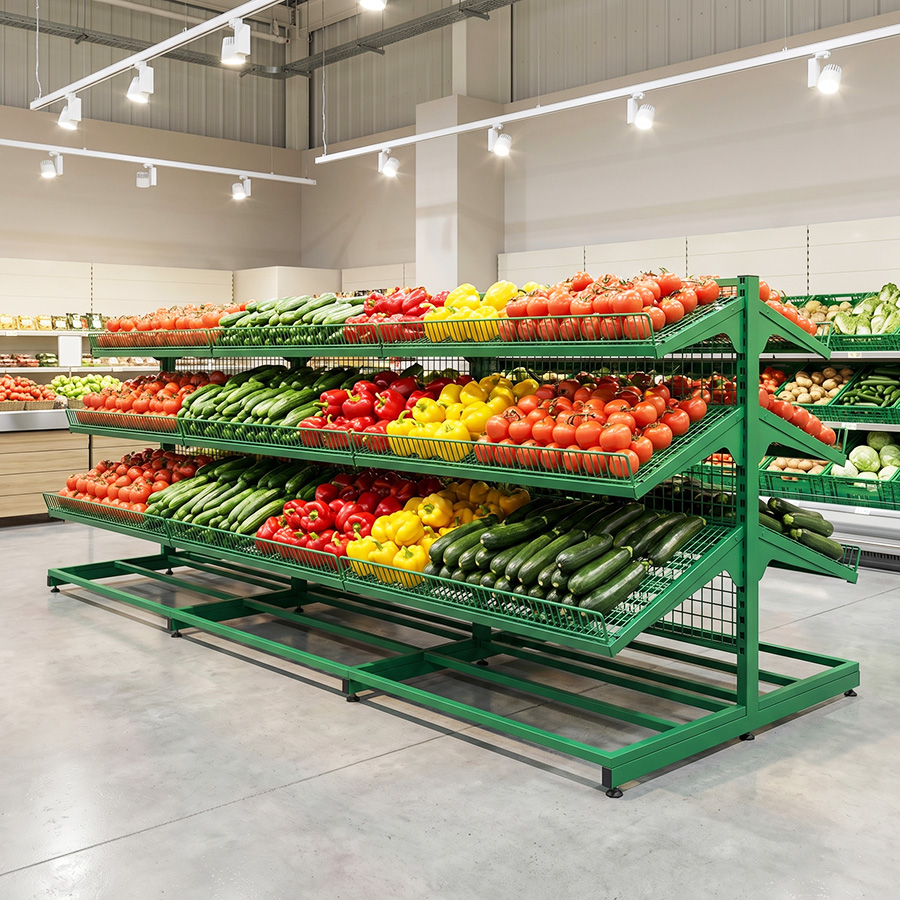
Sound ergonomic organisation of a fruit and vegetable section places products across three visual zones:
Eye zone (120–160 cm height) – the best-selling and most sought-after products should be placed here: tomatoes, cucumbers, salad leaves, apples, bananas. This is the “golden zone” – a shopper’s gaze is drawn here automatically.
Reach zone (60–120 cm height) – products that shoppers like to check for weight and quality: pears, oranges, potatoes. Easy to reach, easy to inspect.
Lower zone (below 60 cm) – large, heavy produce: pumpkins, watermelons, melons. Shoppers are prepared to bend down for a heavier, lower-priced item.
VVN fixtures with adjustable shelves or multi-level systems allow this concept to be implemented in practice. For example, the Fruit and Vegetable Rack Starter Section (2000 mm height, 1330 mm width) provides sufficient height for all three zones within a single structure.
Angled shelves, such as those in the VVN Simple Vegetable Rack (25° inclination), are more than just an aesthetic feature. An angled shelf:
Excessively deep shelves are a trap: shoppers cannot reach products at the back, which spoil there, while the front looks sparsely stocked. The optimal shelf depth for fruit and vegetables is 400–480 mm. Greater depths (up to 730 mm, as in the Free-Standing Vegetable Island) are only justified when the shelves are angled or designed for crates that are regularly restocked by staff.
The visual background of a fruit and vegetable fixture directly influences the perception of the produce. The green background (offered by VVN as standard in RAL 6018 across its entire fruit and vegetable range) is not chosen arbitrarily:
Lighting is another critical and often underestimated factor. Research shows that specialist “food lighting” (a spectrum with enhanced red and yellow tones) increases fruit sales by 12–18%. The VVN Mobile Bio Island provides an optional backlighting facility – a significant advantage for the Premium segment.
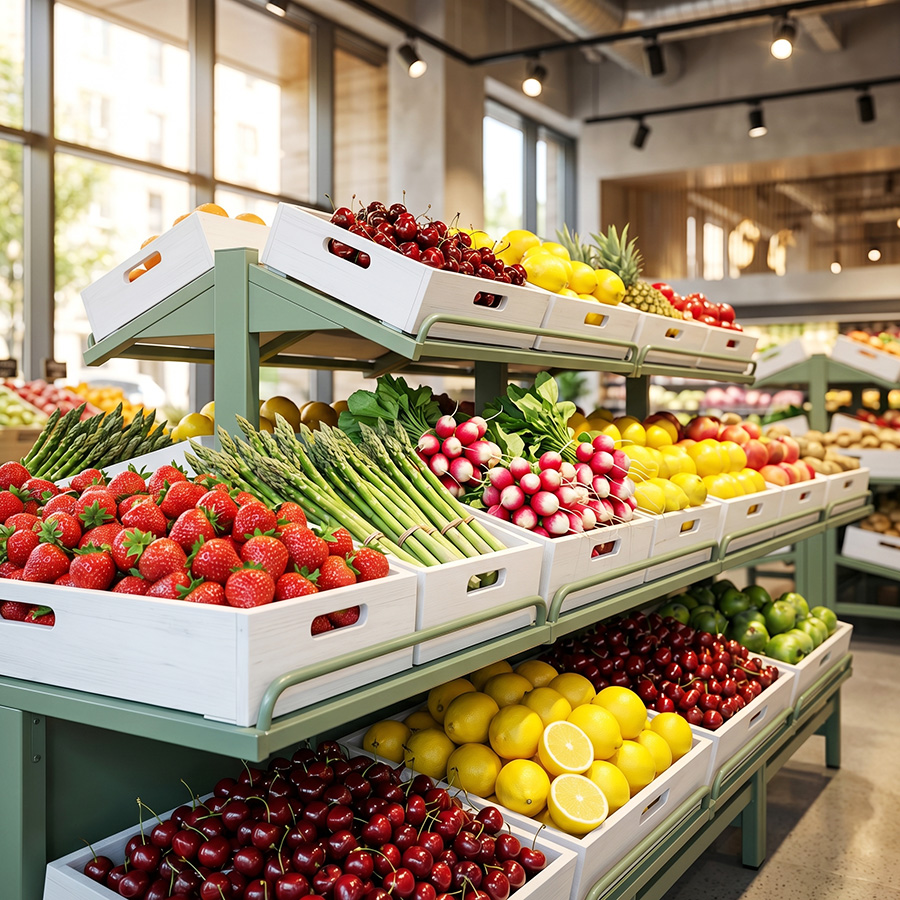
Fruit and vegetables are among the product categories with the highest loss rates in retail – on average, 8–15% of received stock is discarded. Correct fixture design can reduce this figure by half.
How fixture design affects losses:
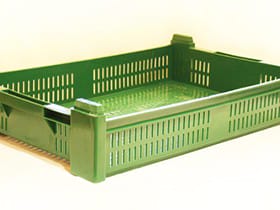
Mechanical damage. If a fixture is designed in such a way that products scatter or fall – for example, vertical shelves without a front rail – tomatoes and peaches are damaged more frequently. In VVN solutions, front shelf rails (120 mm high) eliminate this problem. Products displayed in crates (VVN Fruit and Vegetable Crate, 600×400×125 mm) are also protected from mechanical damage.
Losses during storage on the fixture. Fruit and vegetable losses arise not only from mechanical damage but also from excessive compression of products and poor air circulation. Open metal crates (as opposed to closed plastic ones) provide better ventilation and reduce the risk of mould. VVN’s standard crates with open metal construction serve precisely this purpose.
Difficulties with stock rotation. If restocking or removing products is inconvenient, staff do it less frequently and damaged produce remains on the fixture longer, contaminating surrounding items. The wheeled crates and pull-out drawers in VVN solutions (described in the Free-Standing Vegetable Island specification) are designed specifically for fast, convenient rotation.
One of the most significant trends in modern store equipment is modularity – the ability to create different configurations from base components depending on the season, product range, or store layout.
The VVN Modular Vegetable Island (base dimensions L-1200 × D-1106 × H-1115 mm, extension dimensions L-900 × D-1182 × H-850 mm) has been developed precisely around this philosophy. A store can start with a single base unit and add extension modules as the assortment grows or seasonal demand increases – adding modules for berries and exotic fruit in summer, and root vegetables and squash in autumn.
This approach makes sound financial sense: instead of purchasing two separate fixtures, a single modular unit is acquired that can adapt to changing needs. Modular systems also simplify store rearrangements – particularly valuable when a store periodically adjusts its layout for promotions or campaigns.
The fruit and vegetable zone also provides an opportunity to sell related products. A few concrete examples:
Plastic bags. The VVN Hook for Plastic Bags L-700 (20×40 mm, RAL 6018) is a simple but commercially significant element. Having bags immediately beside the produce reduces shopper hesitation and drives sales of loose, weighed products.
Promotional materials. The ability to attach POS signs, price tags, and promotional posters is a standard requirement for any modern fixture. VVN stands are designed with provision for advertising signage, and the Accessory Stand with Grid (H-1800 mm) provides a large, highly visible surface area for such materials.
Shopping baskets at the fixture. If the fruit and vegetable fixture is located near the entrance, it is essential that shoppers have immediate access to baskets or trolleys. The VVN catalogue includes Shopping Baskets and Trolleys – having a basket right next to the fixture increases the average transaction value, since shoppers are not physically limited in the number of items they can carry.
Even the finest fixture will deliver poor results in the wrong location. Several proven strategies exist for the placement of fruit and vegetables:
“First zone” near the entrance. The first 2–3 metres from the entrance constitute the so-called decompression zone: the shopper is not yet mentally engaged in the shopping process and is adjusting to the environment. Products in this zone are frequently overlooked. A fruit and vegetable fixture performs better slightly further in – approximately 3–5 metres from the entrance.
The right side is the dominant side. Research shows that the majority of people in a store automatically move to the right. A fruit and vegetable fixture placed against the right wall or immediately to the right of the entrance receives more organic traffic.
The start of the route. In large stores using a “flow” concept (where shoppers are guided along a defined route), fruit and vegetables are typically positioned at the beginning of the journey.
Opposite the dairy and bakery section. Another effective strategy is to position the fruit and vegetable zone adjacent to or opposite the dairy shelves: together they form a “fresh food cluster” in which shoppers linger longer.
VVN (Viss Veikaliem un Noliktavām) is one of the leading suppliers of store and warehouse equipment in the Baltic states and Scandinavia, with more than 10 years of experience. The company offers not only the purchase of shelving and display fixtures but also a full service cycle: consultancy, space design, installation, and delivery.
VVN’s fruit and vegetable display solutions offer several advantages:
Standardised colour. The standard colour for all fruit and vegetable display products is RAL 6018 (green) – ensuring visual consistency throughout the section and functioning as a natural, intuitive cue for the shopper.
Modular compatibility. The various fixtures are designed so they can be combined and connected: both extension modules and adjacent stands integrate into a unified visual whole.
Crates in standard dimensions. The VVN Fruit and Vegetable Crate (600×400×125 mm) conforms to the European standard 600×400 mm used by all major suppliers. This means that products can be transferred directly from the supplier’s crate to the fixture without decanting – saving time and reducing damage.
Certification and quality. VVN products are certified to ISO 9001 standards and comply with CE and other European requirements – important both for ensuring staff safety and for demonstrating conformity in documentation when working with retail chains.
Stores frequently purchase quality fixtures and then maintain them inadequately. Metal shelves are durable, but they require regular cleaning – especially in the fruit and vegetable environment, where liquid and gritty residue accumulate quickly. A poorly maintained fixture, even one that was originally Premium-grade, produces the opposite effect: shoppers perceive the produce as less fresh and lower in quality.
Recommendations for daily maintenance:
The design of a fruit and vegetable display fixture is not merely an aesthetic consideration – it has a direct bearing on turnover, product losses, customer satisfaction, and staff efficiency. The right fixture, chosen to match the store format, available space, and target customer profile, can increase sales in this category by 20–40% compared with a suboptimal solution.
The small neighbourhood store benefits from a compact, mobile fixture with angled shelves that facilitate rapid restocking. The supermarket benefits from a modular island system that creates clear navigation and makes effective use of large floor areas. The BIO or Premium store benefits from visually compelling “natural” solutions with backlighting capabilities. Outdoor retail benefits from mobile, durable structures that can be erected and dismantled quickly.
The VVN range of fruit and vegetable display solutions covers all of these scenarios, offering both standardised crates and simple stands and sophisticated modular island systems with extended functionality. It is important not only to purchase the appropriate equipment but also to position it correctly, maintain it regularly, and adapt it to seasonal and assortment changes.
Ultimately, the question is not “whether to invest in a better fruit and vegetable fixture” – it is “how much turnover am I losing every day by using a suboptimal solution.”
| Cookie name | Active |
|---|
Uzraksti mums.